


























Views
Downloads

Essential Root Words & Suffixes Worksheet | Grade 1 ELA
Paste this activity's link or code into your existing LMS (Google Classroom, Canvas, Teams, Schoology, Moodle, etc.).
Students can open and work on the activity right away, with no student login required.
You'll still be able to track student progress and results from your teacher account.
Mastering Early Morphology
This Grade 1 Root Words and Suffixes worksheet provides students with targeted practice to decode and build common vocabulary words. By identifying base words and adding frequent affixes like -s, -es, -ing, and -ed, learners develop the essential morphological awareness needed for early reading fluency and comprehension. It offers a structured path toward mastery.
At a Glance
- Grade: 1 · Subject: English Language Arts (ELA)
- Standard:
CCSS.ELA-LITERACY.L.1.4.B— Use frequently occurring affixes as a clue to the meaning of a word- Skill Focus: Root words and suffixes (-s, -es, -ing, -ed, -ful)
- Format: 3 pages · 17 problems · Answer key included · PDF
- Best For: Independent practice or small group literacy centers
- Time: 15–20 minutes
What's Inside
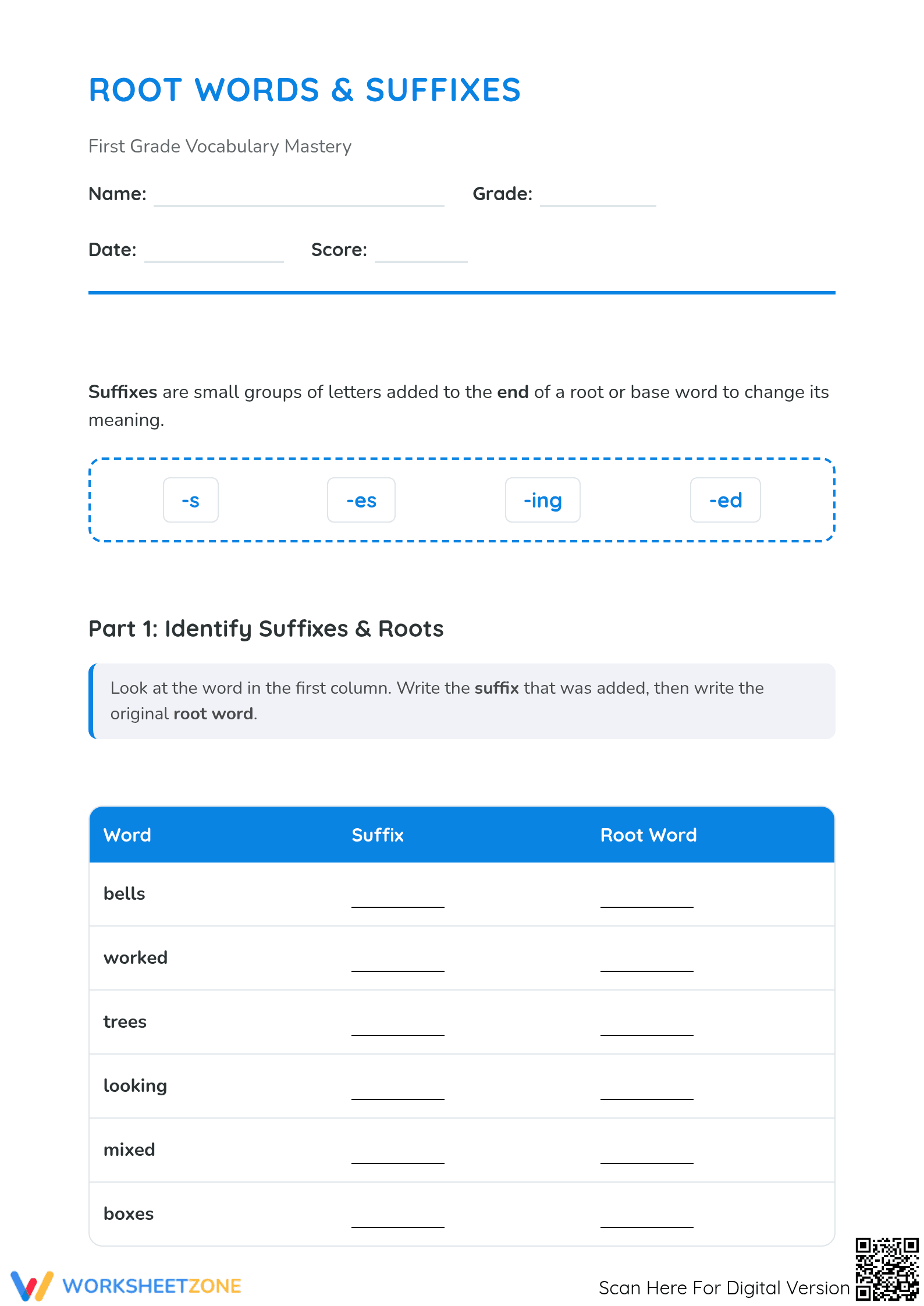
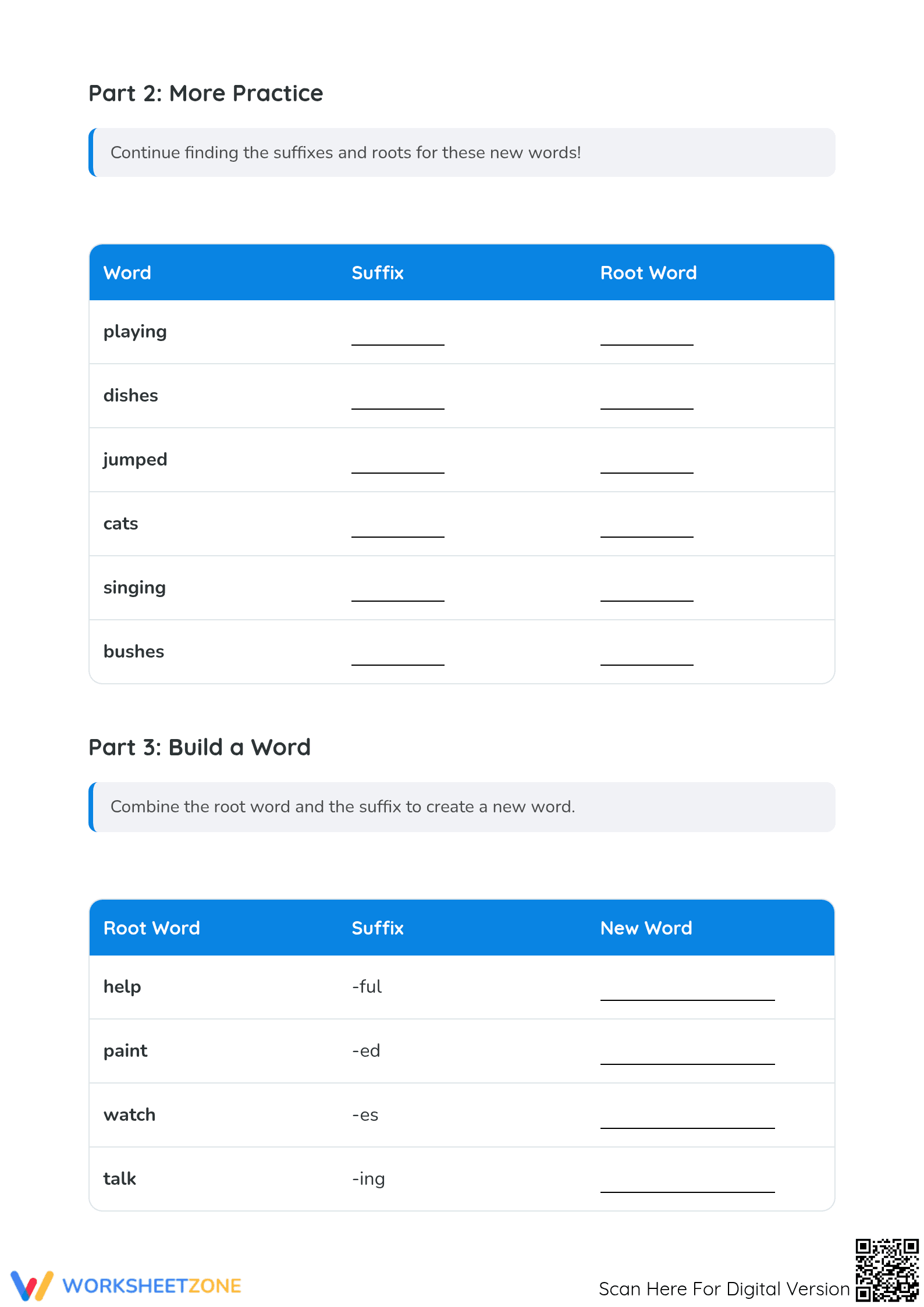
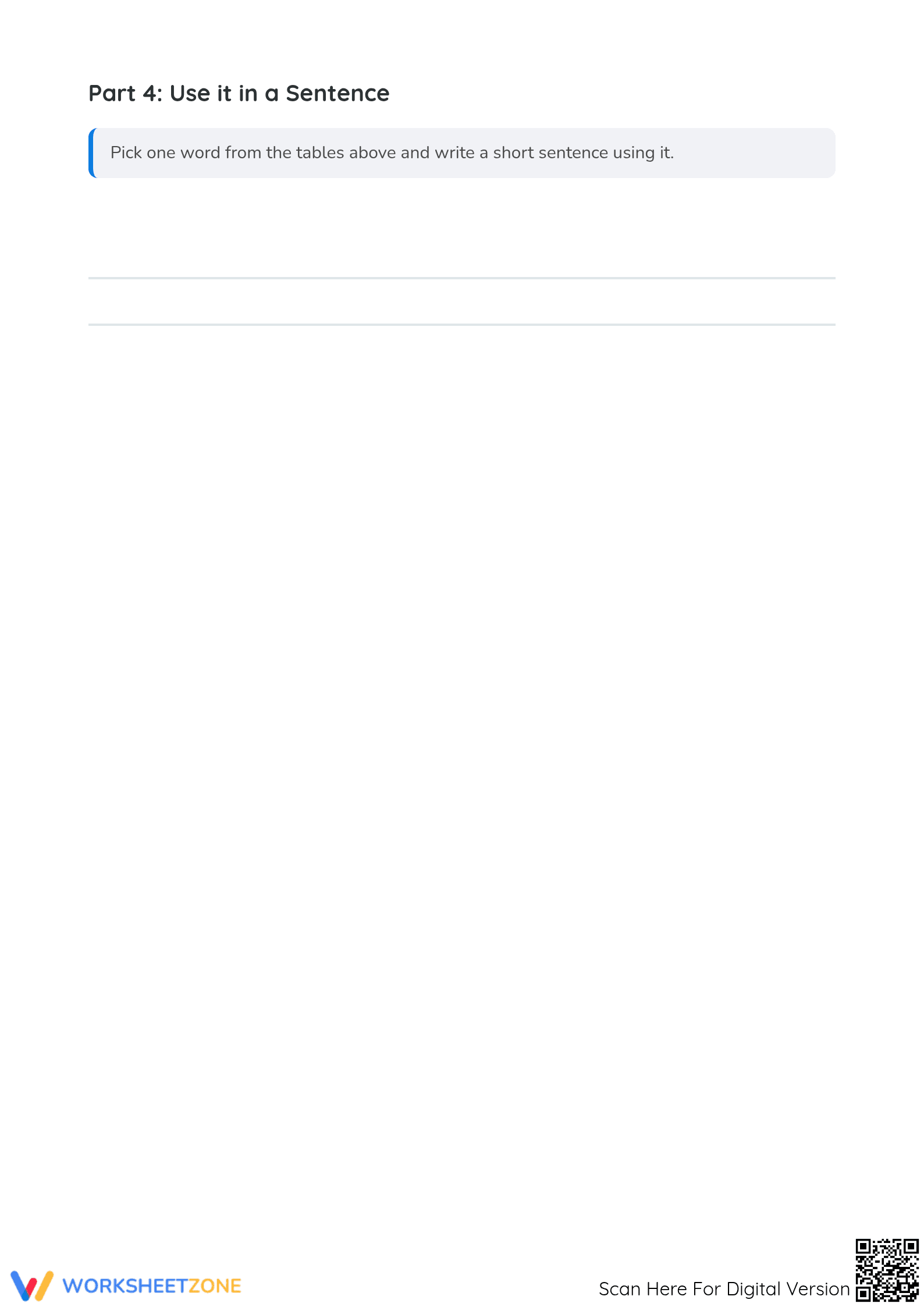
The packet includes three pages of structured exercises designed for young learners. Part 1 and Part 2 focus on identification, where students look at words like 'working' or 'dishes' and isolate the suffix from the original root word. Part 3 challenges students to build new words by combining roots and suffixes such as 'talk' and '-ing'. The final page provides space for sentence application, ensuring students can use their new vocabulary in context. A full answer key is provided for quick grading.
Skill Progression
- Guided identification (6 tasks): Students work with high-frequency words to separate the base from the ending, focusing on plural and past-tense markers.
- Independent analysis (6 tasks): Learners apply their knowledge to a new set of words, reinforcing the concept that the root word holds the primary meaning.
- Word construction (5 tasks): Students synthesize their skills by building complex words and using them in original sentences to demonstrate full lexical understanding.
This sequence follows a gradual-release model, moving from basic recognition to active production.
Standards Alignment
The primary alignment is CCSS.ELA-LITERACY.L.1.4.B, which requires students to use frequently occurring affixes as a clue to the meaning of a word. By breaking down words into their constituent parts, students learn to predict the meaning of unknown terms. This standard code can be copied directly into lesson plans, IEP goals, or district curriculum mapping tools.
How to Use It
Assign this worksheet after a direct instruction lesson on how suffixes change a word's meaning (e.g., how '-ed' makes a verb past tense). It works well as a post-lesson check or a component of a weekly literacy station. During the activity, observe if students can identify the root word 'box' within 'boxes' without needing to sound out the entire word; this is a key indicator of developing morphological fluency. Expect completion in under 20 minutes.
Who It's For
This resource is designed for first-grade students but serves as an excellent intervention tool for second graders who need to reinforce their decoding skills. It is highly effective for English Language Learners (ELLs) who are learning the structural patterns of English grammar. Pair this with a digital suffix sorting game or a set of root word anchor charts for a comprehensive unit.
Aligned with EdReports 2024 and Science of Reading principles, this worksheet (CCSS.ELA-LITERACY.L.1.4.B) provides systematic morphological instruction. Its 17 tasks help first graders move from phonemic awareness to structural analysis, boosting decoding speed and lexical depth. Early exposure to word parts helps predict meanings in complex texts, offering high-utility repetition for successful literacy development.


