


























Views
Downloads
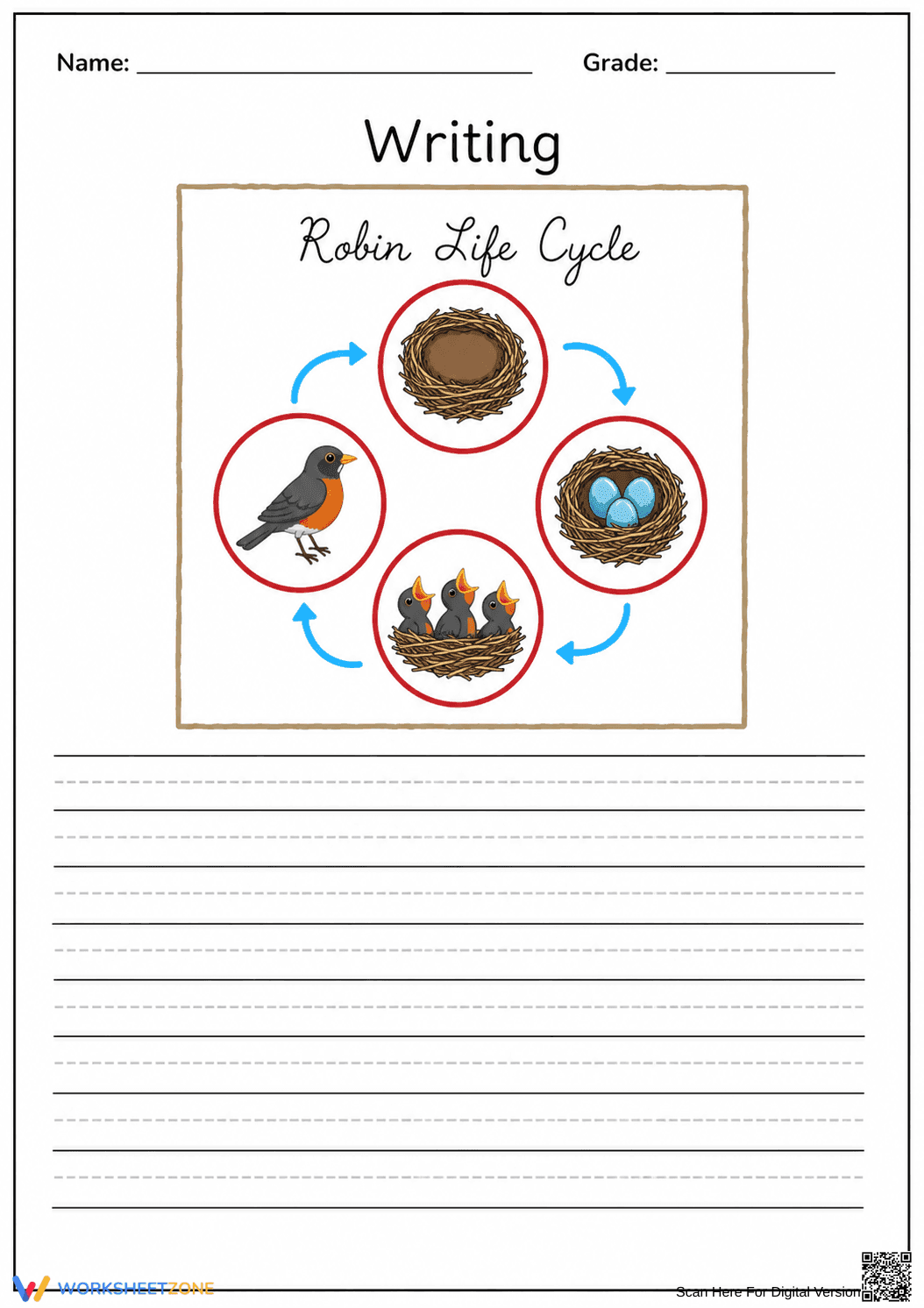

Grade 4-5 Robin Life Cycle — Printable No-Prep Worksheet
Paste this activity's link or code into your existing LMS (Google Classroom, Canvas, Teams, Schoology, Moodle, etc.).
Students can open and work on the activity right away, with no student login required.
You'll still be able to track student progress and results from your teacher account.
This Grade 4 and 5 science-themed writing worksheet helps students master the sequence of a bird's life cycle through structured explanatory writing. By observing the visual diagram of a robin's development, learners practice synthesizing scientific information into a cohesive paragraph while refining their handwriting on primary-ruled lines.
At a Glance
- Grade: 4-5 · Subject: Science & ELA
- Standard:
CCSS.ELA-LITERACY.W.4.2— Write informative/explanatory texts to examine a topic and convey ideas clearly- Skill Focus: Sequential explanatory writing
- Format: 1 page · 1 writing task · Diagram included · PDF
- Best For: Science centers or morning work
- Time: 15–25 minutes
The worksheet features a clear, four-stage circular diagram illustrating the robin life cycle: the nest, the iconic blue eggs, the hatchlings, and the adult bird. Below the visual aid, students are provided with 10 primary-ruled lines, specifically designed to support neat handwriting and proper letter formation during the drafting process.
This resource follows a zero-prep workflow designed for busy educators. First, print the single-page PDF in approximately 30 seconds. Second, distribute the sheets to students as a transition activity or science extension. Third, review student paragraphs for sequential accuracy and handwriting legibility. It is an ideal sub-plan component that requires no teacher setup.
This resource aligns with CCSS.ELA-LITERACY.W.4.2, focusing on the ability to write informative texts that convey information clearly. It also supports NGSS 3-LS1-1 by requiring students to describe unique and diverse life cycles. Both standard codes can be copied directly into lesson plans, IEP goals, or district curriculum mapping tools.
Use this worksheet as a formative assessment after a lesson on avian biology or as a cross-curricular ELA activity. Teachers should observe if students use transitional words like "first," "next," and "finally" to describe the stages. It typically takes 20 minutes for students to complete a thoughtful paragraph based on the visual cues provided.
This is designed for upper elementary students who need to bridge the gap between visual data and written expression. It is particularly effective for English Language Learners (ELLs) who benefit from the visual scaffolding of the diagram and the structured handwriting lines to organize their thoughts.
Research from Fisher & Frey (2014) emphasizes the importance of using visual scaffolds, such as diagrams, to support the development of complex writing skills in elementary learners. By providing a clear visual representation of the robin's life cycle, this worksheet reduces the cognitive load on students, allowing them to focus on the linguistic demands of CCSS.ELA-LITERACY.W.4.2. This approach ensures that students can accurately describe the sequence of biological development while practicing essential handwriting skills. According to the RAND AIRS 2024 report, integrating science content with literacy instruction significantly improves retention of both subject matter and writing proficiency. This worksheet serves as a practical application of these findings, offering a structured environment for students to demonstrate mastery of explanatory text structures within a scientific context.


