




























Views
Downloads

RL.6.1 Worksheet: Inferences — Grade 6 Aligned

Paste this activity's link or code into your existing LMS (Google Classroom, Canvas, Teams, Schoology, Moodle, etc.).
Students can open and work on the activity right away, with no student login required.
You'll still be able to track student progress and results from your teacher account.
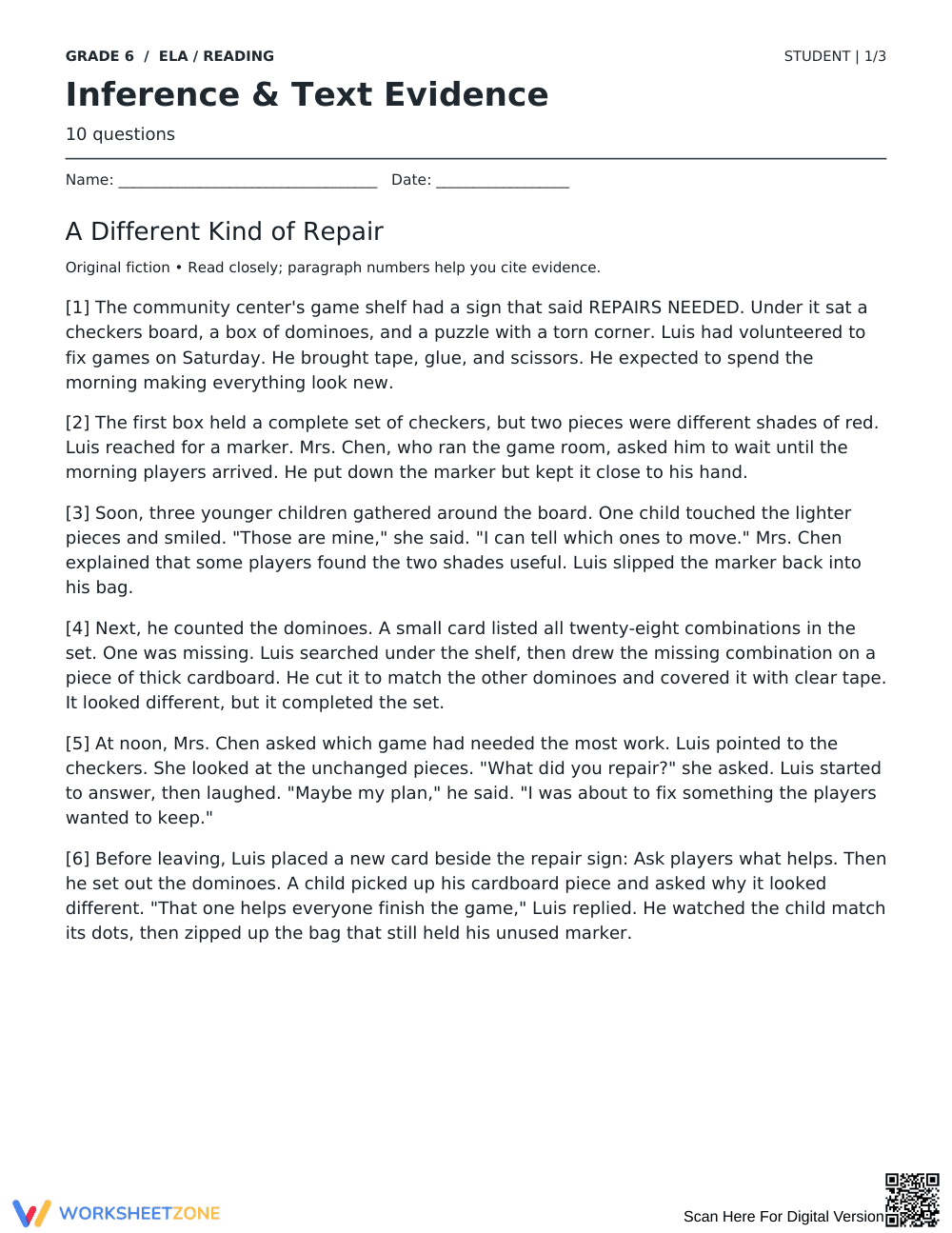
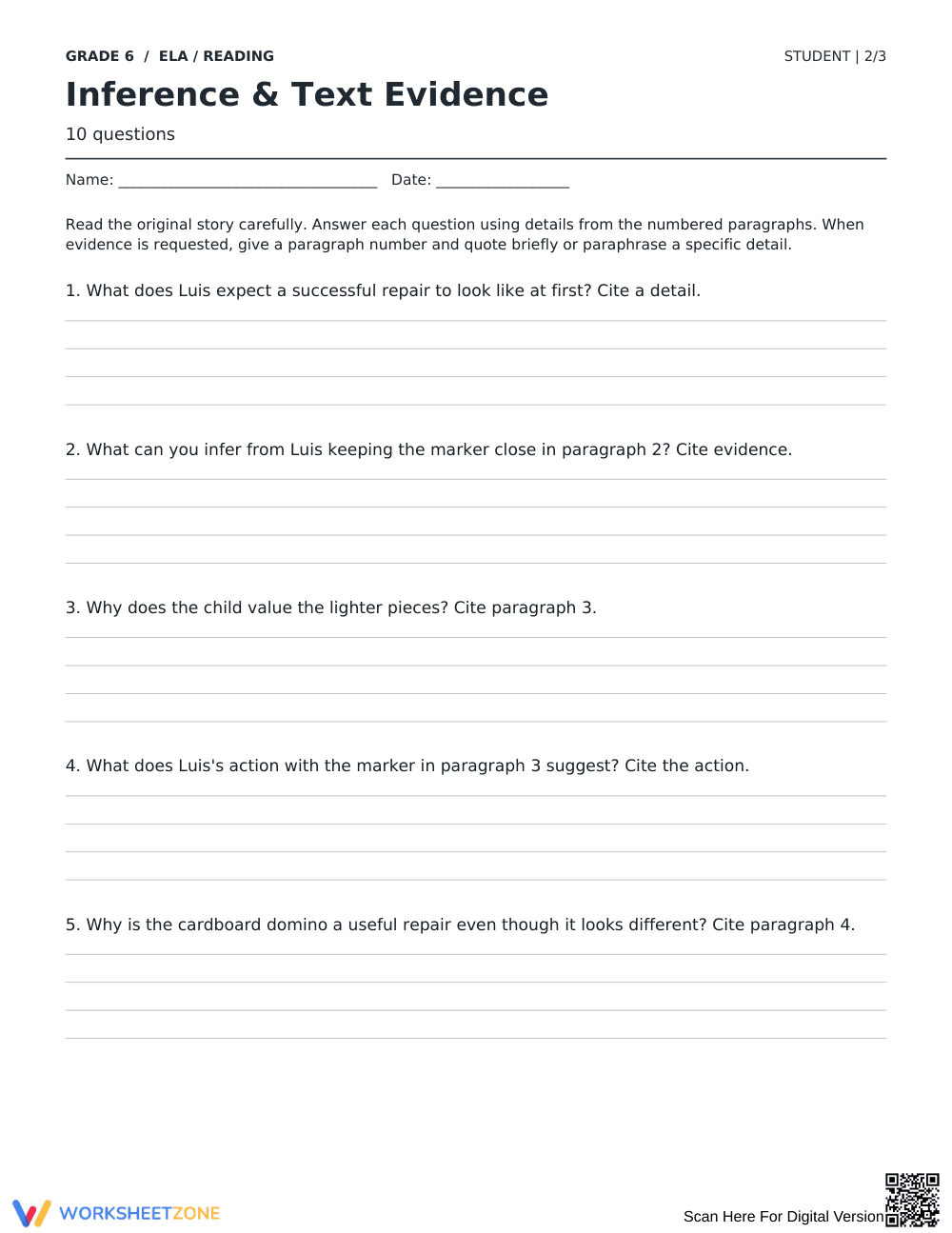
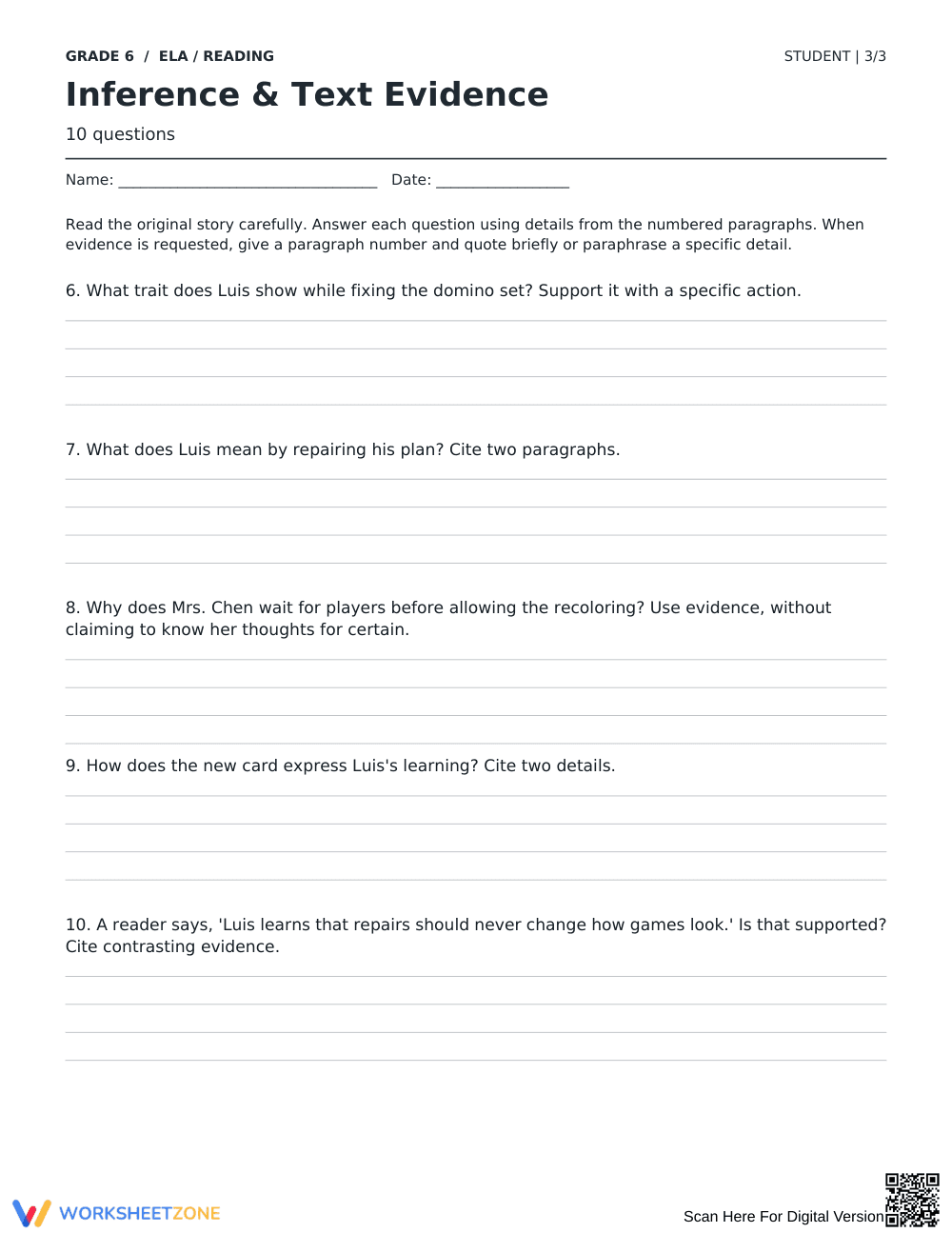
This Grade 6 reading comprehension worksheet develops student mastery in citing textual evidence to support explicit analysis and inferences. Working through an engaging original narrative, students analyze character motives, interpret subtle behavioral shifts, and defend their conclusions with direct quotations and accurate paragraph references.
At a Glance
- Grade: 6 · Subject: English Language Arts, Reading
- Standard:
CCSS.ELA-LITERACY.RL.6.1— Cite textual evidence to support analysis of text and inferences- Skill Focus: Inferencing and Text Evidence
- Format: 3 pages · 10 problems · Answer key included · PDF
- Best For: Standards-based assessment and guided practice
- Time: 25–35 minutes
What's Inside
The 3-page printable includes "A Different Kind of Repair," a 6-paragraph fiction passage with numbered lines for easy citing. It features 10 text-dependent open-response questions and a 2-page answer key with exemplar responses and a 2-point scoring guide.
Mastery Evidence
The 10 tasks evaluate analytical comprehension using an objective 2-point rubric:
- Meeting / Exceeding (2 Points): Complete, defensible inference supported by an accurate quotation or paragraph citation.
- Approaching (1 Point): Valid inference lacking specific text evidence or paragraph attribution.
- Beginning (0 Points): Inaccurate or unsupported response.
Scores map directly to standard mastery and can be entered into gradebooks or IEP progress monitoring notes.
Standards Alignment
This resource aligns directly to `CCSS.ELA-LITERACY.RL.6.1`: "Cite textual evidence to support analysis of what the text says explicitly as well as inferences drawn from the text." It also reinforces `CCSS.ELA-LITERACY.RL.6.3` by examining character responses to conflict. Both standard codes can be copied directly into lesson plans, IEP goals, or district curriculum mapping tools.
How to Use It
Use after direct instruction on close reading or as a mid-unit assessment. For guided practice, have students annotate paragraph clues before completing questions 1–5 in pairs. For formative checks, observe whether citations include direct text details rather than vague summaries. Expected completion time is 25–35 minutes.
Who It's For
Designed for Grade 6 ELA classrooms, reading intervention groups, and ELL students needing structured citation practice. Pair with an inference anchor chart or direct instruction on integrating textual quotes.
Mastering CCSS.ELA-LITERACY.RL.6.1 requires middle school readers to substantiate interpretive claims with explicit textual evidence rather than unsupported intuition. According to research on reading comprehension pedagogy by Fisher & Frey (2014), text-dependent questioning combined with explicit citation routines significantly improves student analytical writing and cognitive engagement with complex prose. This 10-item Grade 6 worksheet reinforces inferential reasoning by requiring students to identify subtle character motivations, evaluate competing interpretations, and validate every conclusion using numbered paragraph references from the original narrative. By systematically pairing an inference with concrete textual proof, students internalize the foundational close-reading habits essential for high-stakes standardized assessments and advanced literary analysis. The integrated 2-point scoring framework gives educators immediate diagnostic data to pinpoint whether comprehension breakdowns stem from faulty inferencing or insufficient evidentiary citation, ensuring targeted intervention across diverse classroom settings.


