


























Views
Plays

River Valley Civilizations Quiz | Grade 6-8 Printable
Paste this activity's link or code into your existing LMS (Google Classroom, Canvas, Teams, Schoology, Moodle, etc.).
Students can open and work on the activity right away, with no student login required.
You'll still be able to track student progress and results from your teacher account.
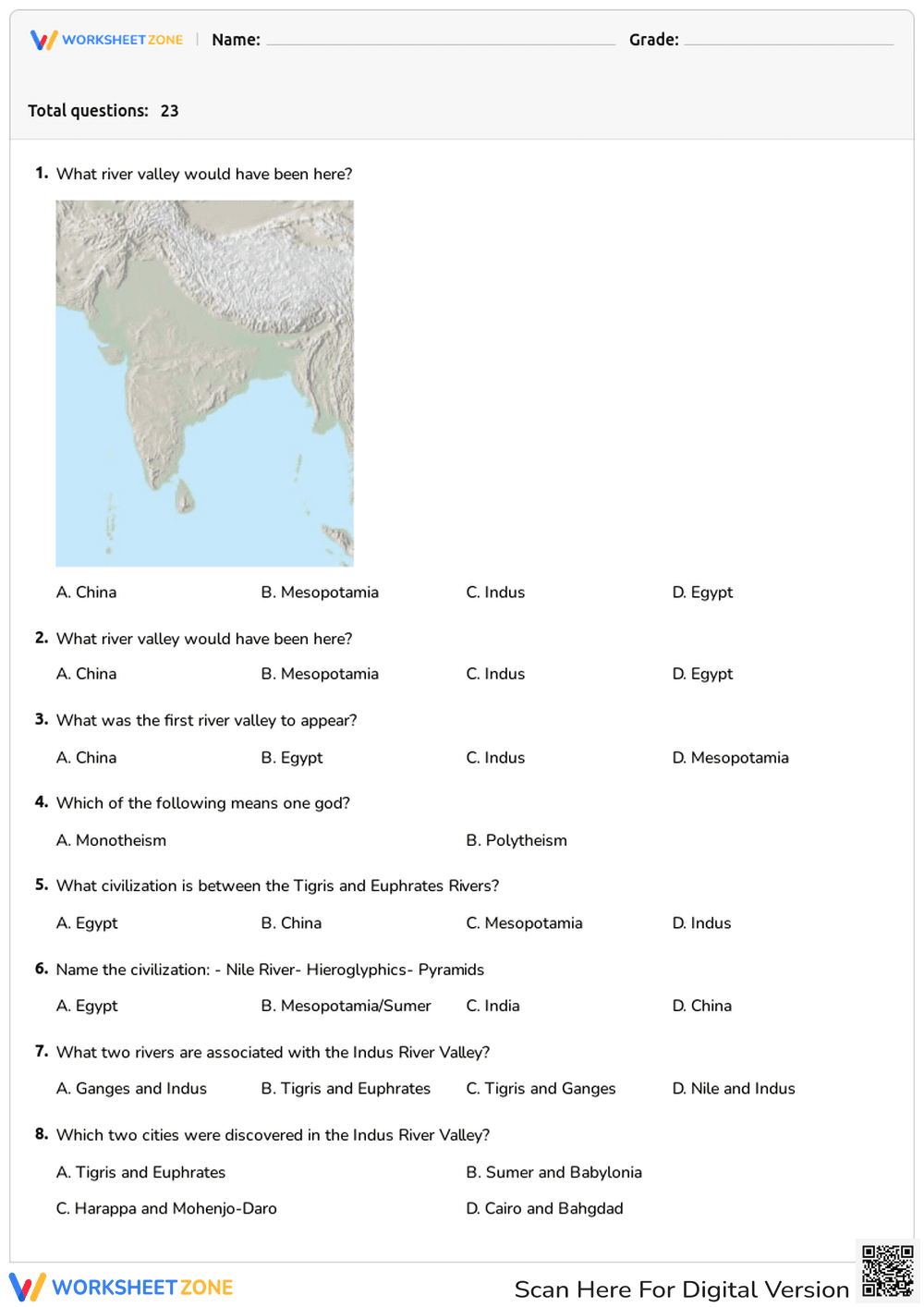
This comprehensive River Valley Civilizations worksheet helps middle school students identify and compare the geographical and cultural features of ancient Mesopotamia, Egypt, India, and China. By analyzing maps and recalling key historical facts, learners build foundational knowledge of how early human societies developed along major river systems.
At a Glance
- Grade: 6–8 · Subject: Social Studies
- Standard:
CCSS.ELA-LITERACY.RH.6-8.7— Integrate visual information with other information in print and digital texts.- Skill Focus: Map analysis and historical fact recall
- Format: 3 pages · 23 problems · Answer key included · PDF
- Best For: End-of-unit assessment or review
- Time: 25–35 minutes
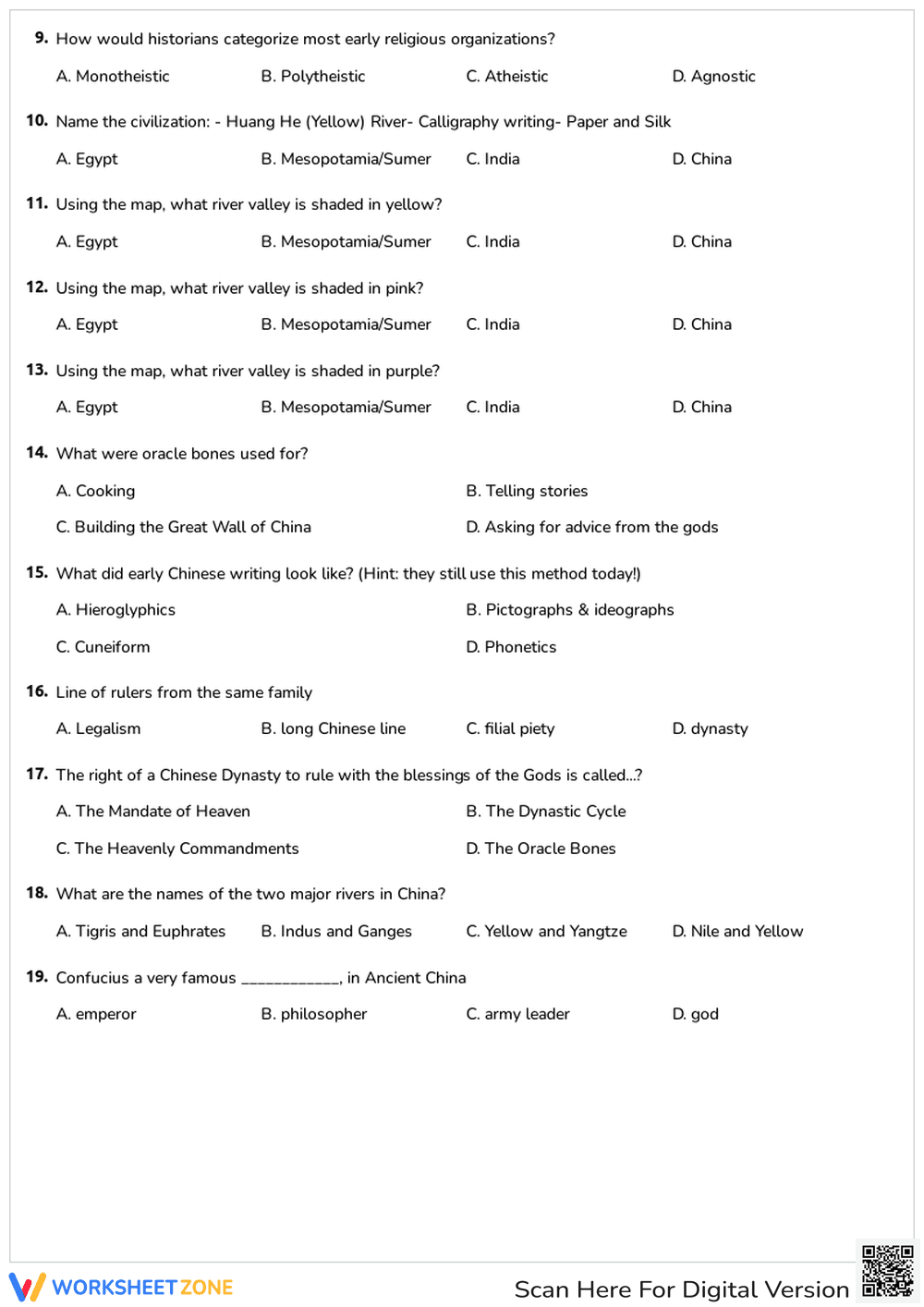
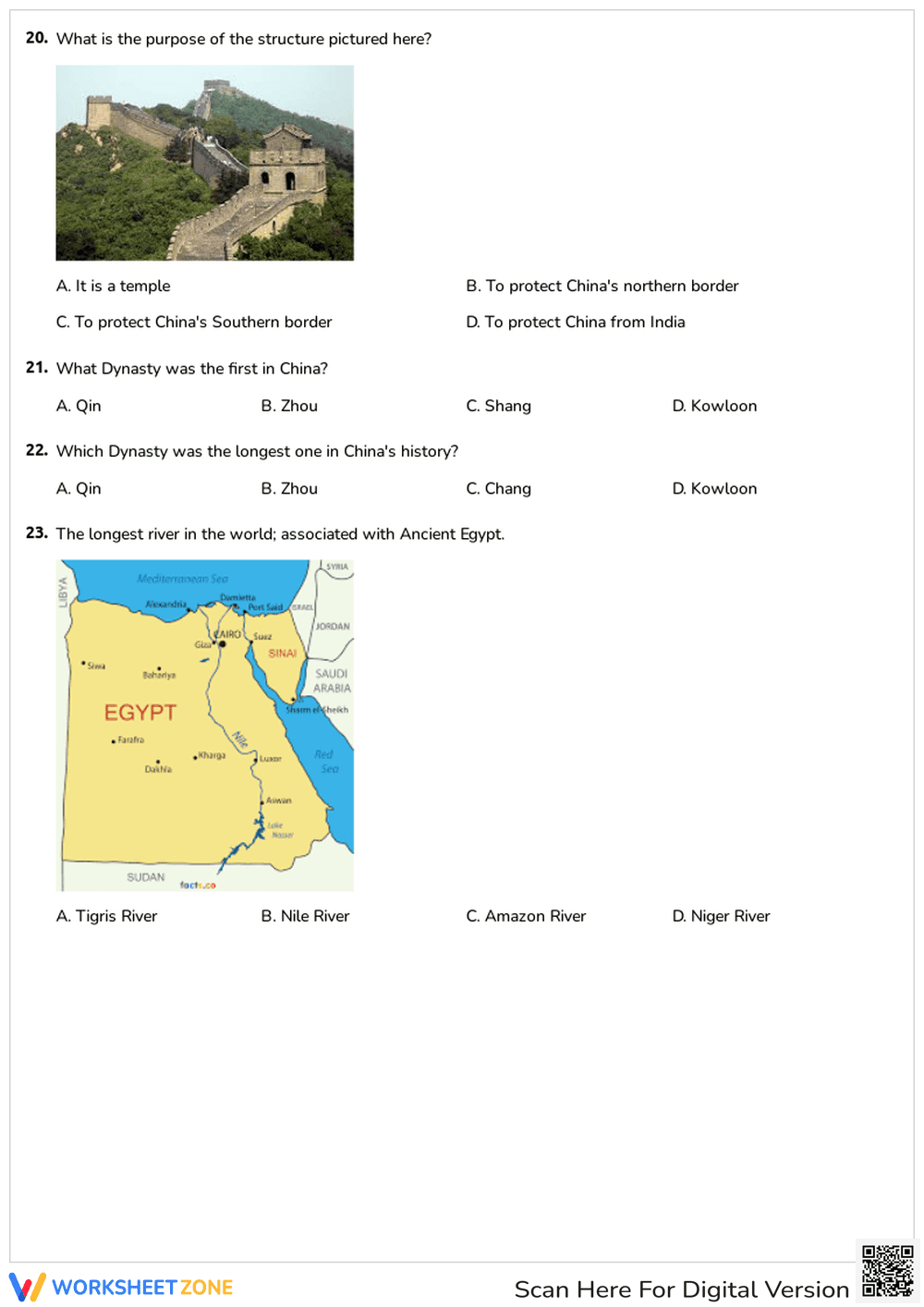
This resource features a robust 23-question multiple-choice assessment spanning three pages. Students will encounter a mix of visual map-reading tasks and text-based recall questions covering the Nile, Tigris, Euphrates, Indus, and Yellow rivers. The layout includes clear, high-contrast maps for geographical identification and straightforward formatting that minimizes student confusion. A complete answer key is provided for rapid grading.
Designed for immediate classroom implementation, this resource requires virtually zero teacher preparation.
- Print (1 minute): Generate the three-page PDF and copy a class set.
- Distribute (1 minute): Hand out the assessment as students enter the room.
- Review (3 minutes): Use the included answer key to quickly score the multiple-choice responses.
With a total teacher prep time of under two minutes, this worksheet serves as an excellent emergency sub plan or a reliable Friday assessment.
This material is directly aligned to CCSS.ELA-LITERACY.RH.6-8.7, requiring students to integrate visual information (e.g., in charts, graphs, photographs, videos, or maps) with other information in print and digital texts. It also supports general state frameworks for ancient world history and geography. Both standard codes can be copied directly into lesson plans, IEP goals, or district curriculum mapping tools.
Deploy this worksheet as a summative assessment after direct instruction on the four major river valley civilizations. Alternatively, use it as an independent study guide where students can research the answers using their textbooks. As a formative assessment observation tip, watch how students interact with the map questions; if they struggle to identify the shaded regions, you may need to review basic continental geography. Expect completion to take between 25 and 35 minutes.
This resource is designed for 6th, 7th, and 8th-grade social studies students studying ancient history. The multiple-choice format provides built-in scaffolding for learners who struggle with open-ended writing, making it accessible for diverse classrooms. Pair this assessment with a direct instruction lesson on the Mandate of Heaven or a collaborative map-labeling activity to reinforce the geographical concepts tested here.
Integrating visual data with historical text is a critical component of middle school social studies instruction. According to a recent EdReports 2024 analysis, instructional materials that require students to actively interpret maps alongside historical facts significantly improve long-term retention of geographical concepts. This worksheet targets CCSS.ELA-LITERACY.RH.6-8.7, asking learners to integrate visual information with other information in print and digital texts. By practicing this specific skill, students move beyond rote memorization and begin to understand how physical geography directly influenced the development of early human societies, such as the predictable flooding of the Nile or the natural barriers of the Himalayas. Regular exposure to map-based assessments ensures that learners can contextualize historical events within their proper physical environments, building a stronger foundation for advanced high school coursework and improving overall spatial awareness.


