




























Views
Downloads

Rhythm of the Oceans Worksheet | Grade 1 Essential

Paste this activity's link or code into your existing LMS (Google Classroom, Canvas, Teams, Schoology, Moodle, etc.).
Students can open and work on the activity right away, with no student login required.
You'll still be able to track student progress and results from your teacher account.
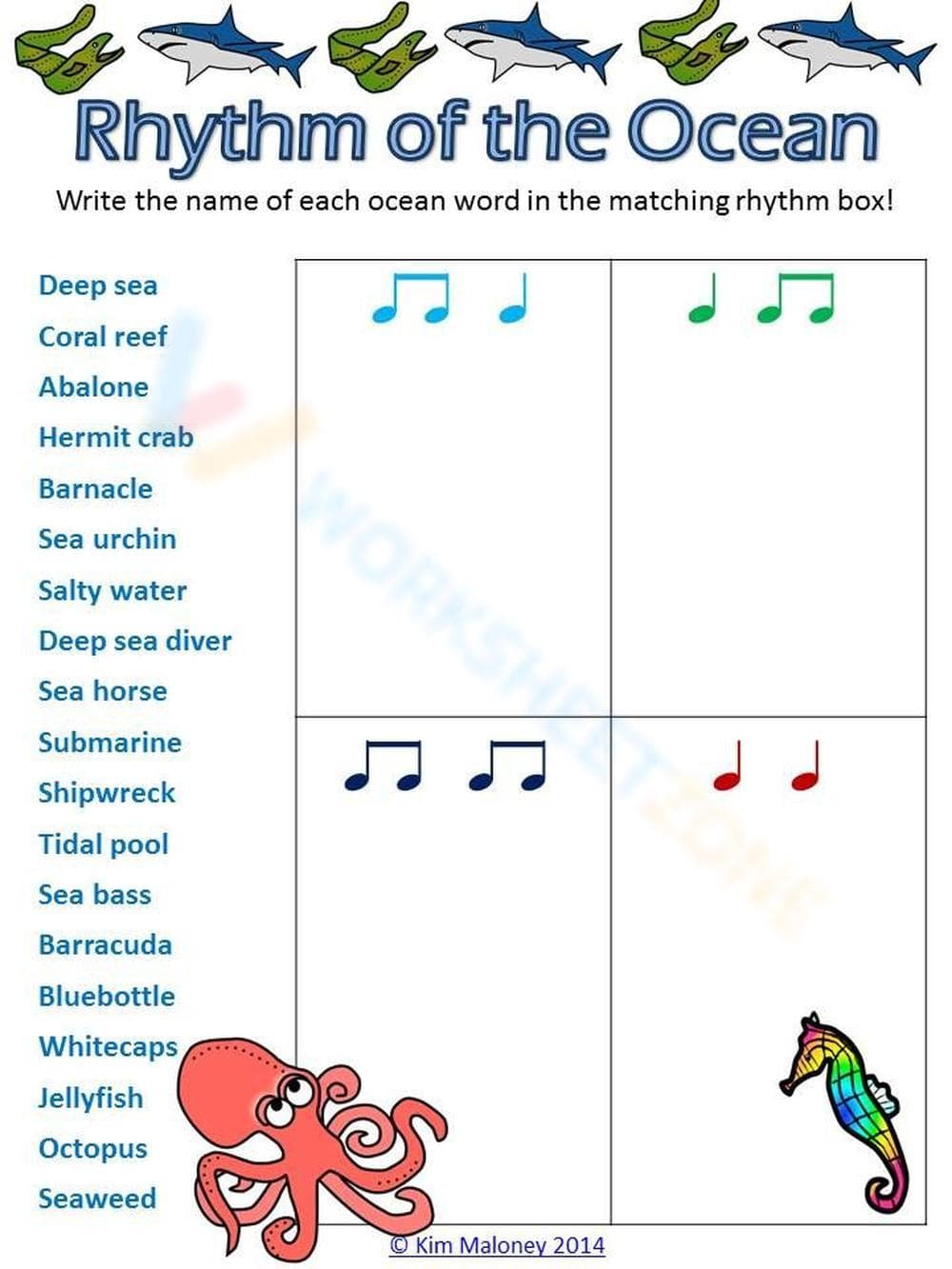
This Grade 1 ocean-themed worksheet helps students master syllable division and rhythmic patterns by categorizing 20 marine vocabulary words. By matching words like Submarine or Jellyfish to specific musical notation, students strengthen their phonological awareness and reading fluency. It provides a multi-sensory approach to language arts and music integration.
At a Glance
- Grade: 1 · Subject: English
- Standard:
CCSS.ELA-LITERACY.RF.1.2— Demonstrate understanding of spoken words, syllables, and sounds (phonemes)- Skill Focus: Syllable counting and rhythmic matching
- Format: 1 page · 20 problems · Answer key included · PDF
- Best For: Independent literacy centers or music integration
- Time: 15–20 minutes
The worksheet features a curated list of 20 ocean-themed words ranging from simple two-syllable phrases to complex four-syllable terms. Students analyze words such as Abalone and Shipwreck, then write them into one of four boxes containing specific rhythmic notation including quarter notes and eighth notes. The layout is clean, featuring engaging marine illustrations to maintain student interest and provide visual context.
This resource is designed for immediate classroom implementation with a total teacher prep time of under 2 minutes. First, print the single-page PDF for your class. Second, distribute the sheets during a literacy block or music rotation. Finally, review the answers as a group by clapping out the rhythms of each word to provide auditory reinforcement of the syllable patterns. It is an ideal choice for a quick sub plan.
This activity aligns with `CCSS.ELA-LITERACY.RF.1.2`, which requires students to demonstrate an understanding of spoken words, syllables, and sounds. By segmenting Barracuda or Sea horse, students practice the essential decoding skill of syllable awareness. This standard code can be copied directly into lesson plans, IEP goals, or district curriculum mapping tools to ensure compliance with state frameworks.
Use this worksheet during a small group session to assess how well students can hear and count syllables in multi-syllabic words. It also serves as an excellent formative assessment tool; observe if students are clapping or tapping their fingers to determine the rhythm. Expect students to complete the 20-word sort in approximately 15 to 20 minutes depending on their familiarity with the vocabulary.
This resource is ideal for Kindergarten through Grade 2 students, particularly those needing extra support with phonological processing. It is also highly effective for English Language Learners (ELLs) who benefit from the visual-rhythmic connection to new vocabulary. Pair this with an ocean-themed anchor chart or a non-fiction text about marine life for a comprehensive and engaging cross-curricular unit.
Research from Fisher & Frey (2014) emphasizes that phonological awareness, specifically the ability to segment syllables, is a primary predictor of later reading success. This worksheet targets CCSS.ELA-LITERACY.RF.1.2 by requiring students to map 20 spoken ocean words to visual rhythmic structures, bridging the gap between auditory processing and written language. According to the RAND AIRS 2024 report, integrated curriculum materials that combine literacy with other domains like music or science increase student engagement and retention of vocabulary. By using rhythmic notation to represent syllable counts, this activity provides a scaffolded approach to decoding complex words. Educators can utilize this tool to gather evidence of student mastery in phonemic segmentation, ensuring that foundational reading skills are solidified before moving to advanced phonics instruction.


