


























Views
Downloads
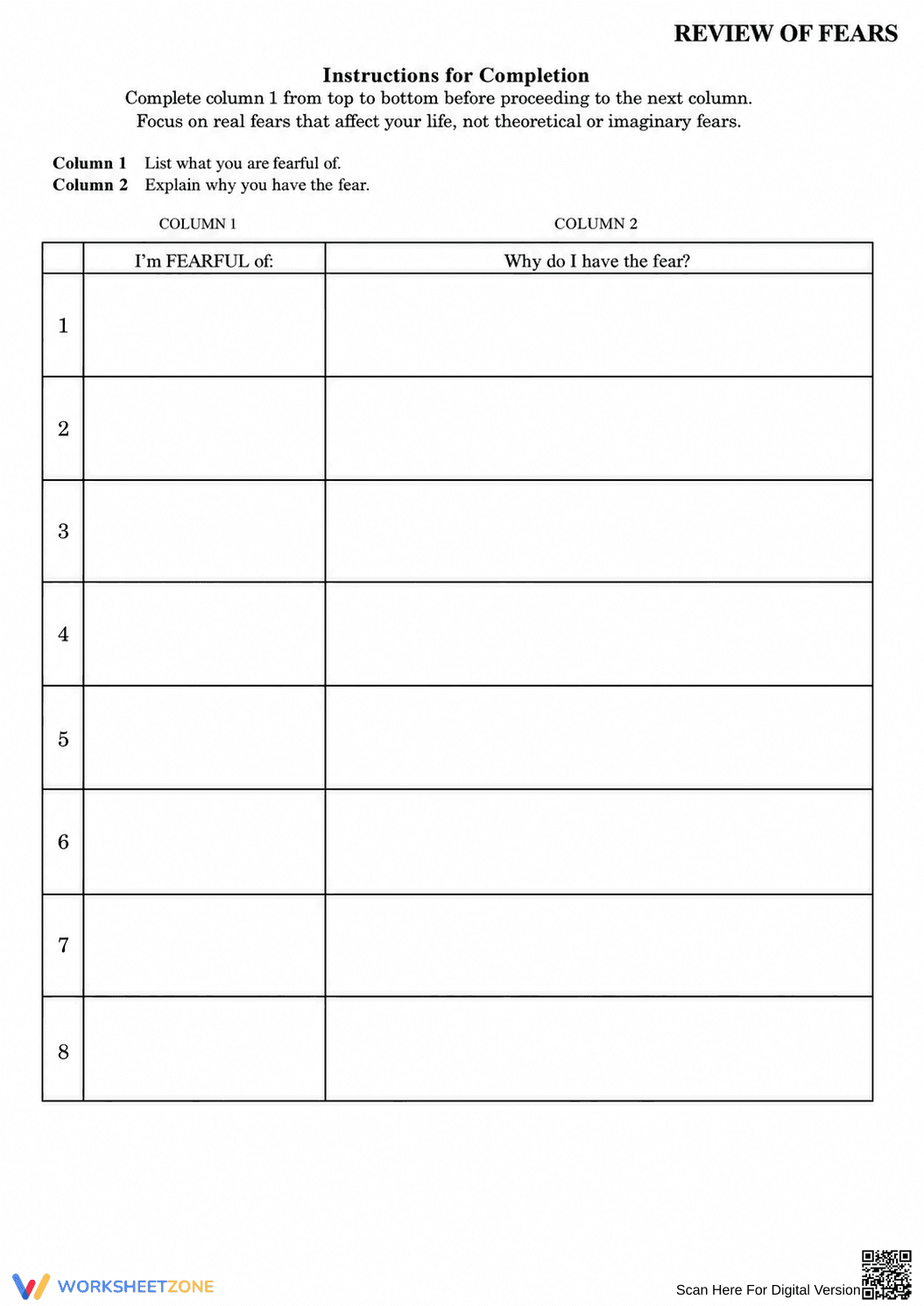


Review of Fears Worksheet | Essential Grade 8-12 SEL
Paste this activity's link or code into your existing LMS (Google Classroom, Canvas, Teams, Schoology, Moodle, etc.).
Students can open and work on the activity right away, with no student login required.
You'll still be able to track student progress and results from your teacher account.
This Review of Fears worksheet provides a structured framework for students to confront and analyze personal anxieties. By documenting specific fears and investigating their root causes, learners develop the emotional literacy required to manage stress and build long-term resilience. It transforms abstract worries into concrete data points for self-improvement.
At a Glance
- Grade: 8–12 · Subject: Social Skills
- Standard:
CCSS.ELA-LITERACY.W.8.10— Write routinely for reflection and personal growth tasks- Skill Focus: Emotional self-awareness and anxiety mapping
- Format: 2 pages · 12 problems · Open-ended reflection · PDF
- Best For: Individual counseling or SEL morning meetings
- Time: 15–25 minutes
The resource consists of a two-page PDF document featuring a clean, distraction-free table. It includes 12 numbered rows where students can list what they are fearful of and explain the underlying reasons for those feelings. The instructions emphasize focusing on real-life fears rather than theoretical or imaginary scenarios, ensuring the exercise remains grounded in the student's actual lived experience.
Zero-Prep Workflow
- Print: Select the two-page PDF and print enough copies for your group (1 minute).
- Distribute: Hand out the worksheets during a quiet reflection period or counseling session (1 minute).
- Review: Allow students to complete the 12 rows independently, then use the responses for private discussion or personal journaling (20 minutes).
Total teacher preparation time is under two minutes, making this an ideal resource for unexpected SEL needs or as a reliable sub plan for health and behavior classes.
Standards Alignment
CCSS.ELA-LITERACY.W.8.10: "Write routinely over extended time frames (time for research, reflection, and revision) and shorter time frames (a single sitting or a day or two) for a range of discipline-specific tasks, purposes, and audiences." This worksheet serves as a shorter time frame task focused on personal reflection. Both standard codes can be copied directly into lesson plans, IEP goals, or district curriculum mapping tools.
How to Use It
Use this worksheet during a unit on mental health or as a formative assessment for emotional regulation skills. Teachers can observe which students struggle to identify the "why" behind their fears, indicating a need for deeper one-on-one support. It is best assigned after a brief discussion on the difference between rational and irrational fears. Expected completion time ranges from 15 to 25 minutes depending on the depth of student reflection.
Who It's For
This activity is designed for middle and high school students who possess the emotional maturity to engage in honest self-reflection. It is particularly effective for students in Tier 2 behavioral interventions or those working with school counselors on anxiety management. Pair this with an anchor chart on coping strategies for a complete lesson.
According to research by Fisher & Frey (2014), routine reflective writing serves as a critical component of the gradual release of responsibility, allowing students to internalize complex emotional concepts through independent practice. This Review of Fears worksheet utilizes that principle by requiring students to articulate internal states in a structured format. By mapping 12 distinct anxieties to their origins, students engage with CCSS.ELA-LITERACY.W.8.10 in a way that promotes both literacy and social-emotional wellness. The clear distinction between "what" and "why" encourages higher-order thinking about personal behavior patterns. This tool is essential for educators seeking to integrate evidence-based SEL practices into the secondary classroom without increasing administrative burden. Accessing this printable ensures that students have a safe, organized space to process the real-world stressors that often impede academic performance and classroom engagement.


