


























Views
Plays


Modal Verbs & Punctuation Review | Essential Grade 4 ELA
Paste this activity's link or code into your existing LMS (Google Classroom, Canvas, Teams, Schoology, Moodle, etc.).
Students can open and work on the activity right away, with no student login required.
You'll still be able to track student progress and results from your teacher account.
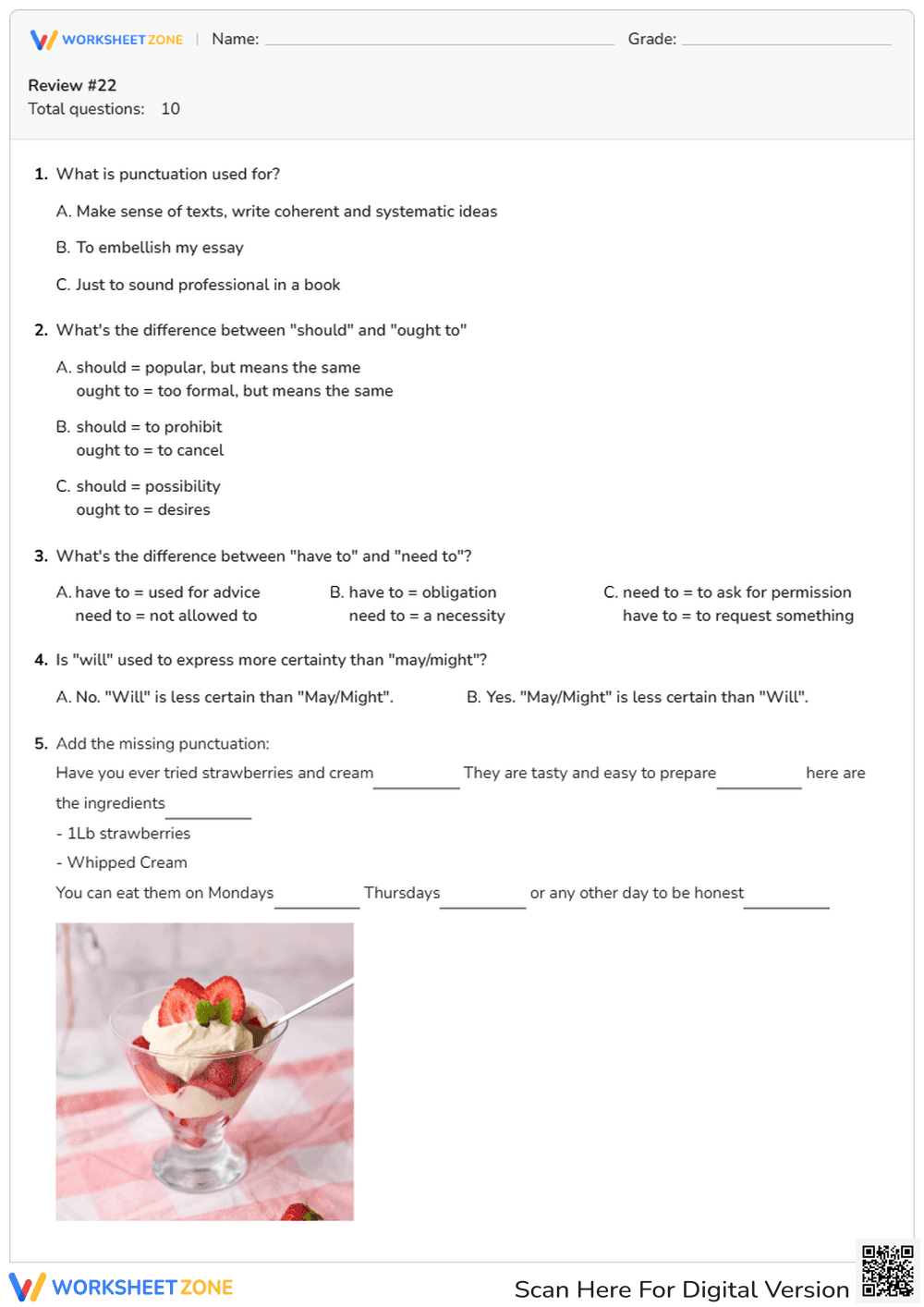
This comprehensive Grade 4 ELA review worksheet helps students master the nuances of modal verbs and essential punctuation marks. By distinguishing between shades of meaning in auxiliary verbs like "should," "must," and "might," learners develop the precision required for advanced academic writing. Students will demonstrate their understanding through multiple-choice analysis and practical application.
At a Glance
- Grade: 4 · Subject: ELA
- Standard:
CCSS.ELA-LITERACY.L.4.1.C— Use modal auxiliaries to convey various conditions like necessity or possibility- Skill Focus: Modal Verbs and Punctuation
- Format: 3 pages · 10 problems · Answer key included · PDF
- Best For: Formative assessment and grammar review
- Time: 20–30 minutes
The packet contains three pages of rigorous grammar practice. It begins with conceptual questions regarding the purpose of punctuation and the semantic differences between common modal pairs. The second page introduces a vocabulary-to-emotion matching task alongside contextual sentence completion. The final page concludes with complex modal selection based on probability and social expectations.
Skill Progression
- Guided practice: The first 4 questions provide explicit definitions and comparisons, helping students identify the specific functions of "will" versus "may" with immediate feedback options.
- Supported practice: Questions 5 and 6 transition to application, requiring students to insert punctuation into a recipe and match physical sensations to emotional vocabulary using visual cues.
- Independent practice: The final set of problems (7-10) challenges students to evaluate social scenarios and weather patterns to select the most accurate modal verb without scaffolding.
This sequence follows a gradual-release model to ensure students move from recognition to authentic usage.
Standards Alignment
This resource is primarily aligned with `CCSS.ELA-LITERACY.L.4.1.C`, which requires students to use modal auxiliaries to convey various conditions. It also supports `CCSS.ELA-LITERACY.L.3.2`, focusing on the correct use of commas and colons in lists and sentences. Both standard codes can be copied directly into lesson plans, IEP goals, or district curriculum mapping tools.
How to Use It
Use this worksheet as a mid-unit formative assessment to identify which students struggle with the subtle differences between "obligation" and "call to action." During instruction, observe if students can explain why "ought to" feels more formal than "should." This activity typically takes 25 minutes to complete and works well as a quiet independent work block.
Who It's For
This worksheet is designed for Grade 4 students but serves as an excellent challenge for Grade 3 or a remedial tool for Grade 5. It is particularly helpful for English Language Learners (ELLs) who often struggle with the nuances of English auxiliary verbs. Pair this with a modal verb anchor chart for maximum instructional impact.
According to the RAND AIRS 2024 report on literacy development, explicit instruction in grammar mechanics, specifically modal auxiliaries, is a significant predictor of writing clarity in the upper elementary years. This worksheet addresses CCSS.ELA-LITERACY.L.4.1.C by forcing students to move beyond basic verb usage into conditional meaning. By requiring students to differentiate between "will" and "might," the resource builds the linguistic precision necessary for meeting NAEP proficiency standards in writing. Research from Fisher & Frey (2014) emphasizes that such targeted practice, when combined with visual aids and contextual scenarios, allows students to internalize complex grammatical structures more effectively than rote memorization. This 10-task review provides the structured repetition needed to bridge the gap between recognizing a rule and applying it fluently in original compositions, ensuring students are prepared for middle-school level syntax.


