


























Views
Downloads

Printable Respect Worksheet | Grade 1 SEL & ELA
Paste this activity's link or code into your existing LMS (Google Classroom, Canvas, Teams, Schoology, Moodle, etc.).
Students can open and work on the activity right away, with no student login required.
You'll still be able to track student progress and results from your teacher account.
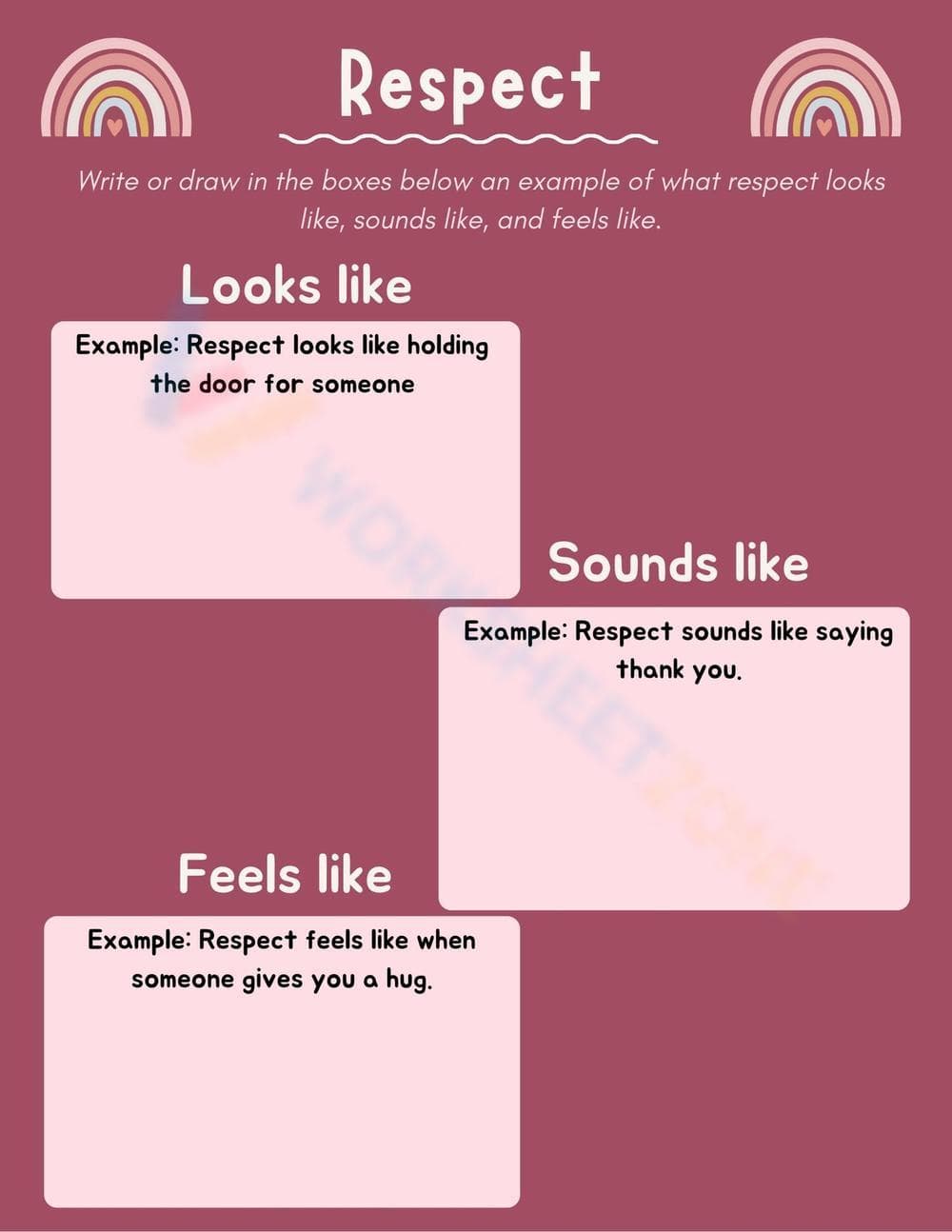
This Grade 1 social-emotional learning worksheet helps students define and internalize the concept of respect. By asking learners to identify what respect looks like, sounds like, and feels like, the activity connects abstract character traits to concrete daily actions. Students can write or draw their responses, making it highly accessible.
At a Glance
- Grade: 1 · Subject: SEL
- Standard:
CCSS.ELA-LITERACY.SL.1.4— Describe feelings and ideas with relevant details- Skill Focus: Defining respect through sensory examples
- Format: 1 page · 3 tasks · Open-ended · PDF
- Best For: Morning work or character education
- Time: 15–20 minutes
This single-page resource features three sections prompting students to explore respect visually, auditorily, and emotionally. Each of the three boxes includes a clear, relatable worked example—such as "holding the door for someone" or "saying thank you"—to guide student thinking. The spacious layout accommodates both written sentences and drawn illustrations, allowing early writers to express their understanding without frustration.
Zero-Prep Workflow
This worksheet requires zero teacher setup.
- Print (1 minute): Simply print the single-page PDF. The colorful but printer-friendly design works well in grayscale if needed.
- Distribute (1 minute): Hand out to students along with pencils, crayons, or markers.
- Review (3 minutes): Read the instructions and the three provided examples aloud to ensure all learners understand the prompt.
With a total teacher prep time of under two minutes, this activity is an excellent addition to any emergency sub plan or spontaneous character education lesson.
Standards Alignment
This activity aligns with CCSS.ELA-LITERACY.SL.1.4: Describe people, places, things, and events with relevant details, expressing ideas and feelings clearly. By asking students to articulate specific examples of respectful behavior, it reinforces their ability to communicate complex social concepts using descriptive language. Both standard codes can be copied directly into lesson plans, IEP goals, or district curriculum mapping tools.
How to Use It
This resource fits perfectly into morning meetings or dedicated social-emotional learning blocks. Use it after a direct instruction read-aloud about kindness or community helpers to solidify the concepts discussed. Alternatively, it serves as a meaningful reflection activity following a classroom discussion on rules and expectations. For formative assessment, circulate to note which children independently generate original examples versus those relying on prompts. Expect completion to take between 15 and 20 minutes.
Who It's For
This worksheet is primarily designed for first-grade students, though it is easily adaptable for kindergarteners (using drawing only) or second graders (requiring complete sentences). The write-or-draw instruction provides built-in differentiation for English Language Learners and developing writers. It pairs naturally with classroom anchor charts detailing behavioral expectations or introductory lessons on empathy and active listening.
Integrating explicit character education into daily literacy practice significantly benefits early childhood development. This activity supports CCSS.ELA-LITERACY.SL.1.4 by challenging students to describe feelings and ideas with relevant details. When learners break down abstract concepts like respect into observable behaviors—what it looks, sounds, and feels like—they build both emotional intelligence and expressive language skills. According to a 2024 report by EdReports, instructional materials that intentionally blend social-emotional competencies with foundational literacy standards increase student engagement and foster much more supportive classroom environments. By providing structured examples alongside open-ended response areas, this resource ensures that young learners can successfully articulate their understanding of positive peer interactions. This targeted approach helps establish a strong foundation for both academic communication and lifelong interpersonal skills, making abstract virtues highly concrete for young minds.


