




























Views
Downloads

Grade 3 Needs of Animals — Essential Printable Worksheet

Paste this activity's link or code into your existing LMS (Google Classroom, Canvas, Teams, Schoology, Moodle, etc.).
Students can open and work on the activity right away, with no student login required.
You'll still be able to track student progress and results from your teacher account.
This Grade 3 science worksheet guides students through a structured research task to identify how various animals satisfy survival requirements. By exploring food, water, and shelter sources for diverse species, learners develop a concrete understanding of biological needs and habitat interactions.
At a Glance
- Grade: 3 · Subject: Science
- Standard:
3-LS4-3— Construct an argument with evidence that organisms have survival needs in habitats- Skill Focus: Animal survival needs (food, water, shelter)
- Format: 1 page · 18 research points · Answer key included · PDF
- Best For: Independent research or science centers
- Time: 20–30 minutes
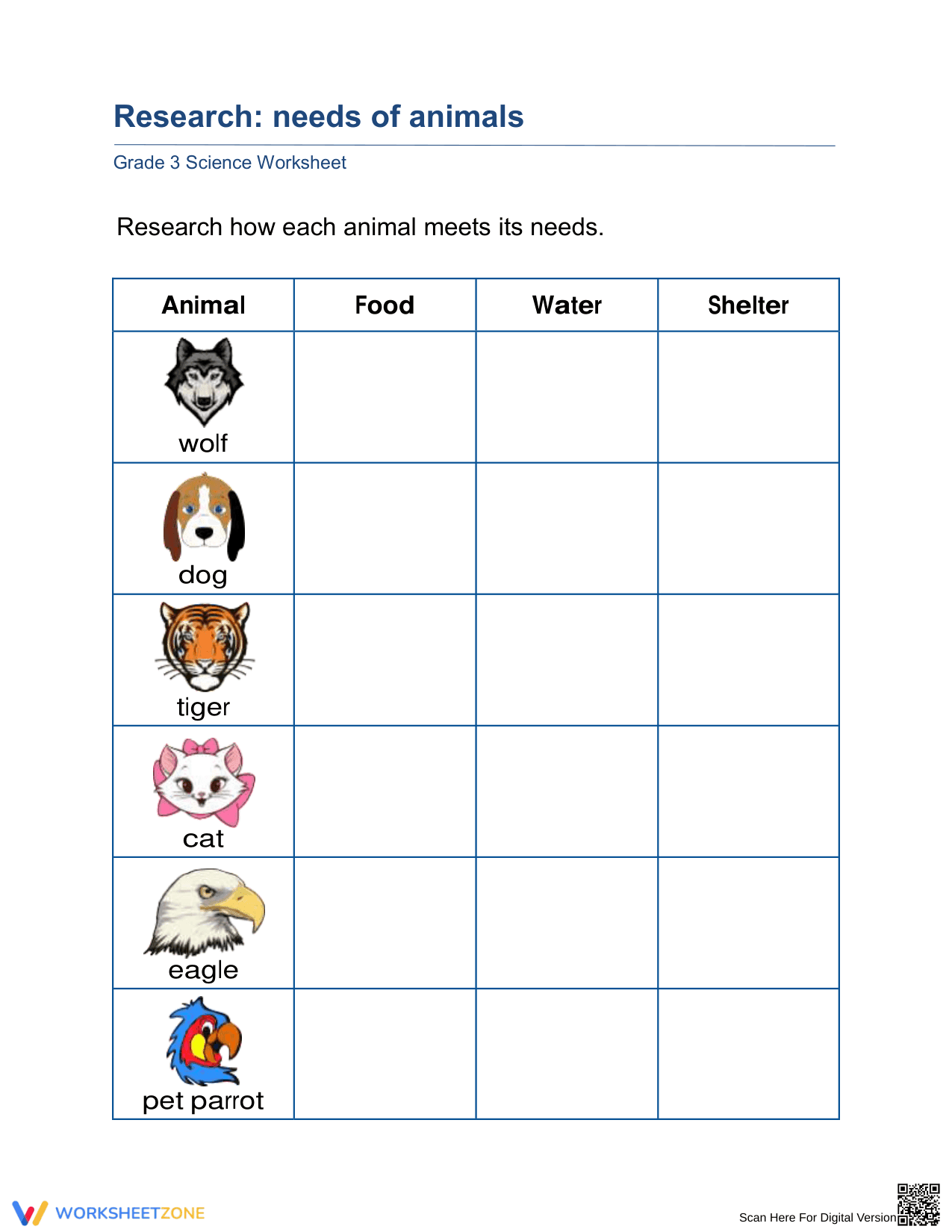
Inside this resource is an organized research table featuring six animals: wolf, dog, tiger, cat, eagle, and pet parrot. This single-page PDF includes a comprehensive answer key. Students research specific data for Food, Water, and Shelter categories, gaining insights into the requirements of both domestic and wild species.
Zero-Prep Workflow
- Print: Generate the single-page PDF for your class in under 30 seconds.
- Distribute: Provide access to non-fiction resources or approved search engines for about 1 minute.
- Review: Use the answer key to facilitate class discussion on cross-species commonalities in 3 minutes.
Total teacher preparation time is under two minutes, making it ideal for sub plans.
Standards Alignment
Aligned with `3-LS4-3`, this worksheet helps students construct evidence-based arguments about organism survival. By documenting the needs of these animals, students gather evidence to understand why environments support specific life forms. This standard code can be copied directly into lesson plans, IEP goals, or district curriculum mapping tools.
How to Use It
Use this worksheet during the "Elaborate" phase of a 5E lesson. It serves as an excellent formative assessment tool; observe if students distinguish between the shelter needs of pets versus wild predators. Expected completion time is 25 minutes, fitting perfectly into a standard science block or a focused station rotation.
Who It's For
Tailored for Grade 3, this is accessible for Grade 2 enrichment or Grade 4 review. Differentiation is natural; advanced learners can research specific prey, while others focus on familiar pets. It pairs naturally with habitat videos or classroom library collections of animal non-fiction texts.
The ScienceDirect TpT Analysis highlights the pedagogical value of structured research tables in elementary science, noting they help students organize biological data into manageable conceptual clusters. By focusing on the food, water, and shelter triad, this worksheet aligns with best practices for cognitive load management. Research indicates that active discovery of animal needs helps students retain the connection to habitat more effectively than passive reading. This resource targets the 3-LS4-3 standard, providing a path for identifying survival requirements across domestic and wild contexts. The 18 research points ensure high engagement and rigorous data collection, critical for meeting national science benchmarks. Such evidence-based design ensures students move beyond simple naming to an understanding of biological function within an ecosystem.


