




























Views
Downloads

Essential Relative Frequency Worksheet | Grade 8 Math

Paste this activity's link or code into your existing LMS (Google Classroom, Canvas, Teams, Schoology, Moodle, etc.).
Students can open and work on the activity right away, with no student login required.
You'll still be able to track student progress and results from your teacher account.
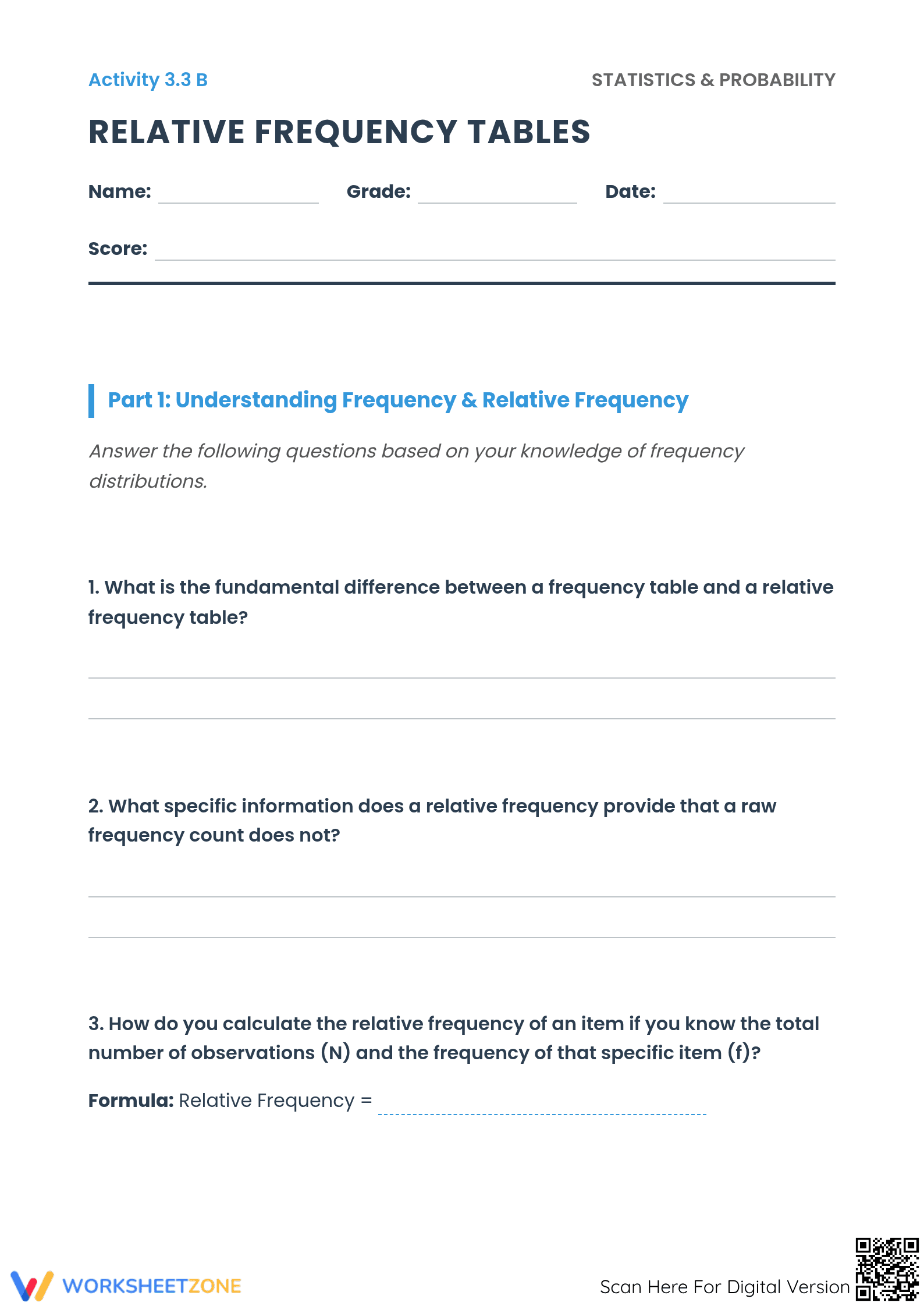
This essential Grade 8 mathematics worksheet empowers students to master the calculation and interpretation of relative frequency within categorical data sets. By engaging with structured data tables, learners move from basic frequency identification to complex proportional reasoning. Students will develop the critical ability to extract meaningful patterns from raw numbers, preparing them for advanced statistical analysis and probability theory.
At a Glance
- Grade: 8 · Subject: Data & Statistics
- Standard:
CCSS.MATH.CONTENT.8.SP.A.4— Use relative frequencies calculated for rows or columns to describe possible association- Skill Focus: Calculating Relative Frequency
- Format: 4 pages · 14 problems · Answer key included · PDF
- Best For: Independent practice after direct instruction
- Time: 35–45 minutes
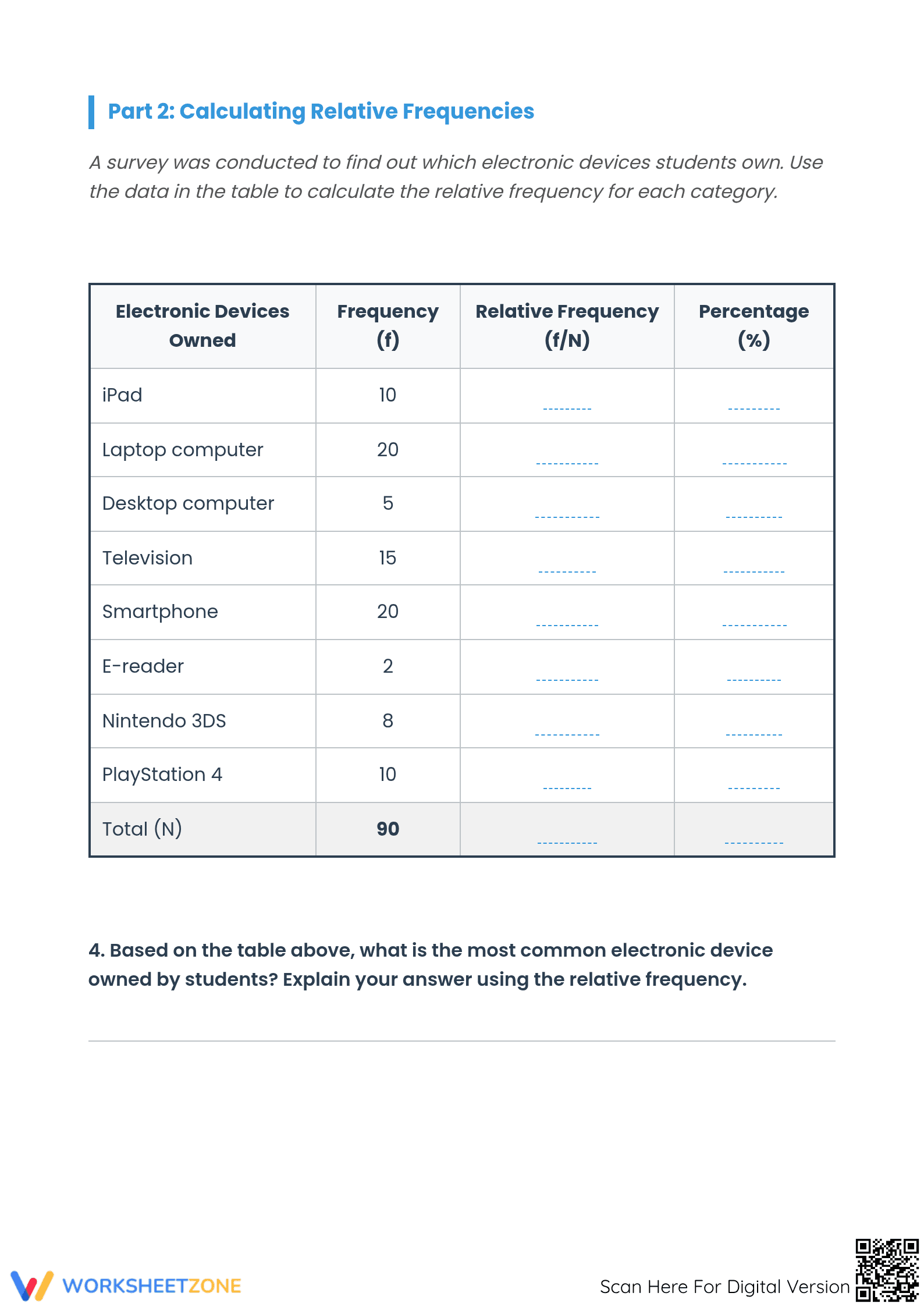
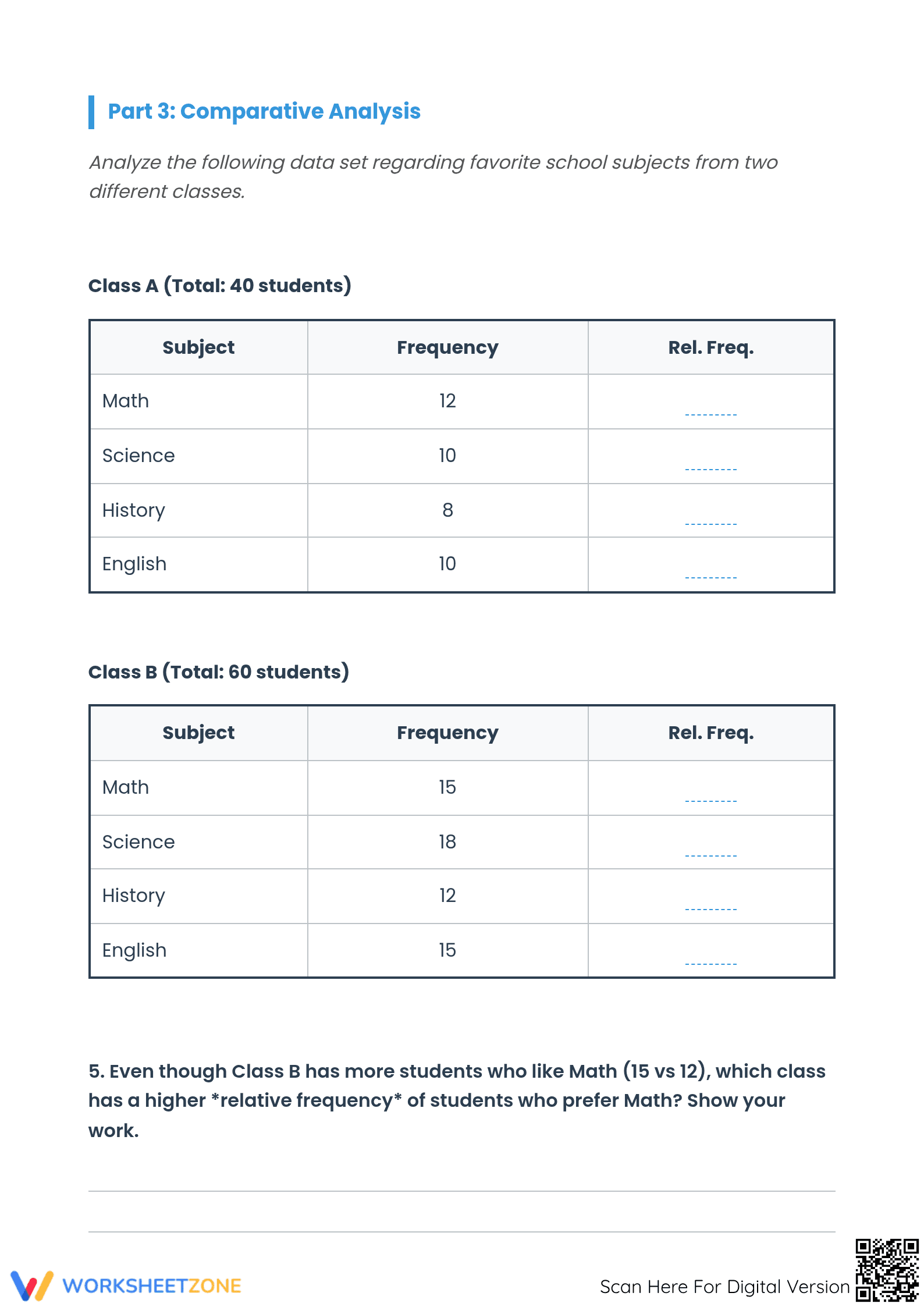
This comprehensive 4-page PDF resource features increasingly rigorous data charts designed to build student confidence. It includes multiple two-way tables, prompts for calculating totals, and questions requiring conversion of raw data into percentages or decimals. A full, high-resolution answer key is provided for rapid grading and immediate feedback during classroom review or self-paced study.
- Guided Practice: The first two problems feature partially filled tables and worked examples that scaffold the division process necessary to find relative frequency.
- Supported Practice: Middle sections provide 6 tables where students must independently calculate totals before determining frequencies, utilizing provided formulas.
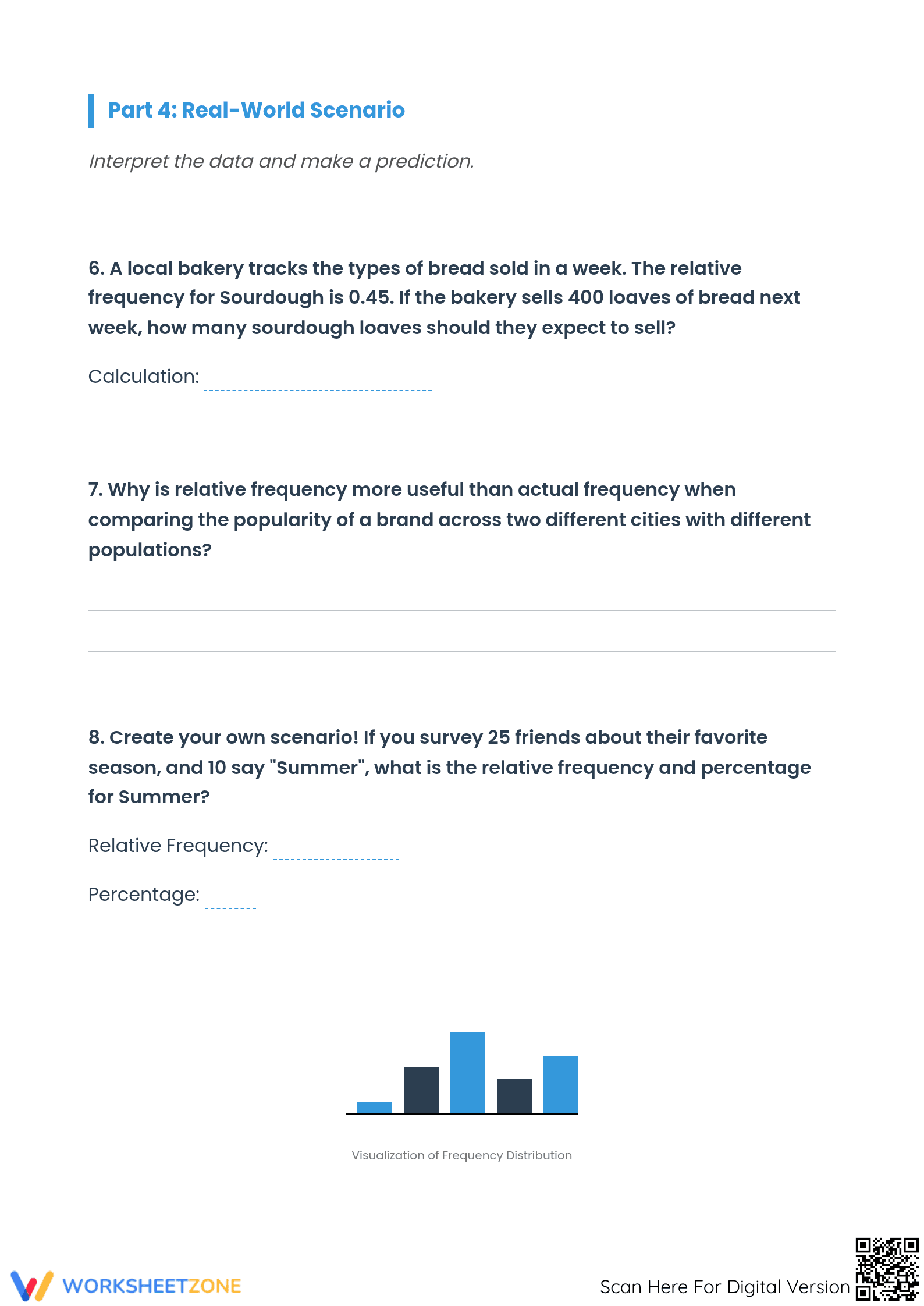
- Independent Practice: The final 6 tasks present complex scenarios without prompts, requiring students to interpret word problems and construct their own frequency distributions.
This sequence follows a gradual-release model, ensuring students transition smoothly from mechanical calculation to conceptual mastery of data relationships.
This resource is strictly aligned to the CCSS.MATH.CONTENT.8.SP.A.4 standard, which focuses on understanding that patterns of association can also be seen in bivariate categorical data by displaying frequencies and relative frequencies in a two-way table. Students are tasked with using these frequencies to describe the association between the two variables. Both standard codes can be copied directly into lesson plans, IEP goals, or district curriculum mapping tools.
Educators can deploy this worksheet mid-statistics unit, after students master one-way frequency tables. It serves as an effective "check for understanding" or exit ticket, assessing students' ability to distinguish joint and marginal relative frequencies. Note that students often struggle with identifying the correct denominator (row total vs. grand total). Completion time for the full packet is approximately 40 minutes.
Designed for Grade 8 students, this worksheet is also effective for advanced Grade 7 learners or High School Algebra 1 students needing data interpretation remediation. It supports English Language Learners with clear, tabular visual aids, reducing linguistic load while maintaining cognitive demand. This resource naturally pairs with an anchor chart on "Parts of a Two-Way Table" or an introductory passage on bivariate data collection methods.
Interpreting relative frequency is a foundational skill for data literacy, as highlighted by the NAEP 2024 Framework, and is crucial for understanding conditional probability. Research indicates that structured, multiple-page practice sets like this one lead to significantly higher retention rates of statistical procedures. This resource, with its 14 distinct opportunities for proportional reasoning, effectively bridges the gap between data collection and analytical synthesis. By standardizing frequency table formats, students can concentrate on mathematical relationships, ensuring comprehensive coverage of CCSS.MATH.CONTENT.8.SP.A.4 for an evidence-based middle school math curriculum.


