


























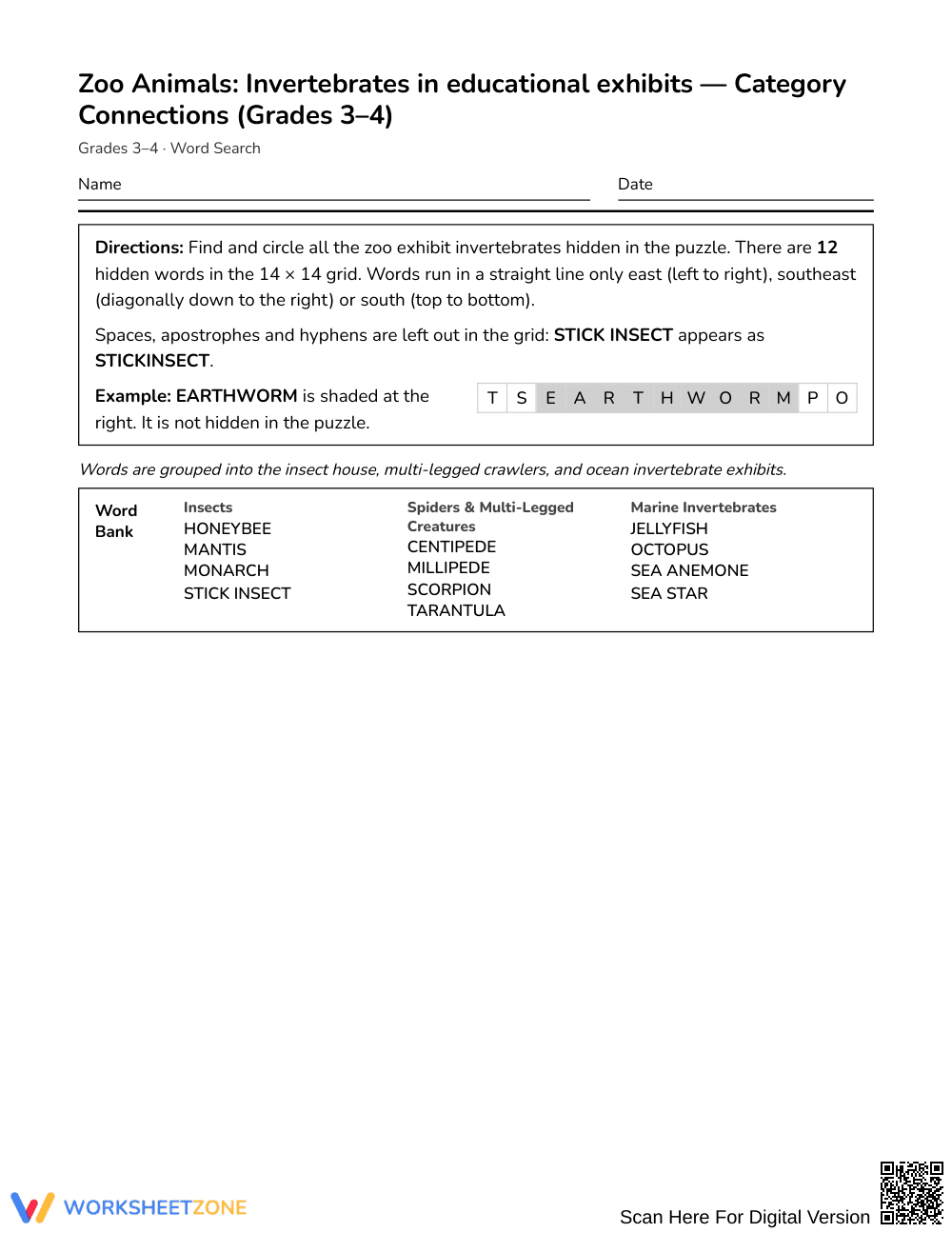


Ready Zoo Invertebrates Word Search | Grades 3–4 Science
Paste this activity's link or code into your existing LMS (Google Classroom, Canvas, Teams, Schoology, Moodle, etc.).
Students can open and work on the activity right away, with no student login required.
You'll still be able to track student progress and results from your teacher account.
This science word search helps elementary students identify and spell 12 key invertebrates frequently featured in educational zoo exhibits. Learners strengthen animal classification vocabulary across three taxonomic groupings while engaging in focused visual scanning. It provides an accessible, enjoyable entry point into biological concepts such as body segmentation, specialized appendages, and habitat adaptations.
At a Glance
- Grade: Grades 3–4 · Subject: Science
- Standard: Not standards-assessed — vocabulary enrichment
- Skill Focus: Invertebrates in educational exhibits
- Format: 2 pages · 12 words · Answer key included · PDF
- Best For: Science warm-up or station work
- Time: 15–25 minutes
What's Inside: The two-page activity introduces 12 target vocabulary words organized into three clear exhibit categories: Insects, Spiders & Multi-Legged Creatures, and Marine Invertebrates. A complete three-page answer key provides quick visual verification with every letter coordinate highlighted for hassle-free checking.
Puzzle Mechanics and Structure
The puzzle features a compact 14 x 14 letter grid configured specifically for upper-elementary developmental levels. All 12 hidden words run exclusively in three predictable orientations: horizontally left-to-right (East), diagonally downward (Southeast), and vertically downward (South). No backward or upward configurations are included, preventing visual frustration while reinforcing standard directional scanning. Students use the organized category word bank to locate each specimen, associating individual animal names with broader biological classifications.
Standards Alignment
This activity serves strictly as science vocabulary enrichment and is not aligned to a formal state or national content standard. It reinforces essential domain-specific terminology supporting general life science and animal diversity instruction.
How to Use It
Use this puzzle at the start of an animal classification unit to activate prior knowledge before introducing taxonomic keys. Alternatively, place it in an independent science station after direct instruction on vertebrate and invertebrate traits. During the activity, circulate to observe whether students recognize morphological traits connecting the grouped animals (such as eight legs on arachnids versus six on insects). Most students complete the puzzle in 15 to 25 minutes.
Who It's For
This resource is tailored for Grades 3–4 students developing foundational life science literacy. It provides supportive vocabulary reinforcement for English language learners through thematic grouping and predictable word orientations. Pair this puzzle with an invertebrate anchor chart or an introductory lesson on zoo exhibit terrariums and marine touch tanks.
Fisher & Frey (2014) emphasize that intentional domain-specific vocabulary acquisition relies on multiple meaningful exposures to academic language within structured contexts. This Grades 3–4 science word search reinforces 12 essential invertebrate terms—including social insects, predatory arachnids, and marine invertebrates—by prompting students to actively scan, decode, and categorize vocabulary across a focused 14 x 14 grid. Rather than testing isolated recall, the activity builds orthographic familiarity and taxonomic awareness through structured category connections. By organizing hidden words into authentic zoo exhibit habitats, the puzzle connects scientific terminology to real-world animal observation. Teachers can utilize this activity as an engaging vocabulary primer or independent reinforcement tool that supports broader scientific literacy goals without requiring preliminary instructional setup.


