


























Views
Downloads


Ready Vector Conversion Worksheet | Grade 12 Precalculus
Paste this activity's link or code into your existing LMS (Google Classroom, Canvas, Teams, Schoology, Moodle, etc.).
Students can open and work on the activity right away, with no student login required.
You'll still be able to track student progress and results from your teacher account.
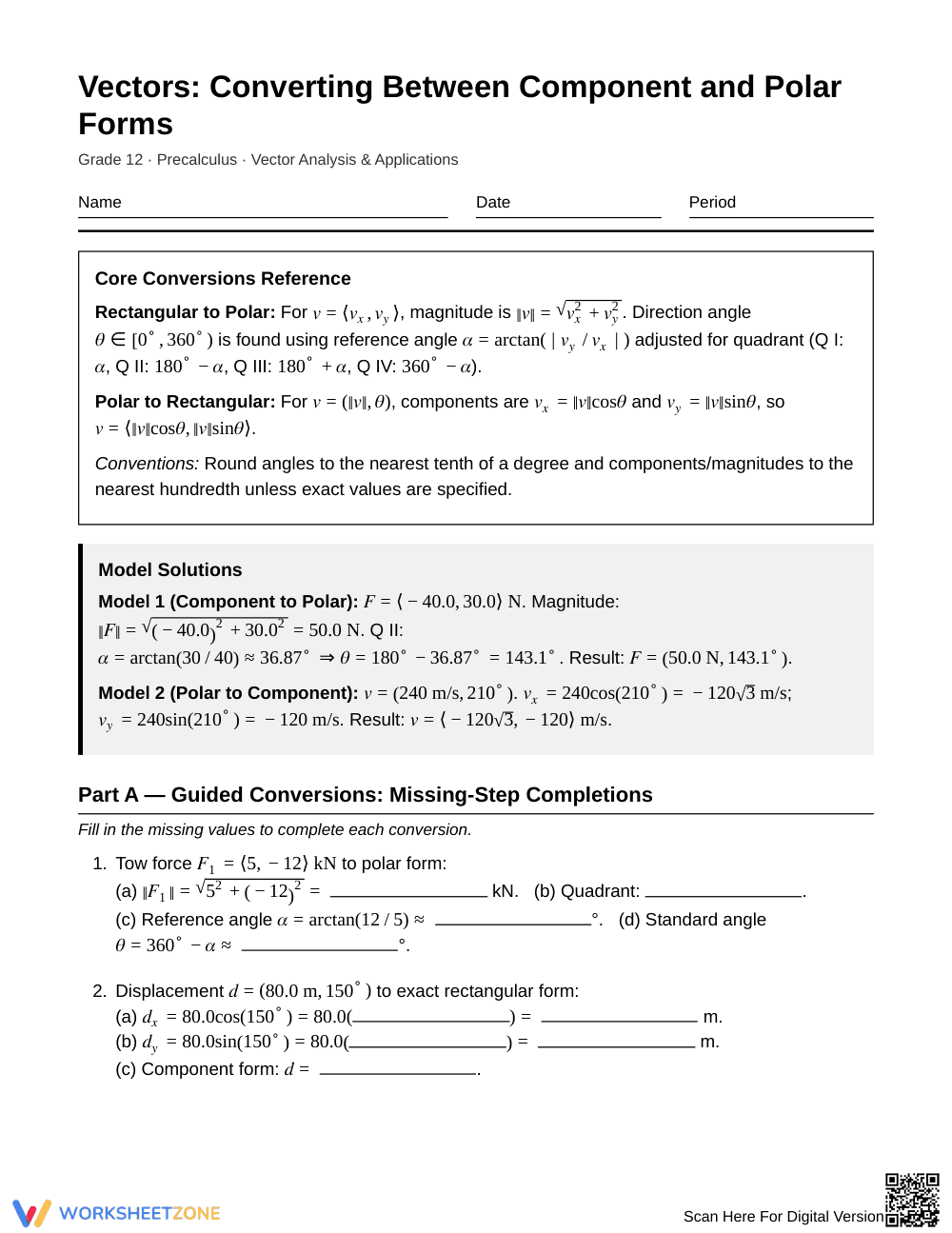
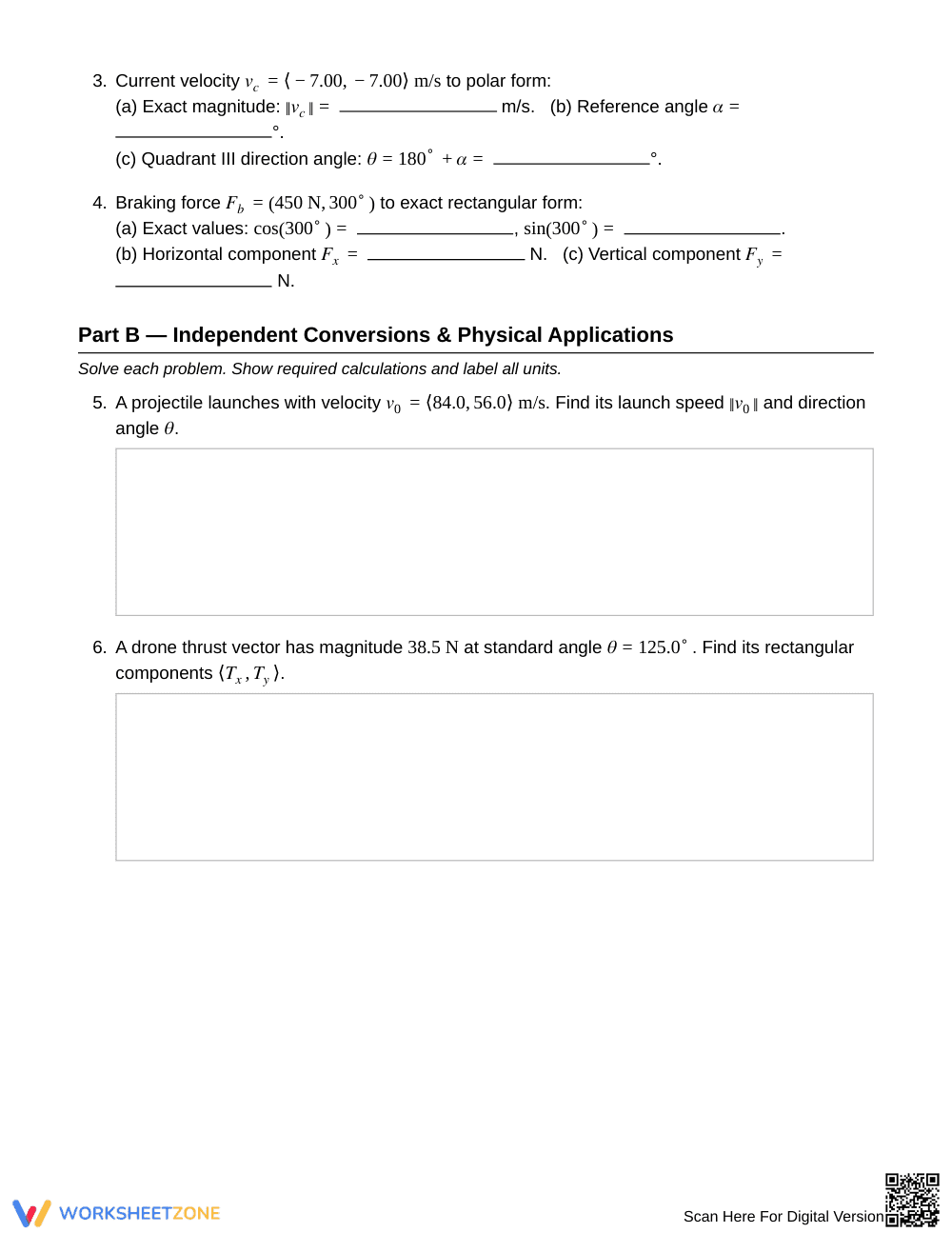
This Grade 12 Precalculus worksheet provides comprehensive practice converting two-dimensional vectors between rectangular component form and polar magnitude-direction form. Students apply trigonometry, reference angles, and quadrant adjustments to represent force, velocity, and displacement vectors accurately across mathematical and real-world physical contexts.
At a Glance
- Grade: 12 · Subject: Precalculus
- Standard: Vector Analysis — Convert between rectangular components and polar magnitude-direction representations of vectors
- Skill Focus: Convert Between Component and Polar Forms
- Format: 4 pages · 12 problems · Answer key included · PDF
- Best For: Independent practice and vector mastery
- Time: 45–60 minutes
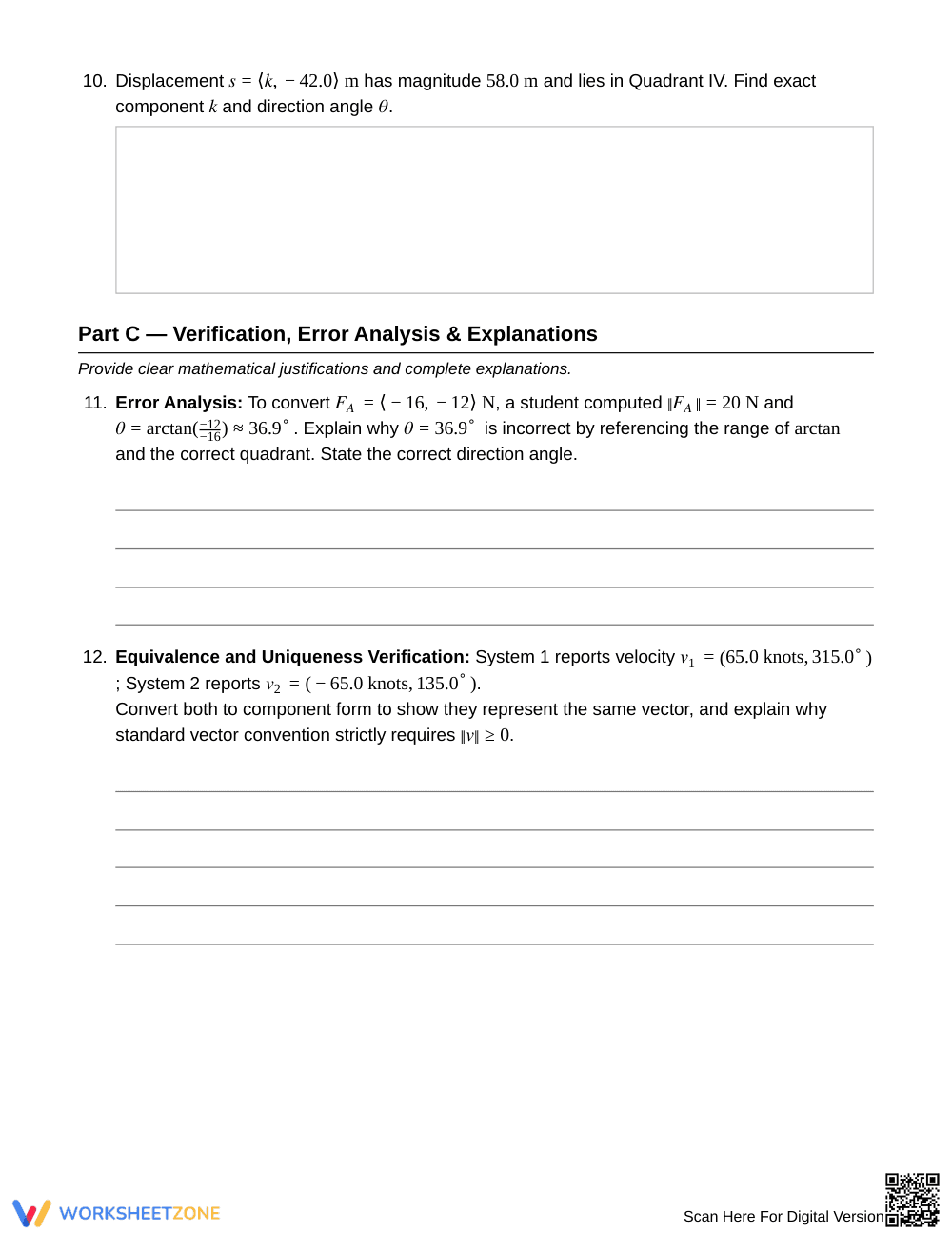
The 4-page resource opens with a structured reference guide defining conversion formulas, reference angle calculations, quadrant rules, and two complete model solutions. Across 12 multi-step problems, students complete scaffolded fill-in calculations, solve independent physics applications with diagrams and radical expressions, and perform detailed error analysis alongside vector uniqueness verifications. A complete 2-page answer key provides step-by-step solutions for rapid grading.
Skill Progression
- Guided practice (Part A, Problems 1–4): Students complete missing calculation steps for magnitude, quadrant identification, reference angles, and exact trigonometric components with heavy structural scaffolding.
- Supported practice (Part B, Problems 5–8): Students calculate projectile velocities, drone thrust vectors, diagrammed quadrant forces, and exact radical components with moderate scaffolding.
- Independent practice (Part B & C, Problems 9–12): Students independently evaluate resultant force additions, solve for missing vector components, diagnose arctangent quadrant errors, and verify vector uniqueness conventions.
This structured progression follows the gradual release of responsibility model, shifting students from guided computation to rigorous analytical reasoning.
Standards Alignment
This resource aligns directly with advanced Precalculus and high school vector standards requiring students to represent vectors in component form and polar form, compute magnitudes and direction angles, and resolve vectors into trigonometric components. Both standard concepts can be copied directly into lesson plans, IEP goals, or district curriculum mapping tools.
How to Use It
Assign this worksheet during the vector analysis unit immediately after direct instruction on the unit circle and vector components. For independent practice, have students complete Part A in pairs before tackling Parts B and C individually. Alternatively, use Part C as a mid-unit formative assessment check to observe whether students account for arctangent range limitations in Quadrants II and III. Expected completion time is 45 to 60 minutes.
Who It's For
This resource is designed for Grade 12 Precalculus, Trigonometry, and Honors Physics students mastering vector operations. Differentiate by providing the built-in reference box for developing learners or challenging advanced students to explain non-standard angle notations. Pair this worksheet with an interactive vector simulation or a direct instruction lesson on vector resultant additions.
According to research by Fisher & Frey (2014) on the gradual release of responsibility instructional model, structured procedural scaffolding directly enhances student retention when tackling complex, multi-step mathematical conversions. Converting vectors between rectangular component and polar forms requires simultaneous coordination of Pythagorean calculations, inverse trigonometric functions, and quadrant-based directional reasoning. This Grade 12 Precalculus worksheet systematically scaffolds this learning trajectory across 12 targeted tasks, starting with guided fill-in models before advancing to independent physical applications and metacognitive error analysis. By isolating critical cognitive pitfalls—such as the restricted range of inverse tangent in Quadrants II and III—the materials ensure high school students build durable conceptual understanding alongside computational fluency. Educators can use these 4 pages of vector practice to evaluate mastery and prepare students for advanced college-level mathematics and classical physics coursework.


