




























Views
Downloads


Ready US Presidents Word Search | Grades 7–8 Social Studies

Paste this activity's link or code into your existing LMS (Google Classroom, Canvas, Teams, Schoology, Moodle, etc.).
Students can open and work on the activity right away, with no student login required.
You'll still be able to track student progress and results from your teacher account.
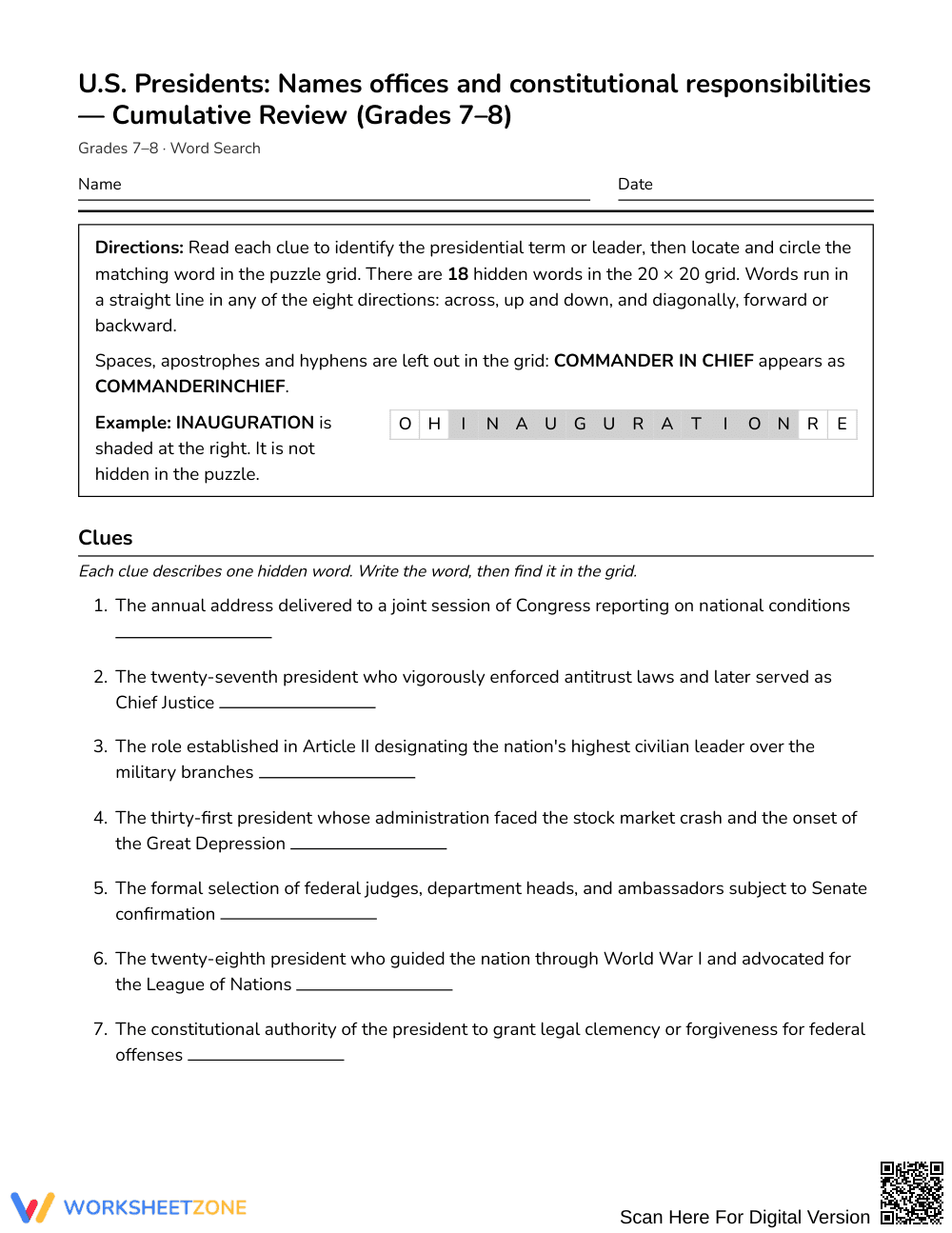
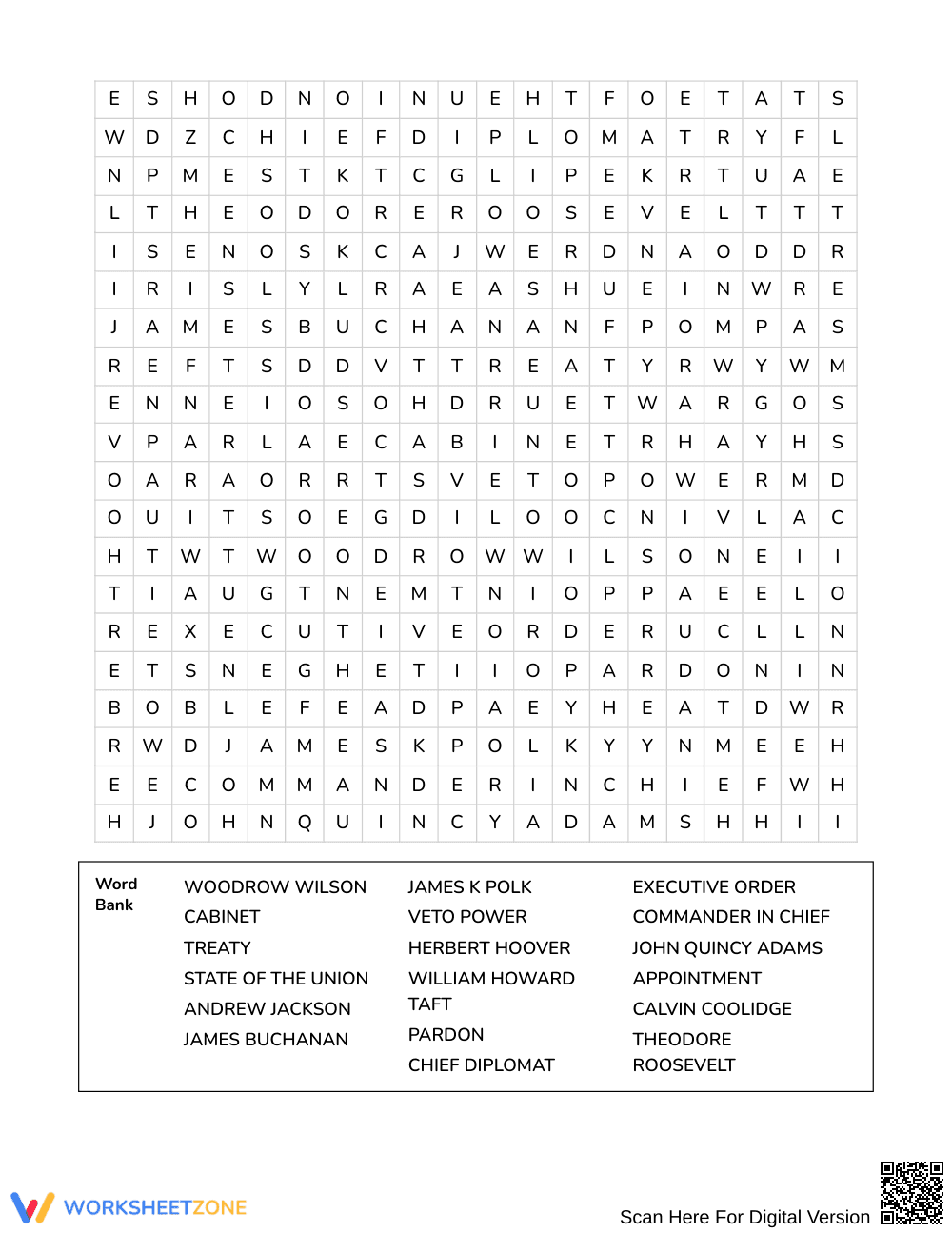
Engage middle school civics learners with this targeted presidential review activity. Students review executive branch vocabulary and historical leaders as they solve clues defining constitutional powers and locate 18 hidden terms across the letter grid. This resource reinforces core civics terminology while building factual recall of key American presidencies.
At a Glance
- Grade: Grades 7–8 · Subject: Social Studies
- Standard: Not standards-assessed — vocabulary enrichment
- Skill Focus: Presidential offices and constitutional responsibilities
- Format: 3 pages · 18 words · Answer key included · PDF
- Best For: Civics unit review and vocabulary reinforcement
- Time: 25–35 minutes
What's Inside
This 3-page printable activity features a full-page puzzle accompanied by substantive historical clues rather than a simple word list. Students read constitutional definitions and historical milestones to identify each president or executive power before searching the grid. The package includes a complete 4-page answer key highlighting exact word placements for quick verification.
Puzzle Mechanics and Structure
This vocabulary challenge incorporates specific structural features to build focused engagement:
- Grid Dimensions: A spacious 20 x 20 letter grid containing 18 hidden vocabulary terms.
- Search Orientations: Words run in all 8 directions: north, northeast, east, southeast, south, southwest, west, and northwest.
- Clue-Driven Bank: Each search entry pairs with an informational clue detailing executive roles, Article II responsibilities, or landmark historical achievements.
Standards Alignment
This activity serves as supplemental vocabulary enrichment and is not aligned to a formal state standard. It provides foundational terminology practice supporting broader middle school social studies, civics, and American government curricula.
How to Use It
Deploy this puzzle as an engaging midpoint review after direct instruction on Article II of the U.S. Constitution, or assign it as an independent station task during an American presidency unit. For formative assessment, check whether students can identify the executive terms from the clues before searching the grid. Most students will complete the search within 25 to 35 minutes.
Who It's For
This activity is designed for students in Grades 7–8 studying early American governance, constitutional roles, and presidential history. It offers accessible terminology reinforcement for general education classrooms, English language learners, and intervention groups. Pair this puzzle with an executive branch anchor chart or primary source analysis of executive orders.
Vocabulary acquisition forms the bedrock of historical literacy and conceptual comprehension in secondary social studies. As emphasized by Fisher & Frey (2014), purposeful word-learning routines that require students to connect domain-specific definitions with target terminology significantly enhance retention and textual analysis. This educational word search operationalizes this principle by pairing substantive constitutional descriptions with 18 key executive branch concepts and historical leaders. Rather than engaging in passive scanning, students must actively interpret Article II powers—such as executive orders, veto authority, and diplomatic appointments—alongside significant presidential administrations before identifying the terms within a complex 20 x 20 matrix. This structured exposure helps Grades 7–8 learners internalize technical civics vocabulary, reinforcing the cognitive schema necessary for complex civic discourse, standardized social studies assessments, and primary source evaluation across middle school American history and government coursework.


