































Ready Two Locus Constructions Worksheet | Grade 10 Geometry

Paste this activity's link or code into your existing LMS (Google Classroom, Canvas, Teams, Schoology, Moodle, etc.).
Students can open and work on the activity right away, with no student login required.
You'll still be able to track student progress and results from your teacher account.
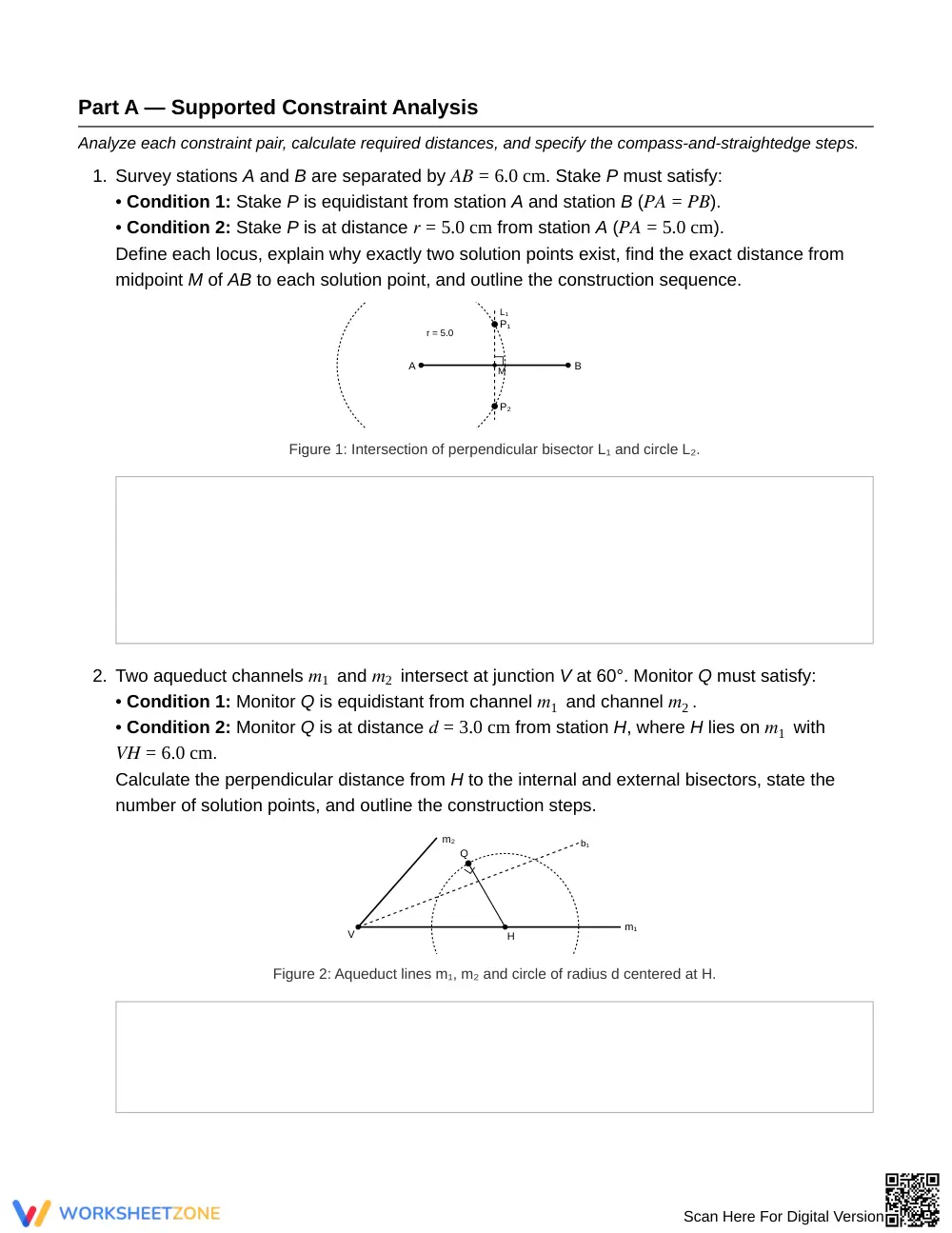
This high school geometry worksheet develops mastery in determining geometric constructions that satisfy two simultaneous locus conditions. Students construct perpendicular bisectors, circles, angle bisectors, and parallel line pairs with a compass and straightedge, calculating exact radical lengths and verifying constraint intersections across 6 rigorous multi-step problems.
At a Glance
- Grade: 10 · Subject: Geometry
- Standard:
HSG-CO.D.12— Make formal geometric constructions with a variety of tools and methods- Skill Focus: Double-Locus Geometric Constructions
- Format: 5 pages · 6 problems · Answer key included · PDF
- Best For: Honors geometry locus mastery practice
- Time: 45–60 minutes
What's Inside
The 5-page printable document features a foundational reference box defining four planar loci, followed by 6 comprehensive multi-step construction tasks across Parts A, B, and C. Every problem pairs technical geometric modeling with precise diagram figures, coordinate constraints, and exact algebraic radical calculations. A complete 3-page teacher answer key provides full step-by-step compass protocols, solution counts, and deductive geometric proofs.
Skill Progression
- Guided practice (Part A, Problems 1–2): Students analyze supported real-world constraint pairs, constructing perpendicular bisectors and circles to calculate exact station distances with provided locus prompts.
- Supported practice (Part B, Problems 3–5): Learners independently tackle multi-step planar scenarios involving parallel corridors, isosceles triangle altitudes, and distance-to-line loci requiring algebraic distance verification.
- Independent practice (Part C, Problem 6): Students execute an end-to-end formal construction protocol and write a deductive Euclidean proof establishing that constructed points meet both locus criteria.
This scaffolded architecture reinforces the gradual release of responsibility model, shifting students from guided locus identification to autonomous formal proof.
Standards Alignment
This resource aligns directly with Common Core standard HSG-CO.D.12: Make formal geometric constructions with a variety of tools and methods, including bisecting segments, bisecting angles, and drawing parallel lines. It also reinforces HSG-MG.A.1 by applying geometric loci to model design constraints. Both standard codes can be copied directly into lesson plans, IEP goals, or district curriculum mapping tools.
How to Use It
Deploy this worksheet after direct instruction on single-locus definitions. Use Part A for partner-based collaborative problem-solving during class, then assign Part B for focused independent practice. As a formative assessment tip, check whether students draw complete compass construction arcs or merely estimate locus intersections with a ruler. Expected completion time ranges from 45 to 60 minutes across one extended block period.
Who It's For
This resource serves Grade 10 Geometry students preparing for formal Euclidean proof assessments. Built-in reference boxes support emerging learners, while non-standard constraints challenge advanced students. Pair this activity with an interactive compass demonstration or an anchor chart displaying the four fundamental planar loci.
According to research by Fisher & Frey (2014) on productive instructional architecture, structured scaffolded progression enables high school mathematics students to master rigorous analytical tasks by bridging conceptual definitions with independent procedural execution. This Grade 10 geometry resource operationalizes that evidence base around standard HSG-CO.D.12, requiring learners to make formal geometric constructions that satisfy simultaneous locus conditions. By moving systematically from guided two-point bisector analysis to multi-step parallel line and circle intersections, students deepen their spatial reasoning while connecting geometric definitions to algebraic radical computations. The integrated compass-and-straightedge protocols demand deductive precision, ensuring that students justify why construction points exist rather than relying on visual approximations. Consequently, this focused instructional sequence equips secondary geometry learners to synthesize planar locus theory, execute formal Euclidean proofs, and achieve measurable mastery across standards-aligned mathematical practice goals.


