




























Ready Temperature Trends Word Search | Grades 8–9 Science
Paste this activity's link or code into your existing LMS (Google Classroom, Canvas, Teams, Schoology, Moodle, etc.).
Students can open and work on the activity right away, with no student login required.
You'll still be able to track student progress and results from your teacher account.
This climate change word search reinforces scientific vocabulary related to observed temperature trends for Grades 8–9 science students. Learners identify key climatology concepts by reading precise definitions and locating terms hidden within the puzzle. The activity deepens comprehension of instrumental records, atmospheric monitoring, and thermal indicators to build content mastery across Earth and environmental science units.
At a Glance
- Grade: Grades 8–9 middle and high school · Subject: Science
- Standard: Not standards-assessed — supplementary climate vocabulary enrichment
- Skill Focus: Climatology vocabulary and observed temperature trends
- Format: 3 pages · 14 words · Full answer key included · Printable PDF
- Best For: Independent vocabulary review, sub plans, and lesson warmup
- Time: 20–30 minutes of focused student work
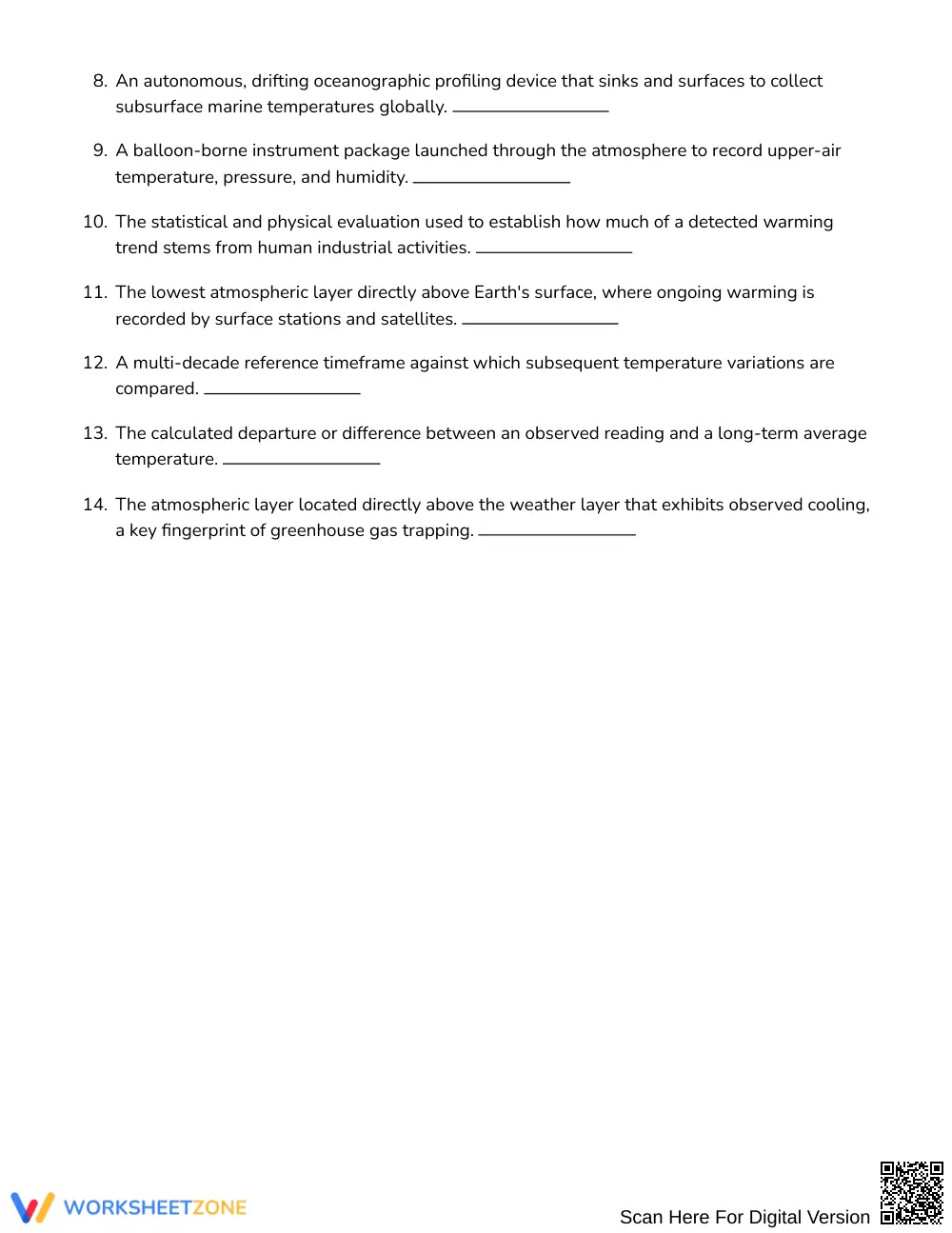
The 3-page printable activity features 14 essential scientific terms embedded within a structured grid, accompanied by an exhaustive 3-page solution set. Instead of passive letter hunting, students analyze rigorous scientific clues defining phenomena such as tropospheric warming, stratospheric cooling, and urban heat retention before searching for the target terms. A shuffled word bank provides immediate spelling support while preventing simple rote matching.
The puzzle is built on a 16 x 16 letter grid containing 14 hidden climate vocabulary terms. Words run in four specific orientations: northeast, east, southeast, and south, eliminating reverse-reading frustration while maintaining rigorous spatial engagement. Students read descriptive clues to identify matching concepts, consult the shuffled word bank to confirm accurate terminology, and scan the grid along the designated directional vectors to locate each term.
This resource serves as targeted vocabulary enrichment rather than a formal standards-assessed task. Because foundational science literacy relies heavily on tier-three domain terminology, this activity deliberately focuses on conceptual terminology and operational definitions without assessing specific state or national performance expectations.
This activity works effectively in two primary instructional moments. First, use it as an introductory schema-builder before direct instruction on modern climate data, allowing students to encounter instruments like radiosondes and Argo floats. Alternatively, assign it after direct instruction as a quiet review or emergency substitute plan. During work, circulate to observe whether students solve the conceptual clues before searching the grid. Expect 20 to 30 minutes for completion.
Designed specifically for Grades 8–9 science students, this word search accommodates general Earth science, physical science, and introductory environmental science classrooms. For emerging bilingual learners or students needing additional support, teachers can highlight the first letter of each clue in the word bank. Pair this activity directly with an authentic temperature anomaly graph or instrumental record analysis lesson.
Academic research consistently underlines that domain-specific vocabulary acquisition forms the essential bedrock of conceptual scientific literacy. According to Fisher & Frey (2014), intentional exposure to disciplinary terminology paired with semantic clues reinforces reading comprehension across secondary informational texts. While this word search operates strictly as vocabulary enrichment rather than an assessment-aligned instrument, mastering concepts such as paleoclimate proxies, marine thermal absorption, and tropospheric trends equips students to interpret complex climate documentation. Grounding puzzle activities in contextual clues rather than simple word copying prevents superficial engagement, prompting learners to actively retrieve definitional knowledge before conducting visual searches across letter arrays. Cognitive science demonstrates that structured word puzzles integrating rigorous definitions stimulate active cognitive retrieval, thereby improving long-term retention of multisyllabic scientific vocabulary across secondary Earth and environmental science curricula. This deliberate combination of vocabulary recall and directional pattern recognition supports overall disciplinary fluency.


