





























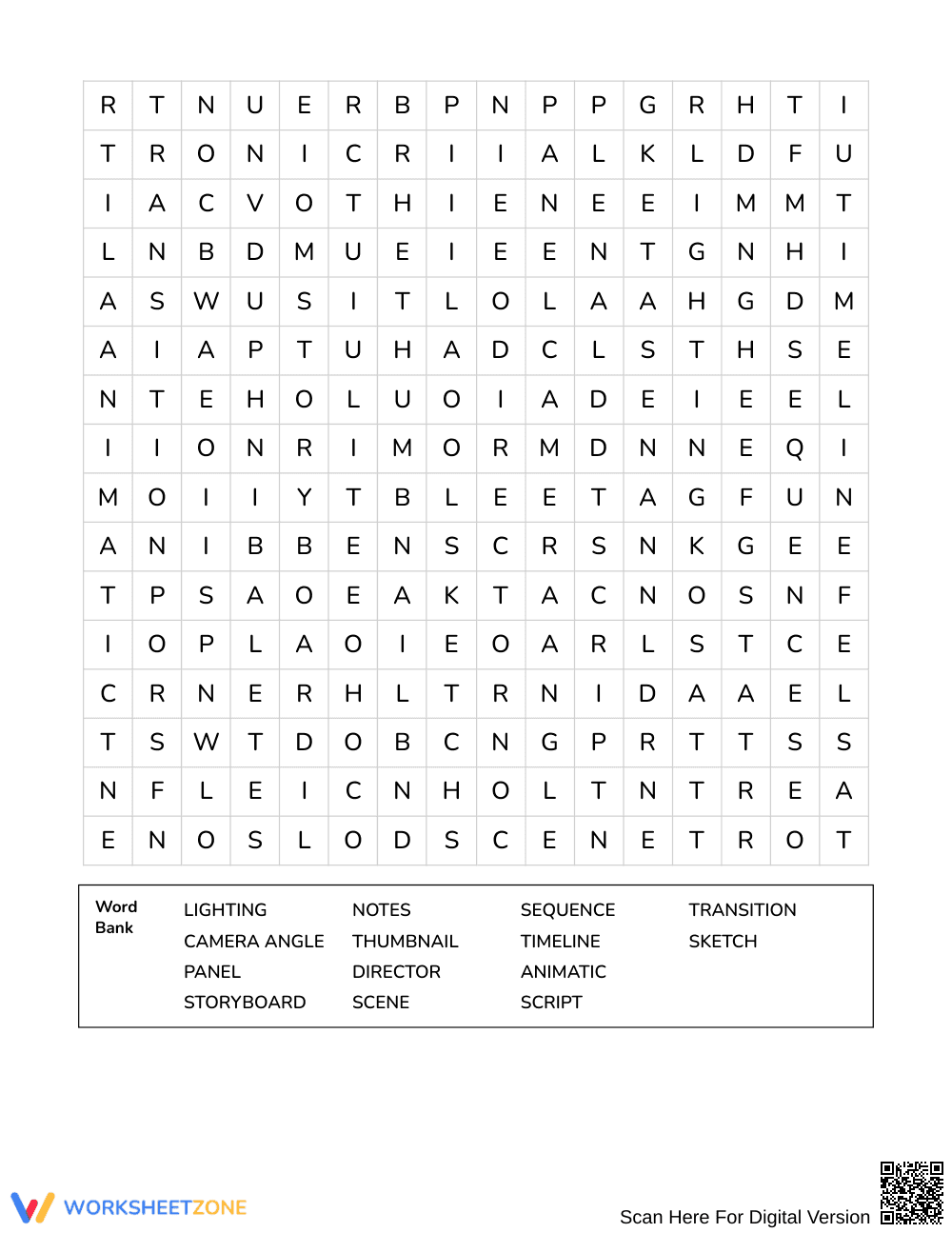


Ready Storyboard Planning Word Search | Grades 4–5 ELA

Paste this activity's link or code into your existing LMS (Google Classroom, Canvas, Teams, Schoology, Moodle, etc.).
Students can open and work on the activity right away, with no student login required.
You'll still be able to track student progress and results from your teacher account.
This Grades 4–5 English Language Arts word search builds media literacy vocabulary by challenging learners to identify core film planning concepts. Students solve 14 definitional clues before locating storyboard terms hidden throughout the puzzle grid. The activity reinforces foundational visual storytelling terminology, strengthening comprehension of narrative structures and pre-production workflows across upper elementary language arts units.
At a Glance
- Grade: Grades 4–5 · Subject: English Language Arts (ELA)
- Standard: Not standards-assessed — vocabulary enrichment
- Skill Focus: Storyboards and planning
- Format: 3 pages · 14 words · Answer key included · PDF
- Best For: Media units and fast finishers
- Time: 20–30 minutes
This 3-page printable puzzle features a clue detective layout that requires students to read definitions rather than simple word lists. Learners match definitions for essential production terms like thumbnail, animatic, scene, and camera angle before searching the letter grid. The package includes a full 3-page solution key displaying highlighted word locations, allowing for rapid self-checking or teacher verification.
How the Puzzle Works
The activity is built on a dense 16 x 16 letter grid that conceals 14 targeted vocabulary terms. Words are placed in four distinct directions: northeast, east, southeast, and south. Rather than scanning for a visible word bank, students read descriptive clues to identify each mystery term, demanding cognitive recall before searching. This clue-first structure transforms basic letter hunting into an authentic vocabulary application exercise.
Standards Alignment
This instructional resource is designed strictly for vocabulary enrichment and is not aligned to a formal state standard. It enhances interdisciplinary visual literacy, supporting narrative planning and multimedia projects without tethering instruction to rigid standardized metrics. Teachers can integrate the activity into creative writing workshops, media arts units, or drama electives to introduce technical production vocabulary naturally.
How to Use It
Deploy this word search during pre-writing instruction before students create their own narrative comic strips or video scripts. Alternatively, utilize it as an independent sponge activity for fast finishers during workstation rotations. As students work, observe whether they can identify terms from memory or need to reread the definitions multiple times, noting who might need extra visual scaffolding during storyboard drafting. Most students finish within 20 to 30 minutes.
Who It's For
Designed for general education students in Grades 4–5, this activity also supports English language learners and gifted students exploring digital storytelling. Pair this puzzle with a storyboard template anchor chart or a short animated film analysis lesson to help students see how planned panels translate into moving scenes.
According to Fisher & Frey (2014), intentional exposure to domain-specific vocabulary within purposeful contexts accelerates reading comprehension and content retention across elementary grades. This Grades 4–5 storyboards and planning word search reinforces that principle by pairing rigorous definitional clues with an engaging 16 x 16 puzzle format. Students do not merely search for passive letter strings; they actively interpret technical terms such as animatic, panel, and sequence before locating them across 4 directional orientations. This two-phase retrieval process activates prior knowledge of narrative design and multimodal communication. Educators utilizing this 14-word vocabulary enrichment resource provide meaningful pre-production exposure that supports student writing and digital media planning. By embedding context-rich definitions directly alongside active puzzle mechanics, the resource promotes sustained cognitive engagement without requiring preliminary instructional intervention or formal testing overhead.


