




























Views
Downloads


Ready Similar & Congruent Images Worksheet | Grade 8 Math

Paste this activity's link or code into your existing LMS (Google Classroom, Canvas, Teams, Schoology, Moodle, etc.).
Students can open and work on the activity right away, with no student login required.
You'll still be able to track student progress and results from your teacher account.
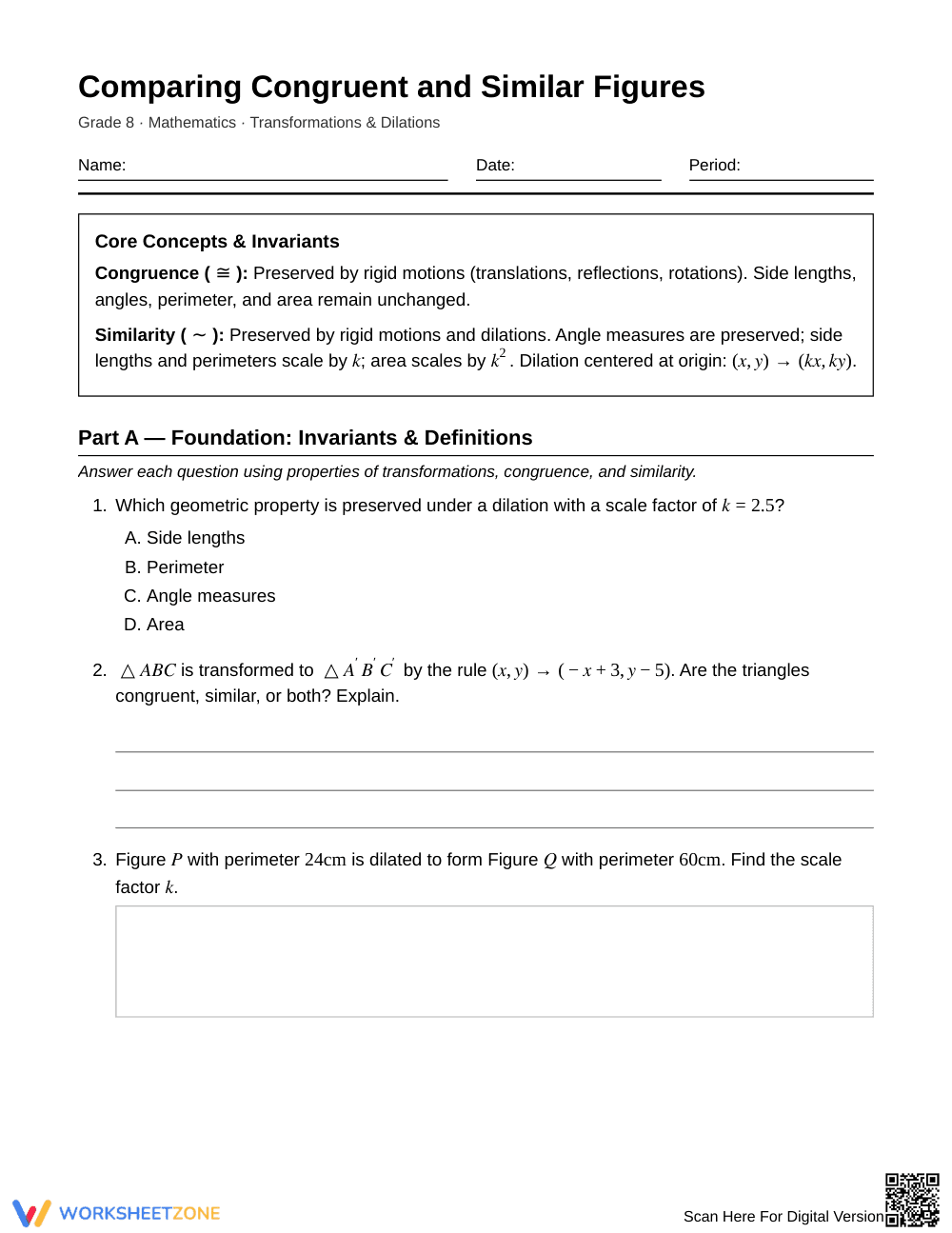
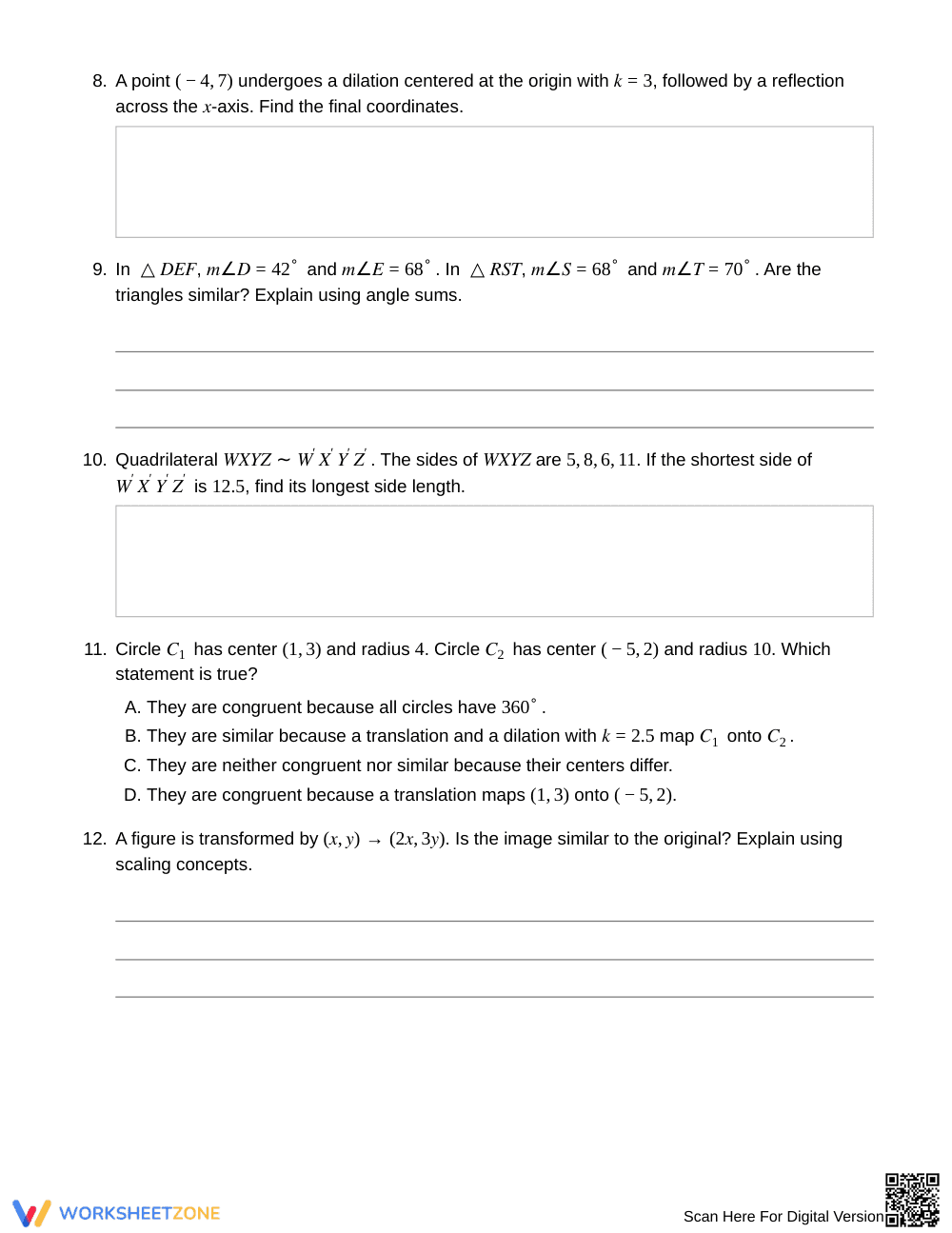
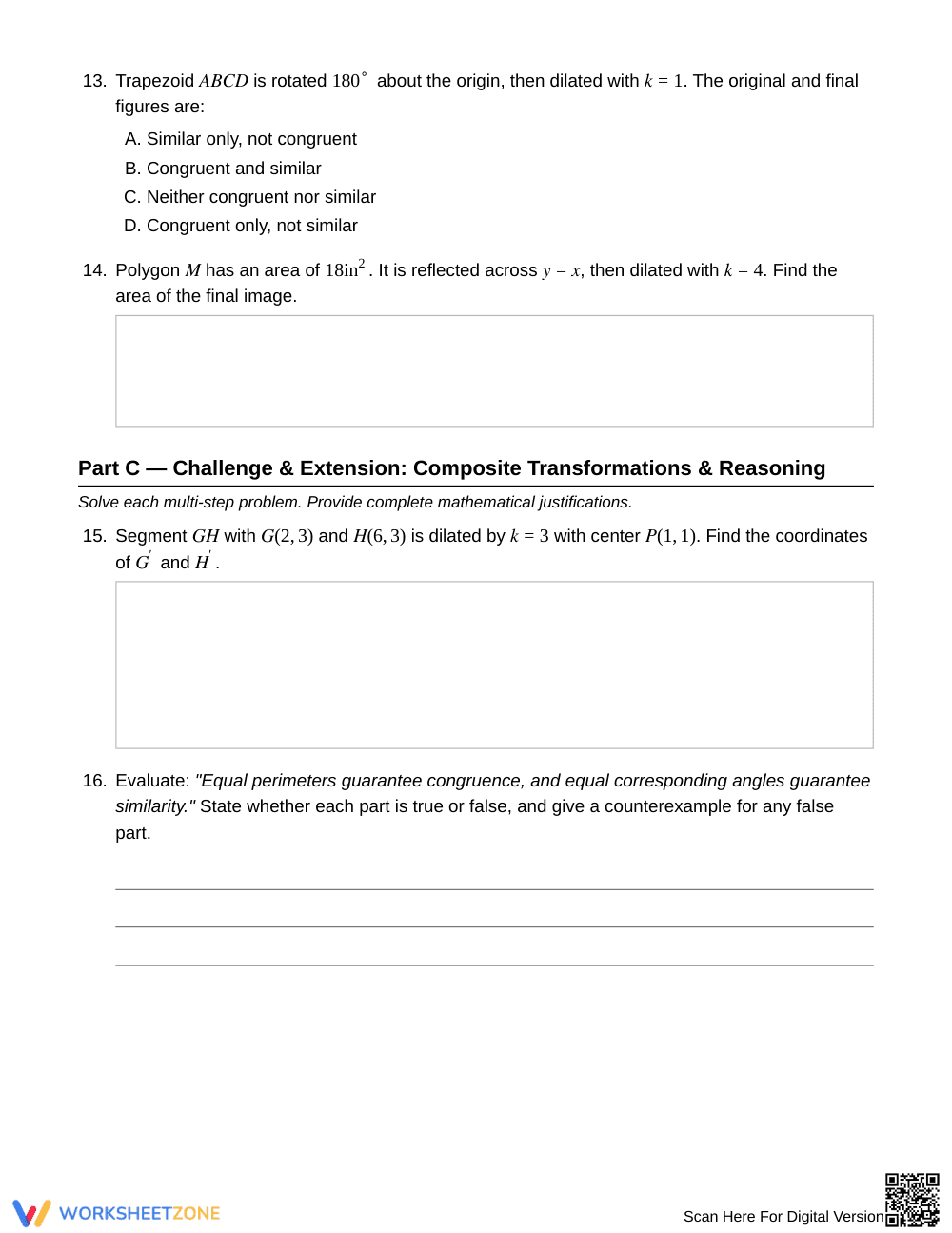
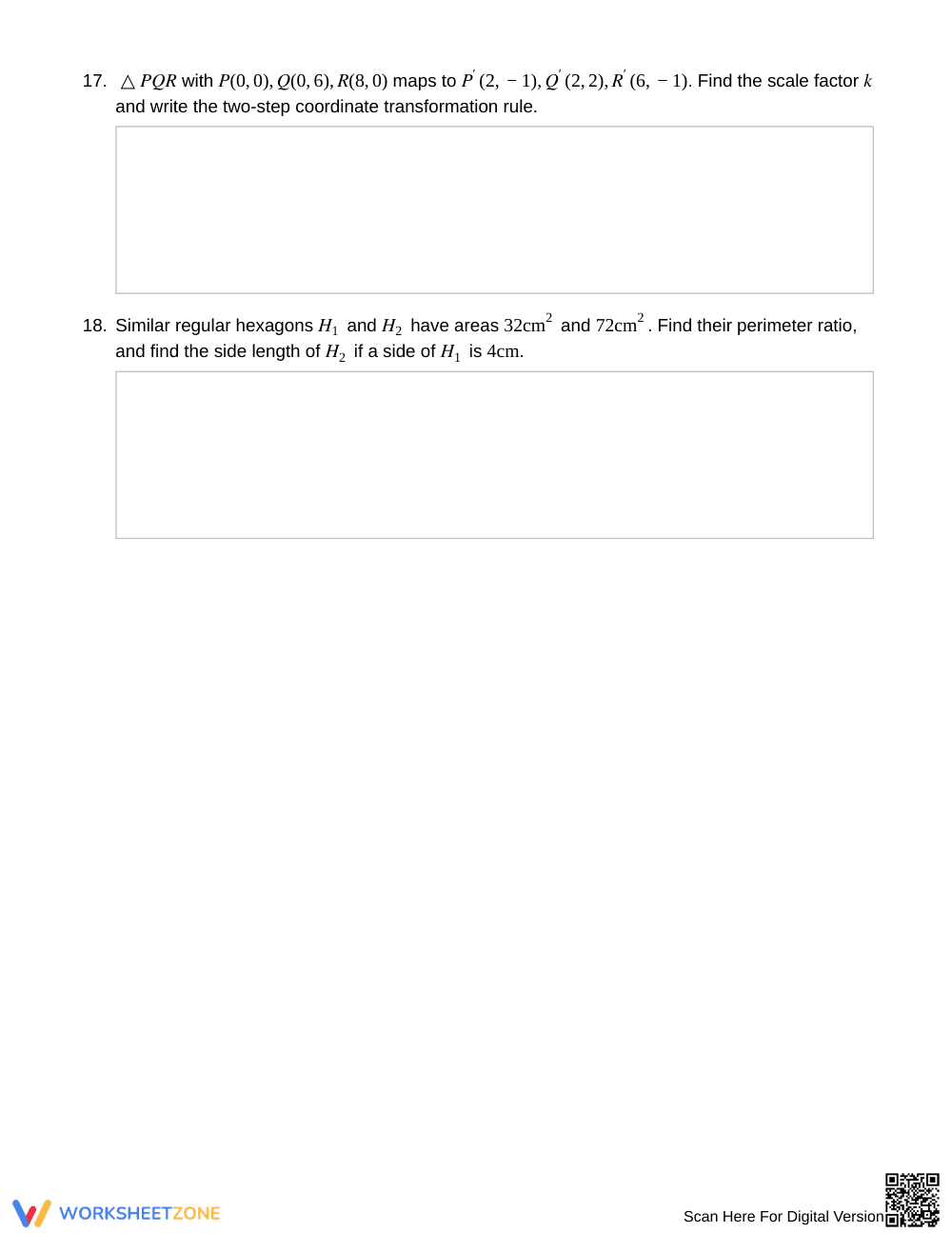
Master geometric transformations by analyzing the fundamental differences between congruence and similarity. This comprehensive 18-problem worksheet guides eighth-grade math students through identifying preserved geometric properties, calculating scale factors, and writing two-step coordinate transformation rules. Students build conceptual fluency while connecting algebraic mapping notations directly to visual geometric figures.
At a Glance
- Grade: 8 · Subject: Math
- Standard: Connect congruence and similarity using rigid motions and coordinate dilations
- Skill Focus: Compare Similar and Congruent Images
- Format: 5 pages · 18 problems · Full answer key included · Printable PDF
- Best For: Geometry transformations unit practice and review
- Time: 45–60 minutes of instructional time
This 5-page instructional resource contains 18 rigorous math exercises divided into three intentional phases, supplemented by a 2-page detailed answer key. Students engage with multiple-choice invariant checks, coordinate transformation tables, graph-based sequence mapping, and composite geometric proofs involving area and perimeter ratios.
Skill Progression
- Guided practice (Problems 1–4): Focuses on establishing baseline vocabulary and invariant properties across rigid motions versus dilations with high visual support and structured classification tables.
- Supported practice (Problems 5–14): Requires students to compute coordinate rules, verify triangle similarity through angle sums, and evaluate area scaling factors with intermediate guidance.
- Independent practice (Problems 15–18): Challenges learners with non-origin dilation centers, perimeter ratios of similar polygons, and multi-step geometric justification.
This structured progression leverages an "I Do, We Do, You Do" framework to transition students smoothly from foundational invariant recognition to advanced coordinate proof.
Standards Alignment
This resource aligns with grade-level middle school geometry expectations for understanding congruence and similarity through transformations. Students demonstrate that two-dimensional figures are congruent if a sequence of rigid motions maps one onto another, and similar when dilations are included. This content can be copied directly into lesson plans, IEP goals, or district curriculum mapping tools.
How to Use It
Use this worksheet during Tier 1 direct instruction or as targeted partner practice following a lesson on non-rigid transformations. For formative assessment, observe whether students correctly square the scale factor when computing transformed areas in Part B, which quickly identifies conceptual gaps between linear and two-dimensional scaling. Expect students to complete the 18 problems in 45 to 60 minutes.
Who It's For
Designed for Grade 8 mathematics classrooms, this resource supports general education learners, honors students requiring extension proofs, and Tier 2 intervention groups reviewing transformation properties. Pair this activity with coordinate grid whiteboards or an anchor chart summarizing rigid motion invariants versus dilation rules.
According to research from Fisher & Frey (2014) on the gradual release of responsibility model, structured scaffolding from foundational invariant checks to autonomous multi-step problem solving significantly enhances procedural accuracy and long-term conceptual retention in middle school mathematics. When eighth-grade students compare similar and congruent images, they must clearly distinguish between angle-preserving rigid motions and side-scaling dilations. Transitioning students across guided definition tables, coordinate calculations, and composite transformation proofs ensures deeper geometric comprehension. By systematically analyzing how coordinates, perimeters, and two-dimensional areas scale across transformations, learners build the abstract spatial reasoning necessary for high school coordinate geometry. This 18-task progression equips educators with targeted formative assessment data to address common student misconceptions, such as confusing linear perimeter ratios with quadratic area scaling factors, ensuring that all learners attain demonstrable mastery in geometric similarity and congruence.


