


























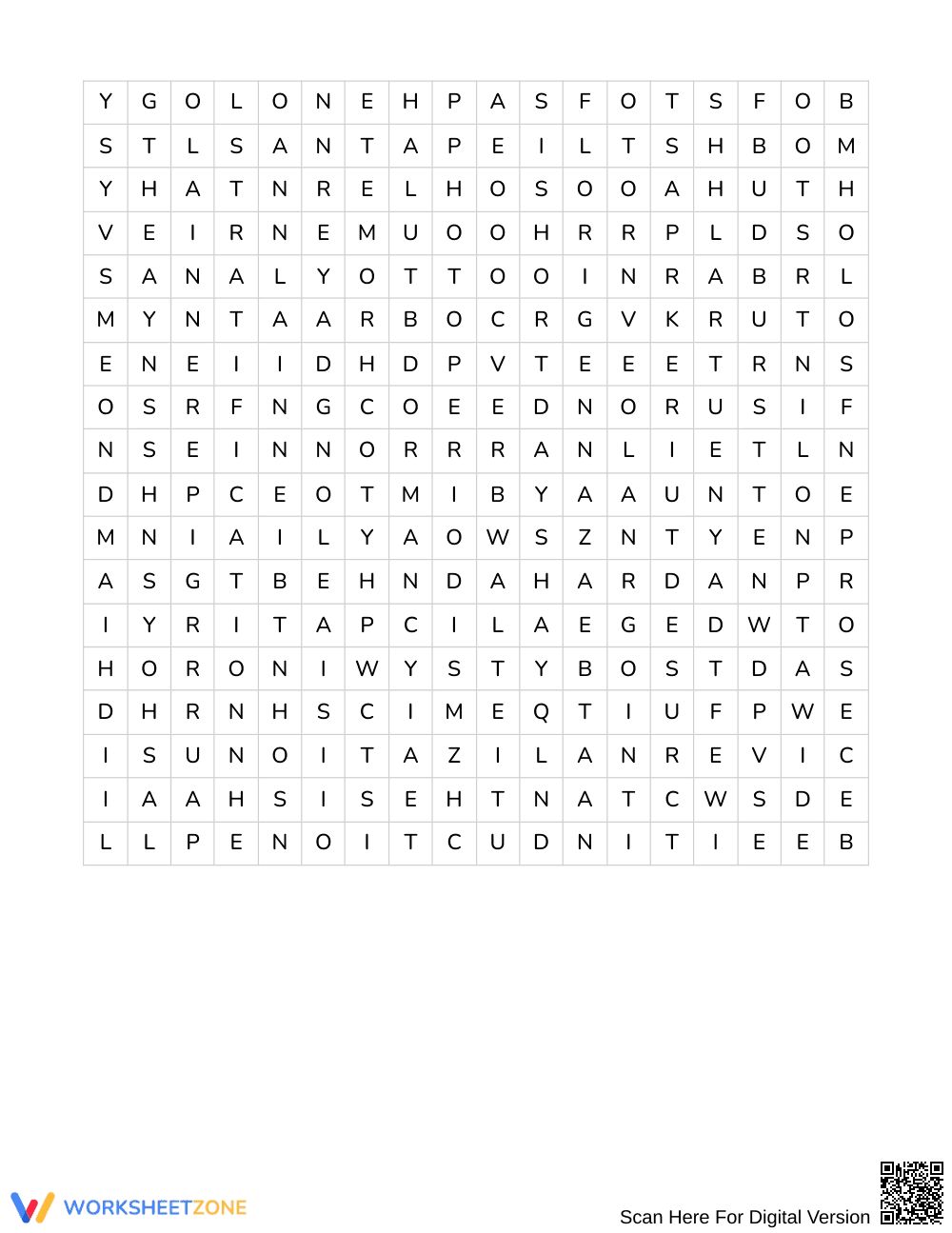

Ready Seasonal Flowering Word Search | Grades 6–7 Science
Paste this activity's link or code into your existing LMS (Google Classroom, Canvas, Teams, Schoology, Moodle, etc.).
Students can open and work on the activity right away, with no student login required.
You'll still be able to track student progress and results from your teacher account.
This seasonal flowering patterns word search reinforces botanical science vocabulary for Grades 6–7 learners through active retrieval. Students define 16 critical plant development concepts using rigorous descriptive clues before locating each hidden term. The no-word-bank format requires students to engage directly with botanical definitions, strengthening scientific terminology retention and conceptual comprehension.
At a Glance
- Grade: Grades 6–7 · Subject: Science
- Standard: Not standards-assessed — vocabulary enrichment
- Skill Focus: Seasonal flowering patterns and biological plant reproduction
- Format: 3 student pages · 16 words · Complete 4-page answer key included · Printable PDF
- Best For: Targeted vocabulary reinforcement and science lab stations
- Time: 25–40 minutes of total completion time
What's Inside
This 3-page science resource features an advanced puzzle covering 16 words related to plant growth cycles. Rather than supplying a standard word bank, the activity presents 16 detailed biological clues defining terms such as photoperiodism, vernalization, and florigen. Students read each definition to identify the term before searching the grid. A complete 4-page answer key provides full letter coordinates for quick checking.
Puzzle Mechanics and Structure
This botanical word search features specific structural parameters:
- Grid Size: An 18 x 18 letter grid containing 324 letters.
- Word Directions: Terms are hidden in all 8 directions: north, northeast, east, southeast, south, southwest, west, and northwest.
- Clue Format: With no word bank provided, students read 16 scientific clues to deduce the terms before locating them.
Standards Alignment
This activity provides targeted vocabulary enrichment and is not aligned to a formal state or national content standard. It is specifically designed to build academic vocabulary and reinforce botanical concepts through clear, contextual definitions.
How to Use It
Use this word search following direct instruction on plant reproduction. First, assign it as a collaborative review where student pairs interpret the clues together before scanning the grid. Second, use it as an independent station activity. During work time, observe whether students identify concepts like photoperiodism from definitions or require textbook reference. Expected completion time is 25 to 40 minutes.
Who It's For
This puzzle is designed for Grades 6–7 life science students mastering botanical vocabulary. Provide an illustrated textbook glossary for learners needing reading support, while allowing advanced students to complete the challenge independently. This activity pairs effectively with a hands-on flower dissection lab or a guided reading passage on plant growth cycles.
This Grades 6–7 science word search provides targeted vocabulary enrichment focused on seasonal flowering patterns and plant reproductive physiology without formal standards alignment. Rather than passive scanning, the activity requires students to retrieve 16 advanced botanical terms—including photoperiodism, vernalization, and florigen—by analyzing rigorous functional clues. Educational research by Fisher & Frey (2014) demonstrates that intentional domain-specific vocabulary acquisition is foundational to disciplinary literacy and scientific conceptual understanding. By withholding a traditional word bank and setting terms across an 18 x 18 grid in eight compass orientations, this resource transforms basic word searches into an active cognitive retrieval exercise. Students consolidate academic language, reinforce physiological definitions, and build deep scientific literacy. The included 4-page answer key provides complete grid coordinate verification, making this 3-page instructional resource an efficient, evidence-informed tool for middle school life science classrooms.


