































Ready Scientific Method Word Search | Grades 7–8 Science

Paste this activity's link or code into your existing LMS (Google Classroom, Canvas, Teams, Schoology, Moodle, etc.).
Students can open and work on the activity right away, with no student login required.
You'll still be able to track student progress and results from your teacher account.
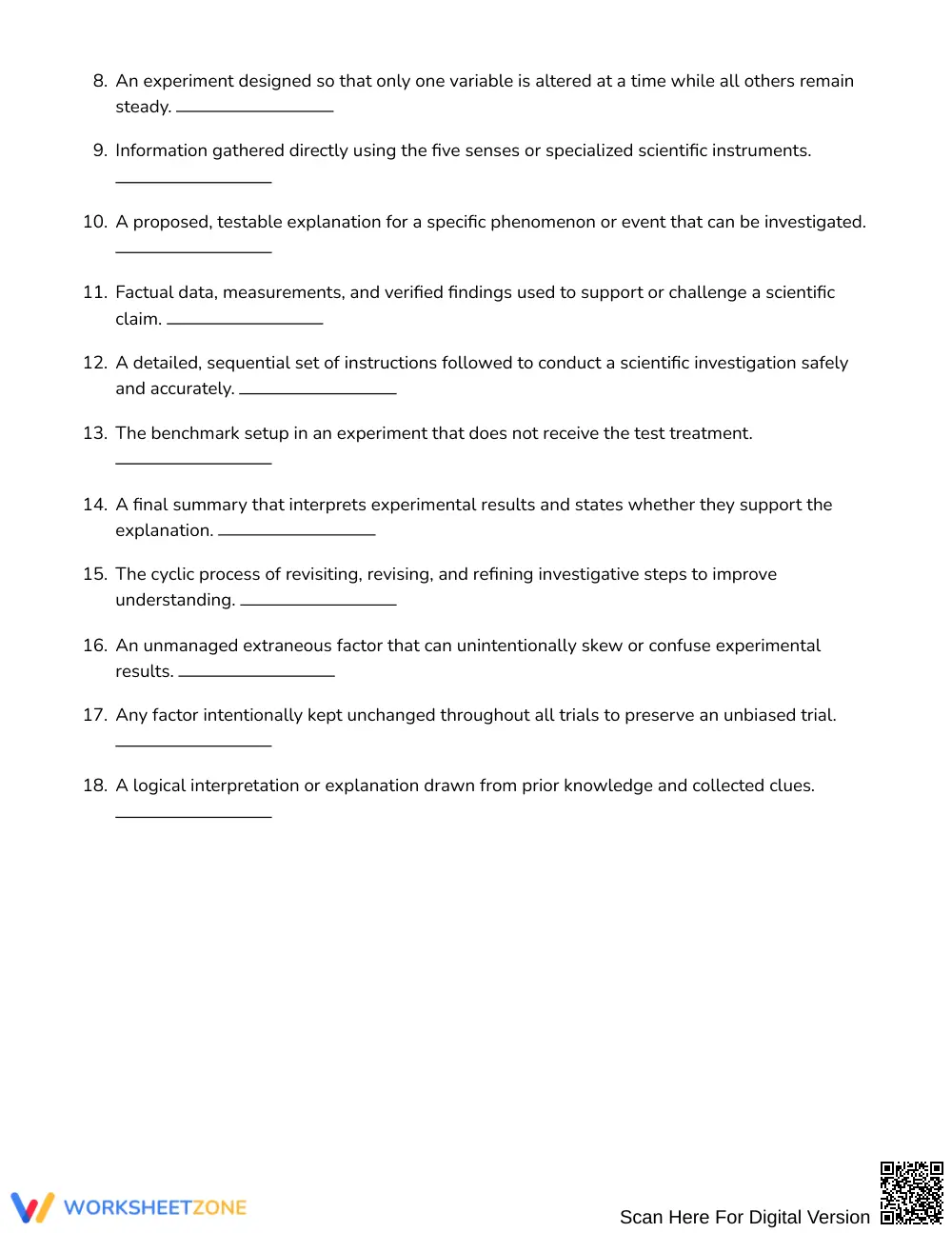
Reinforce essential scientific investigation vocabulary with this targeted word search designed for middle school science classes. Students read definition-based clues to identify 18 core inquiry terms before locating them within the letter grid. This activity strengthens academic language retention, consolidates cumulative inquiry concepts, and supports precise conceptual understanding across multiple scientific disciplines.
At a Glance
- Grade: Grades 7–8 · Subject: Science
- Standard: Not standards-assessed — vocabulary enrichment
- Skill Focus: Scientific investigation practices review
- Format: 3 pages · 18 words · Answer key included · PDF
- Best For: Cumulative review and vocabulary reinforcement
- Time: 20–30 minutes
What's Inside
This 3-page printable resource delivers a comprehensive vocabulary challenge built around experimental design. It includes a 20-by-20 puzzle grid containing 18 hidden vocabulary words, accompanied by an aligned list of technical clues. A shuffled word bank prompts students to connect formal scientific definitions with target vocabulary like confounding variables, qualitative data, and replication. A dedicated answer key clearly highlights all word placements across the grid for rapid verification.
Puzzle Structure & Mechanics
The activity challenges learners through deliberate structural parameters rather than a basic word search layout:
- Grid Dimensions: Words are arranged across a dense 20-by-20 letter grid, offering sufficient search complexity for Grades 7–8 learners.
- Search Orientations: Target vocabulary runs in eight directions: north, northeast, east, southeast, south, southwest, west, and northwest, including reverse and diagonal placements.
- Clue-First Decodability: Students read thorough content definitions to recall key concepts before confirming spelling in the shuffled word bank and scanning the letter array.
Standards Alignment
This resource serves as supplemental vocabulary enrichment and is not aligned to a specific state or national content standard. It reinforces foundational scientific literacy by cementing precise terminology used across all empirical laboratory practices and middle school inquiry units.
How to Use It
Deploy this word search as an engaging post-unit review activity after completing direct instruction on experimental design. Alternatively, use it as a productive starter task before a cumulative laboratory assessment. While students work, circulate to observe whether they use the conceptual clues or rely entirely on the shuffled word bank to identify target terms. Most middle school learners finish the puzzle within 20 to 30 minutes.
Who It's For
This activity is designed for Grades 7–8 science students synthesizing foundational laboratory methodology. For learners needing additional support, teachers can highlight initial letters directly on the grid or review the clue definitions collaboratively. Pair this word search with a hands-on controlled experiment lab report or an anchor chart detailing variables and scientific inquiry steps.
Building a robust technical vocabulary is fundamental to student success in middle school scientific inquiry practices review. According to Fisher & Frey (2014), intentional exposure to academic language through dual-modality tasks—such as pairing operational definitions with orthographic word retrieval—substantially improves domain-specific comprehension and long-term memory consolidation. Rather than memorizing isolated glossary terms, students who actively engage with precise scientific definitions demonstrate greater fluency when explaining experimental variables, recording qualitative and quantitative observations, and formulating evidence-based conclusions. This cumulative word search operationalizes vocabulary acquisition by prompting learners to decode detailed inquiry clues across a challenging 20-by-20 letter matrix. Integrating structured vocabulary reviews prior to summative lab investigations equips seventh and eighth-grade science students with the exact linguistic tools needed to articulate experimental controls, identify confounding factors, and evaluate experimental data accurately during authentic laboratory investigations.


