































Ready Romeo and Juliet Irony Word Search | Grades 8–10 ELA

Paste this activity's link or code into your existing LMS (Google Classroom, Canvas, Teams, Schoology, Moodle, etc.).
Students can open and work on the activity right away, with no student login required.
You'll still be able to track student progress and results from your teacher account.
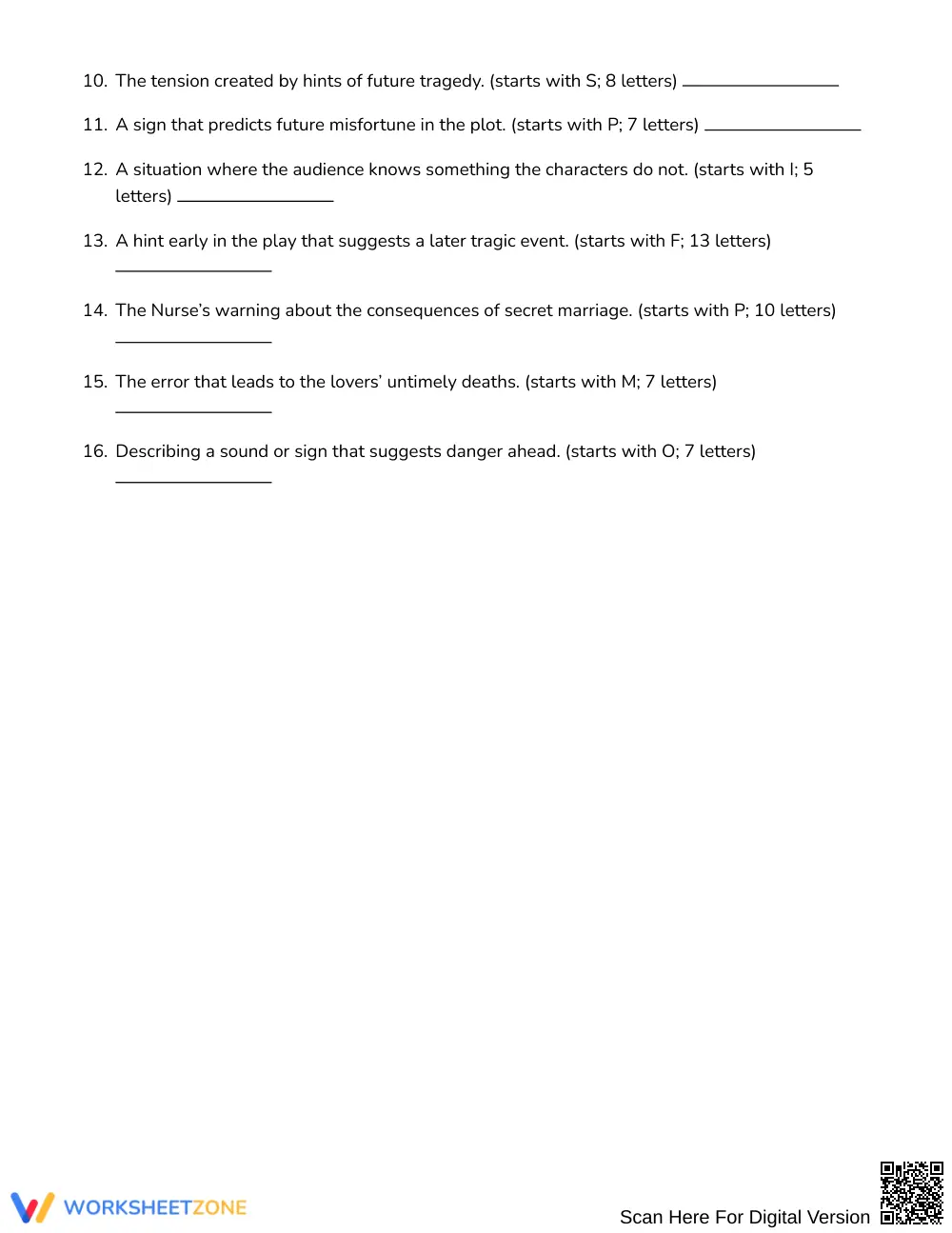
This Grades 8–10 Romeo and Juliet word search builds vocabulary by having students identify dramatic irony and foreshadowing terminology across an 18-by-18 grid. Without a traditional word bank, learners interpret 16 context clues from Shakespeare's tragedy to deduce terms before finding them.
At a Glance
- Grade: Grades 8–10 · Subject: English Language Arts (ELA)
- Standard: Not standards-assessed — vocabulary enrichment and literary term reinforcement
- Skill Focus: Dramatic irony and foreshadowing in Romeo and Juliet
- Format: 3 pages · 16 words · Answer key included · PDF
- Best For: Vocabulary review, introductory preview, or sub plans
- Time: 20–30 minutes
What's Inside
This 3-page printable PDF features an 18-by-18 letter grid with 16 literary clues instead of a word bank. Students read each narrative clue to identify key vocabulary before searching. A 3-page answer key is included for fast checking.
Puzzle Mechanics and Structure
This word search provides an intentional challenge by withholding a word bank. Students solve 16 clues targeting dramatic concepts such as fate, tragedy, suspense, and deceit. All 16 words are hidden in an 18-by-18 grid across 8 directions: North, Northeast, East, Southeast, South, Southwest, West, and Northwest (N, NE, E, SE, S, SW, W, NW). Words run forwards, backwards, and diagonally.
Standards Alignment
This word search is designed for vocabulary enrichment and is not aligned to an assessed standard. Rather than targeting specific testing benchmarks, it enriches ELA study by reinforcing dramatic terminology and thematic concepts in Romeo and Juliet.
How to Use It
Assign this activity after reading Act I or Act III of Romeo and Juliet to reinforce concepts of foreshadowing and irony, or use it as an independent station task. As a formative assessment tip, check if students identify words from the clues before locating them in the puzzle. Expected completion time is 20 to 30 minutes.
Who It's For
This resource is built for Grades 8–10 English Language Arts students studying Romeo and Juliet. For differentiation, provide highlighters or pair students for clue solving. Pair this puzzle with an introductory study of Shakespearean drama or an anchor chart on dramatic irony.
Vocabulary enrichment activities that integrate contextual problem-solving reinforce secondary literary analysis and text retention. According to Fisher & Frey (2014), intentional word exposure linked to conceptual definitions supports domain-specific reading comprehension far more effectively than isolated memorization. By challenging Grades 8–10 learners to interpret 16 analytical clues about dramatic irony, foreshadowing, and tragic structure in Romeo and Juliet, this puzzle requires active cognitive retrieval before word location begins. Students synthesize critical terminology—such as ominous portents, prophetic statements, and tragic misunderstandings—deepening their command of Shakespearean conventions without relying on passive recognition. As students navigate an 18-by-18 grid across 8 directional pathways, they continually re-read definitions and evaluate thematic vocabulary. Integrating clue-driven vocabulary tasks alongside direct textual analysis strengthens secondary students' overall capacity to interpret complex dramatic texts and articulate nuanced literary themes throughout high school English coursework.


