
































Ready Rigid Motion Sequences Worksheet | Grade 10 Geometry

Paste this activity's link or code into your existing LMS (Google Classroom, Canvas, Teams, Schoology, Moodle, etc.).
Students can open and work on the activity right away, with no student login required.
You'll still be able to track student progress and results from your teacher account.
This high school geometry worksheet develops student mastery in composing and analyzing sequences of rigid transformations across 16 rigorous problems. Learners identify orientation changes, evaluate non-commutative transformation compositions, write algebraic mapping rules, and prove geometric congruence. By synthesizing reflections, rotations, and translations, students transition from simple visual movements to formal geometric proof.
At a Glance
- Grade: 10 · Subject: High School Geometry
- Standard:
HSG-CO.A.5— Draw and specify sequences of rigid transformations mapping one figure onto another- Skill Focus: Mix Reflections, Rotations, and Translations as Sequences
- Format: 5 pages · 16 problems · Answer key included · PDF
- Best For: Geometric congruence unit synthesis and assessment preparation
- Time: 45–60 minutes
What's Inside
Across five instructional pages, this resource presents 16 multi-step problems divided into three structured stages, accompanied by a comprehensive three-page worked answer key. Students engage with multiple-choice conceptual checks, coordinate-plane grid problems, algebraic vector notation, and formal justification prompts. A dedicated key principles reference header reviews isometry, function composition notation, and vertex orientation rules to scaffold student reasoning before independent work.
Skill Progression
- Guided practice (Part A, Items 1–4): Students examine orientation changes, test non-commutativity with given coordinate points, write algebraic composite rules, and determine reflection-translation pairings using provided foundational scaffolding.
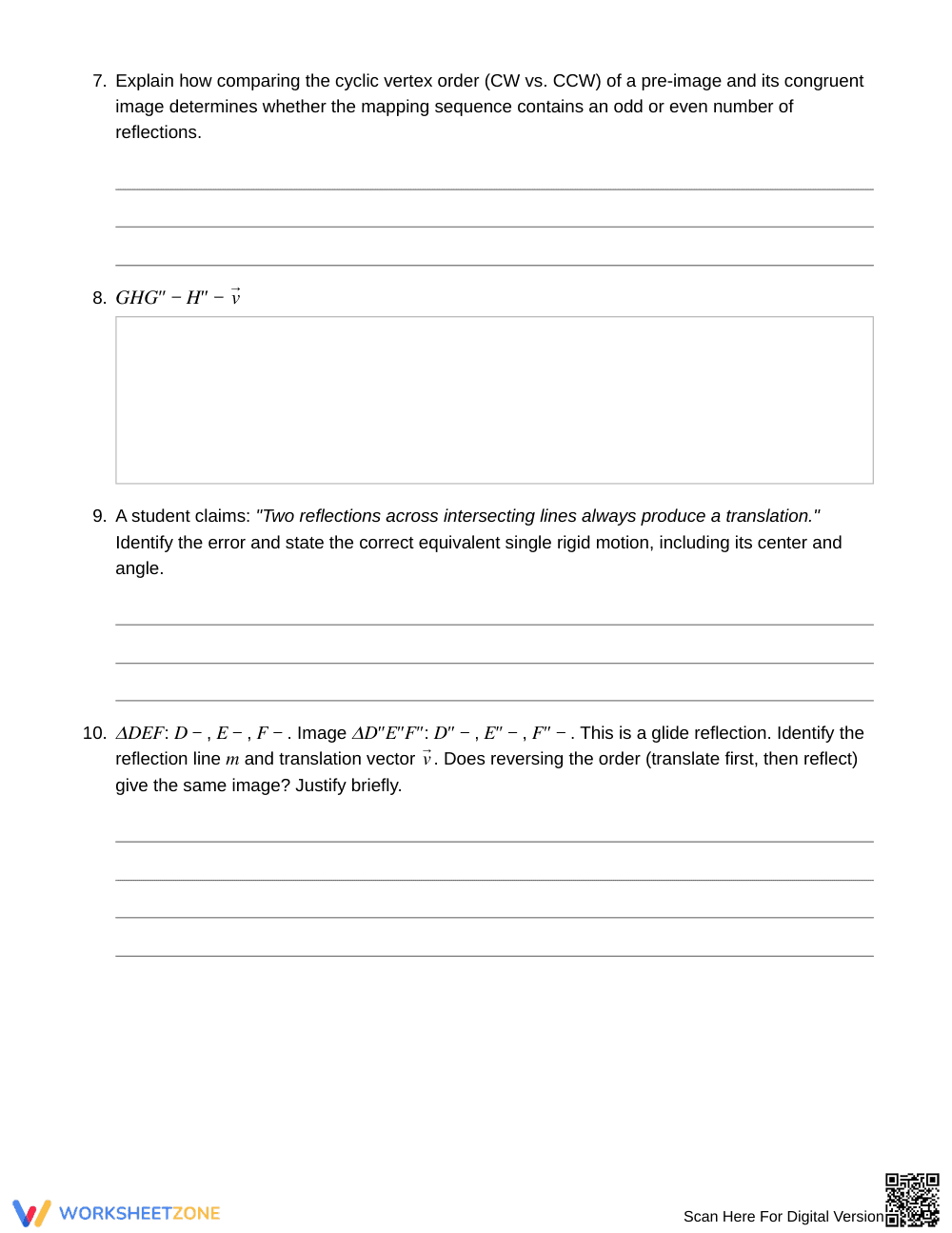
- Supported practice (Part B, Items 5–12): Students specify precise transformation parameters on coordinate grids, analyze glide reflections, adjust translation vectors after reflections, and invert complex transformation chains with moderate prompting.
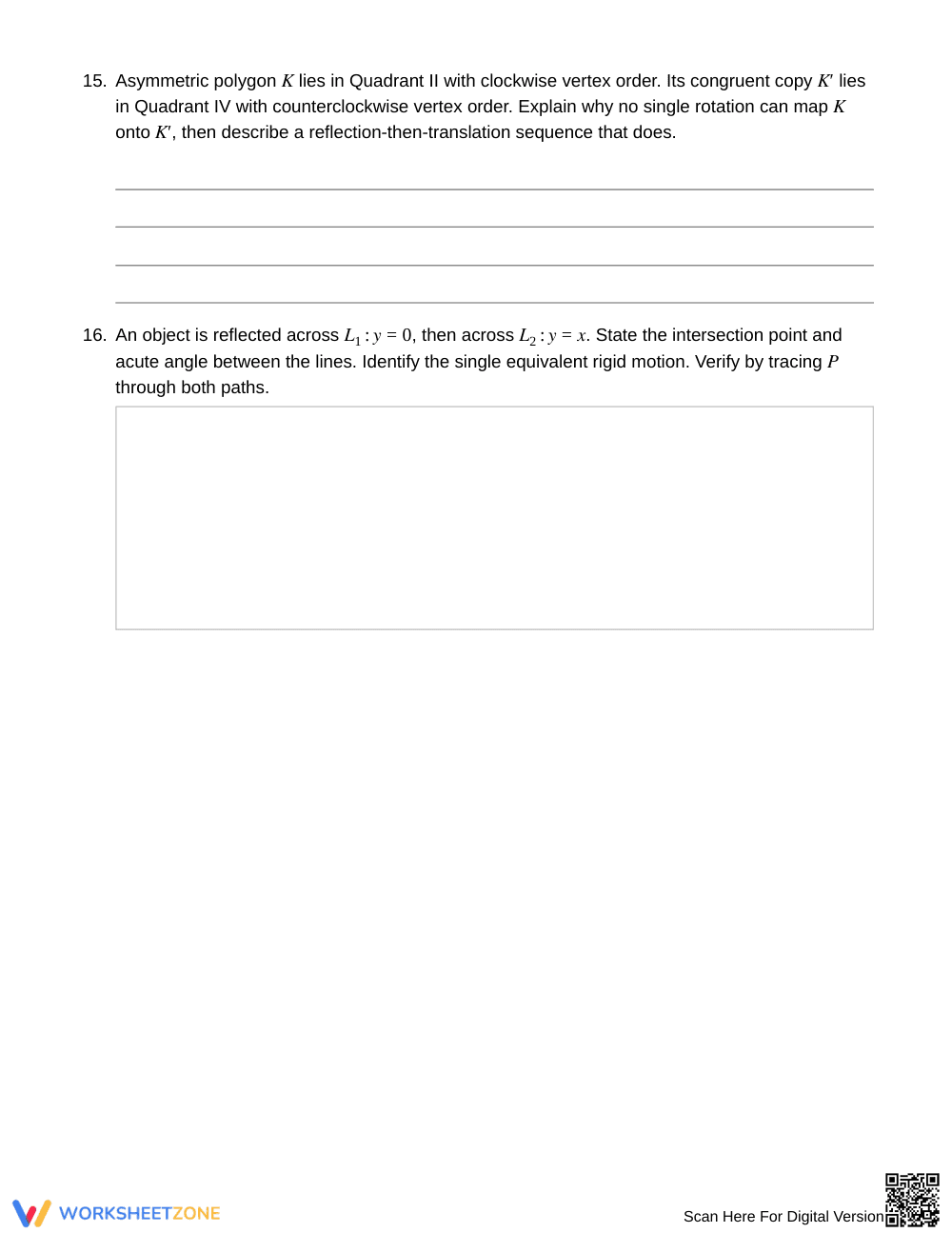
- Independent practice (Part C, Items 13–16): Students complete advanced coordinate tracking, construct coordinate-free triangle congruence proofs, resolve orientation paradoxes across quadrants, and identify single equivalent motions for intersecting reflections without scaffolds.
Standards Alignment
This activity aligns to `HSG-CO.A.5` and supports `HSG-CO.B.6` by using rigid transformations to define and prove congruence. Both standard codes can be copied directly into lesson plans or curriculum mapping tools.
How to Use It
Deploy this worksheet after direct instruction on rigid motions to practice multi-step compositions. It functions effectively as a partner workshop or review before a congruence exam. As a formative assessment tip, observe whether students reverse transformation order during composition notation. Completion takes 45 to 60 minutes.
Who It's For
This resource is designed for Grade 10 Geometry students preparing for proof units. For struggling learners, highlight the "Key Principles" box to clarify vector addition and orientation rules, while offering coordinate grid paper for scratch work.
Rigid motion sequences form the conceptual bridge connecting middle-school visual transformations to rigorous high-school axiomatic geometry. Aligned with HSG-CO.A.5, this worksheet targets specifying and analyzing sequences of rigid transformations, requiring learners to predict orientation preservation, evaluate non-commutative composite operations, and prove geometric congruence through isometry chains. According to Fisher & Frey (2014), structuring mathematical tasks through a gradual-release progression significantly improves conceptual retention and procedural fluency compared to unstructured practice. By moving systematically from foundational coordinate evaluations to method selection and open-ended congruence proofs, the resource enables tenth-grade students to internalize how reflections, rotations, and translations interact dynamically. Teachers utilizing this resource gain reliable diagnostic evidence of whether students merely execute mechanical transformations or truly grasp structural geometric mapping, establishing the necessary analytical groundwork for formal triangle congruence postulates and coordinate geometry theorems in subsequent curricular units.


