































Ready Revising Questions Word Search | Grades 7–8 Science

Paste this activity's link or code into your existing LMS (Google Classroom, Canvas, Teams, Schoology, Moodle, etc.).
Students can open and work on the activity right away, with no student login required.
You'll still be able to track student progress and results from your teacher account.
This science word search helps middle school students reinforce critical terminology for revising questions using evidence. Learners review definitions and locate eighteen essential inquiry terms across a letter grid, solidifying the academic vocabulary necessary to refine experimental hypotheses, evaluate empirical observations, and communicate valid scientific conclusions.
At a Glance
- Grade: Grades 7–8 · Subject: Science
- Standard: Not standards-assessed — vocabulary enrichment
- Skill Focus: Revising questions using evidence
- Format: 3 pages · 18 words · Answer key included · PDF
- Best For: Vocabulary reinforcement and cumulative scientific review
- Time: 20–30 minutes
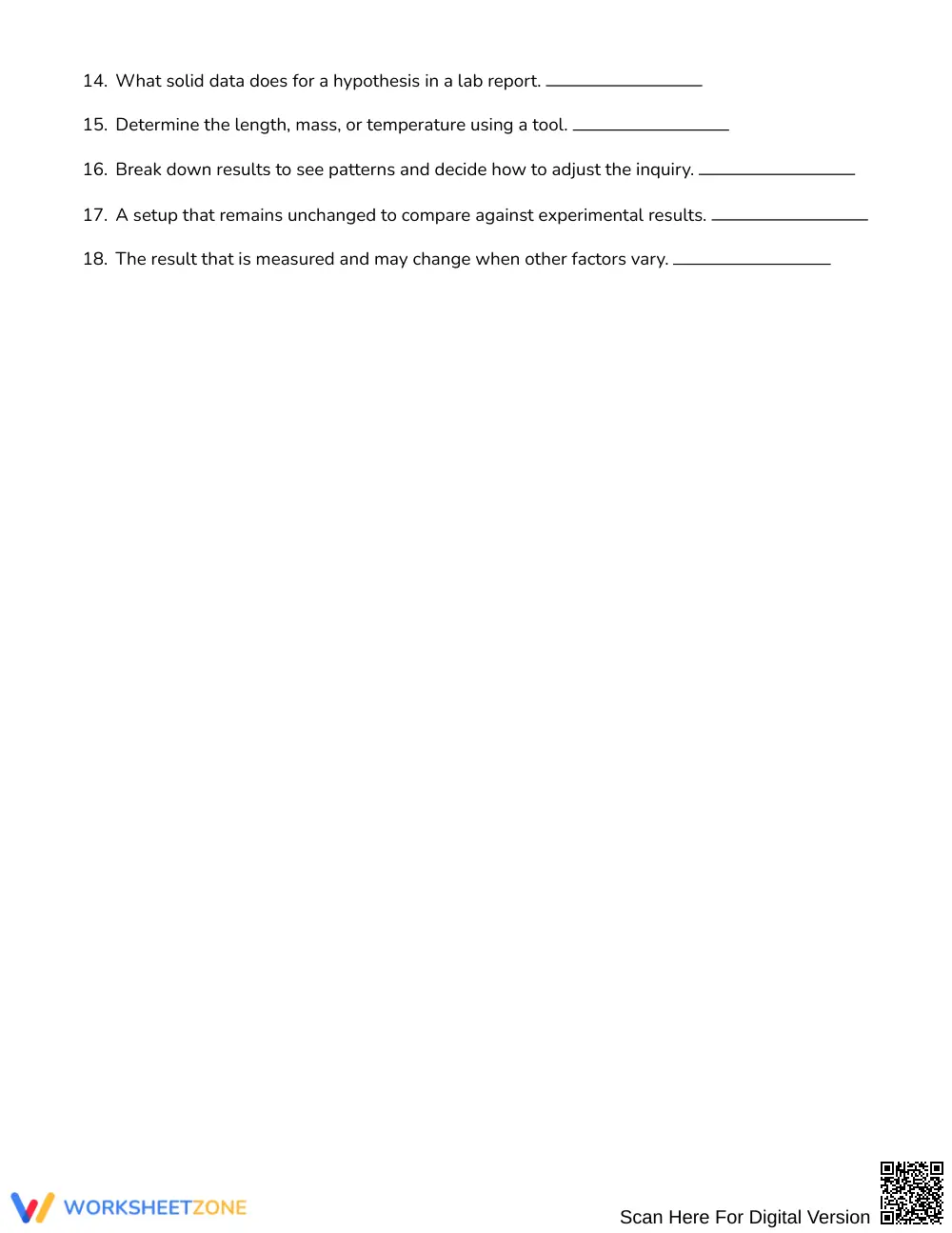
This three-page printable packet features an 18-word search puzzle supported by comprehensive vocabulary clues, paired with a matching three-page answer key showing full letter coordinates. Rather than simple rote searching, each entry provides a functional definition for key inquiry concepts such as variables, controls, calibration, and empirical support, ensuring learners actively process meaning while solving the puzzle.
Puzzle Architecture
The activity centers on a dense 20-by-20 letter grid containing 18 hidden vocabulary terms. Words run in all eight possible directions: north, northeast, east, southeast, south, southwest, west, and northwest. The word bank is presented with shuffled clue definitions, requiring learners to connect conceptual descriptions to target terms before scanning the grid.
Standards Alignment
This activity serves strictly as supplementary vocabulary enrichment and is not aligned to an individual state or national standard. It provides focused practice with scientific discourse terms, supporting broader scientific literacy and lab investigation readiness across general middle school physical, life, and earth science curricula.
Classroom Implementation
Deploy this puzzle immediately after direct instruction on experimental design, or use it as an engaging mid-unit review station. Working individually or in pairs, students read each clue, identify the corresponding term, and search the grid within an estimated 20 to 30 minutes. During the session, circulate to observe which concepts—such as differentiating dependent from independent variables—prompt student hesitation, using those observations to target follow-up lab discussions.
Target Audience and Support
Designed for students in Grades 7–8, this resource is suitable for general education science classes, introductory physical science units, and English language learners needing explicit exposure to academic vocabulary. For students needing additional scaffolding, consider highlighting first letters or providing a pre-labeled word list. Pair this activity naturally with a guided lab investigation or an experimental question revision workshop.
According to research documented in Fisher & Frey (2014), acquiring academic domain vocabulary directly enhances students' ability to engage in complex inquiry practices, such as revising questions using evidence. When middle school learners develop fluency with specialized terminology—including variables, calibration, precision, and empirical support—they demonstrate greater conceptual understanding during hands-on investigations and scientific discourse. Word searches paired with explicit definitional clues prompt active cognitive retrieval, bridging mechanical word identification with functional semantic comprehension. Fisher & Frey emphasize that structured vocabulary reinforcement provides essential linguistic scaffolds, allowing young scientists to articulate observations, adjust testable questions based on experimental data, and synthesize conclusions with precision. By anchoring eighteen foundational scientific terms within an accessible puzzle format, this activity strengthens the academic language required for rigorous middle school science inquiry and long-term disciplinary literacy across diverse classroom settings.


