




























Ready Red-Fruit Growing Word Search | Grades 4–5 Science
Paste this activity's link or code into your existing LMS (Google Classroom, Canvas, Teams, Schoology, Moodle, etc.).
Students can open and work on the activity right away, with no student login required.
You'll still be able to track student progress and results from your teacher account.
This Grades 4–5 science word search reinforces plant growth concepts by challenging students to identify 14 essential red-fruit growing conditions. Through contextual clue-solving and word discovery, learners connect horticultural terms such as trellis, pollinator, and acidic soil to real-world fruit cultivation. The activity solidifies specialized botanical vocabulary while providing engaging, focused science seatwork.
At a Glance
- Grade: Grades 4–5 Upper Elementary · Subject: Science
- Standard: Not standards-assessed — vocabulary enrichment
- Skill Focus: Red-fruit growing conditions and plant growth vocabulary
- Format: 3 pages · 14 words · Full answer key included · Printable PDF
- Best For: Science vocabulary reinforcement and independent practice centers
- Time: 20–30 minutes of focused classroom seatwork
What's Inside
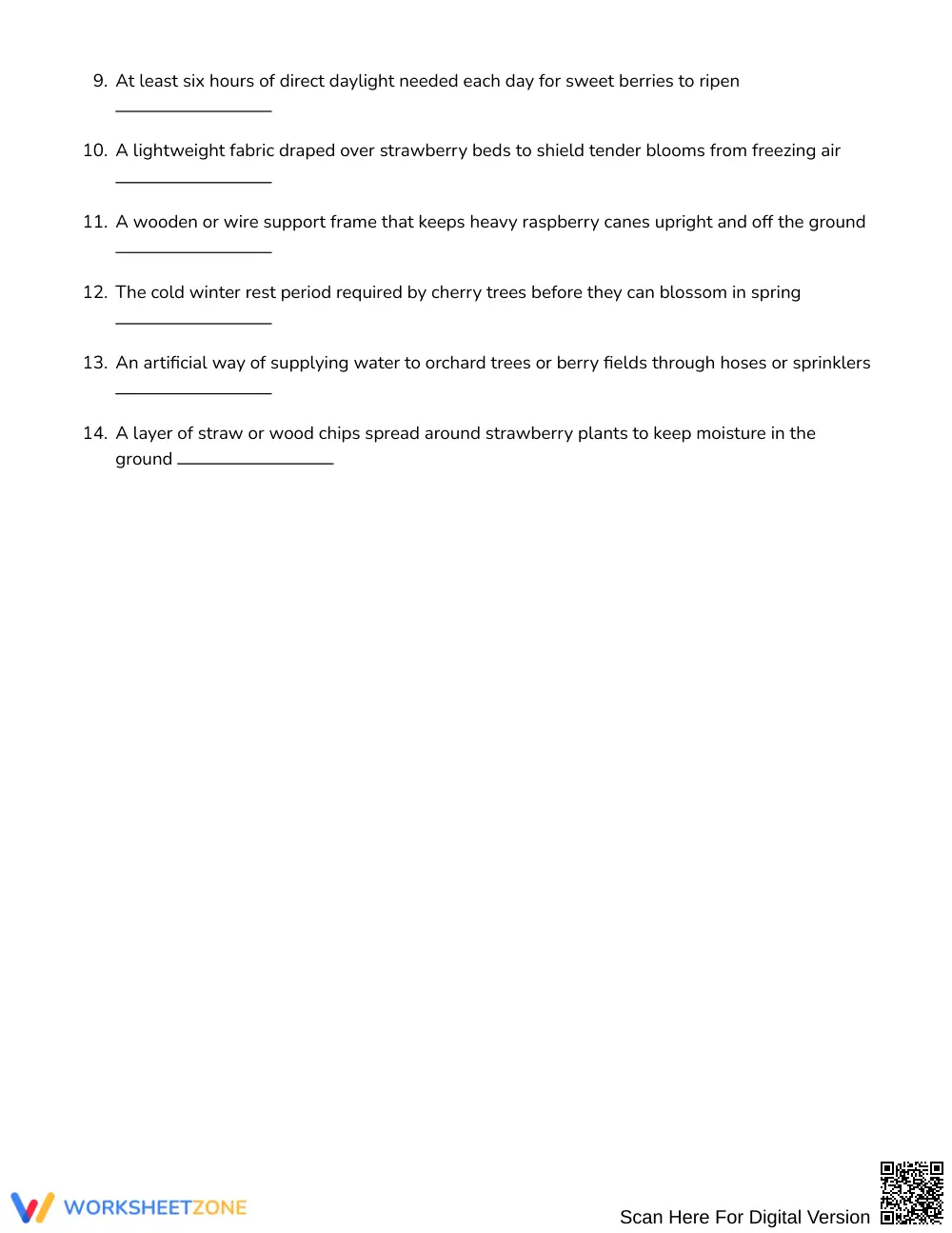
This 3-page printable science resource combines vocabulary building with a clue-driven word search. Students read 14 clues describing environmental needs and horticultural practices for growing berries and orchard fruits. The puzzle presents a 16 x 16 letter grid alongside a shuffled word bank containing terms such as drainage, compost, chill hours, and frost cover. A full 3-page answer key provides letter highlighting so teachers and students can verify word locations instantly.
How the Puzzle Works
Rather than functioning as a standard word find, this activity requires active content retrieval before students search the puzzle grid.
- Clue Detective Retrieval: Students examine 14 science definitions to deduce target vocabulary terms before checking the shuffled word bank.
- Grid Layout: The puzzle features a 16 x 16 letter grid that conceals all 14 horticultural vocabulary terms.
- Search Directions: Words run across four distinct directions: northeast (NE), east (E), southeast (SE), and south (S).
This layout challenges spatial awareness and ensures students spend meaningful time interacting with each term.
Standards Alignment
This activity serves as vocabulary enrichment and is not aligned to a formal state standard. It supports upper-elementary plant growth and ecosystem units by reinforcing domain-specific terms such as rootstock, acidic soil, and irrigation.
How to Use It
Implement this word search directly after whole-class instruction on plant growth requirements or introduce it during science centers. As students work, circulate and observe whether they read the clues to infer concepts or scan randomly; prompt learners to explain why certain fruits need chill hours or bogs. Most students complete the 14-word puzzle within 20 to 30 minutes.
Who It's For
This resource is tailored for students in Grades 4–5 studying botany, gardening, or life sciences. For English language learners and striving readers, pair the activity with visual plant diagrams or allow partner clue-reading. It coordinates effectively with an illustrated plant growth anchor chart or informational text on berry farming.
Building domain-specific vocabulary is essential for elementary science comprehension. According to Fisher & Frey (2014), intentional exposure to academic terminology within meaningful contexts significantly improves conceptual retention and reading proficiency across informational texts. This Grades 4–5 science word search targets 14 specialized terms associated with red-fruit growing conditions, including drainage, acidic soil, pollinators, and rootstock. While designed as non-assessed vocabulary enrichment rather than a standard-aligned assessment, the resource prompts students to read definitions, retrieve botanical principles, and actively locate target terms within a 16 x 16 letter grid. By pairing descriptive clues with orthographic recognition across multiple search directions, the activity reinforces fundamental life science concepts. Teachers can integrate this exercise into plant growth units to solidify academic language, support scientific dialogue, and strengthen content-area literacy through structured, student-centered vocabulary practice during independent classroom work.


