




























Views
Downloads



Ready Radians & Arc Length Worksheet | Grade 12 Precalculus

Paste this activity's link or code into your existing LMS (Google Classroom, Canvas, Teams, Schoology, Moodle, etc.).
Students can open and work on the activity right away, with no student login required.
You'll still be able to track student progress and results from your teacher account.
This Precalculus worksheet strengthens students' understanding of radians, arc length, and circular coordinates through rigorous analytical practice. Students establish radian measure as a dimensionless ratio, compute exact terminal coordinates on the unit circle, and transfer circle definitions to modeling contexts, developing the conceptual grounding required for advanced trigonometric analysis and calculus.
At a Glance
- Grade: 12 · Subject: Precalculus
- Standard:
HSF-TF.A.1— Understand radian measure as subtended arc length on a unit circle- Skill Focus: Radians, Arc Length, and Coordinates
- Format: 5 pages · 16 problems · Answer key included · PDF
- Best For: Advanced unit circle and radian practice
- Time: 45–60 minutes
What's Inside
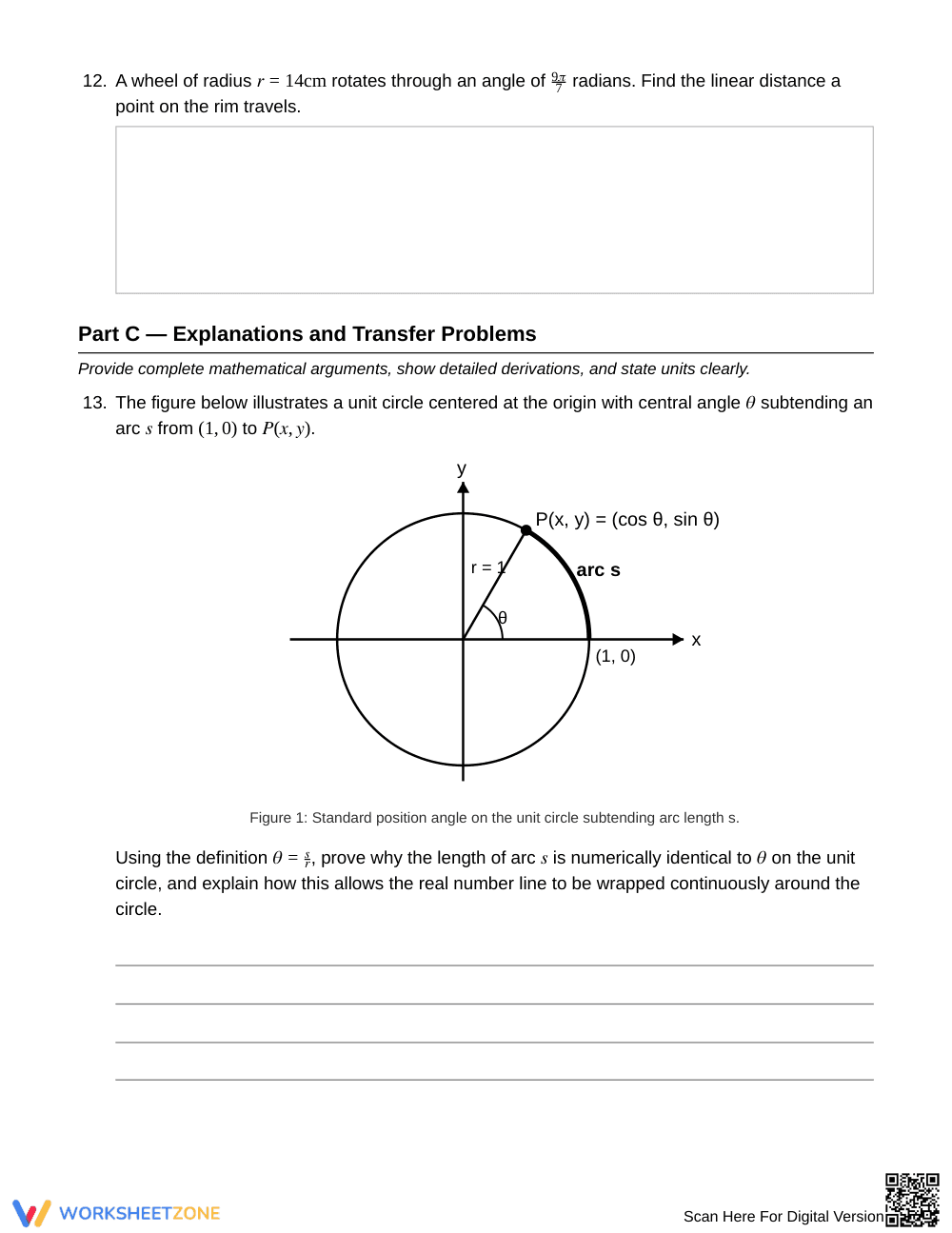
The 5-page student resource delivers 16 targeted tasks supported by a front-page formula reference detailing radian definitions and coordinate relationships. Students navigate conceptual comparisons, exact-value algebraic evaluations, and geometric modeling scenarios accompanied by a labeled unit circle diagram. A comprehensive 4-page answer key provides complete algebraic solutions and geometric proofs for immediate verification.
Skill Progression
- Guided Practice (Part A, Problems 1–4): Conceptual prompts scaffolded by core formulas help learners evaluate why radians are dimensionless and compare arc lengths across varying radii.
- Supported Practice (Part B, Problems 5–12): Computational tasks guide students through angle conversions, arc length formulas, and exact trigonometric coordinates in specific quadrants.
- Independent Practice (Part C, Problems 13–16): Multi-step transfer prompts challenge students to write geometric proofs, model concentric running tracks, and analyze periodic pendulum coordinates.
This structured sequence reflects the gradual-release model, moving learners from conceptual foundations to autonomous mathematical modeling.
Standards Alignment
This resource aligns directly with `HSF-TF.A.1`: Understand radian measure of an angle as the length of the arc on the unit circle subtended by the angle. It also supports `HSF-TF.A.2` by connecting arc length to terminal coordinates (cos θ, sin θ). Both standard codes can be copied directly into lesson plans, IEP goals, or district curriculum mapping tools.
How to Use It
Deploy this worksheet after direct instruction on angle measurement or as an intensive review before introducing analytic trigonometry. During collaborative problem solving, observe whether students write exact radical coordinates or rely on rounded decimals in Part B. Anticipate an instructional completion window of 45 to 60 minutes across one extended period or two class sessions.
Who It's For
Designed for Grade 12 Precalculus students and advanced Algebra II classes, this resource bridges geometric angle concepts and calculus readiness. Provide struggling learners with a laminated unit circle chart, while offering high-achieving students the pendulum derivation as an enrichment task. Pair this printout with a circular motion demonstration.
According to Fisher & Frey (2014), structured instructional progressions that guide high school students from foundational conceptual distinctions to complex application tasks significantly enhance conceptual retention and mathematical fluency. This worksheet addresses standard HSF-TF.A.1 by establishing radian measure as the length of an arc subtended on a unit circle, helping twelfth-grade learners bridge foundational geometry and advanced periodic analysis. By working through sixteen carefully sequenced problems, students define dimensionless ratios, compute exact circular coordinates, and apply arc length principles to real-world concentric velocity and harmonic pendulum systems. Furthermore, Fisher & Frey (2014) demonstrate that integrating scaffolded reference boxes with independent analytic derivations fosters student autonomy and deep conceptual transfer across secondary STEM courses. Educators can utilize this rigorous curriculum tool to prepare students for college-level calculus while systematically targeting verified state standards in classroom settings.


