




























Views
Downloads
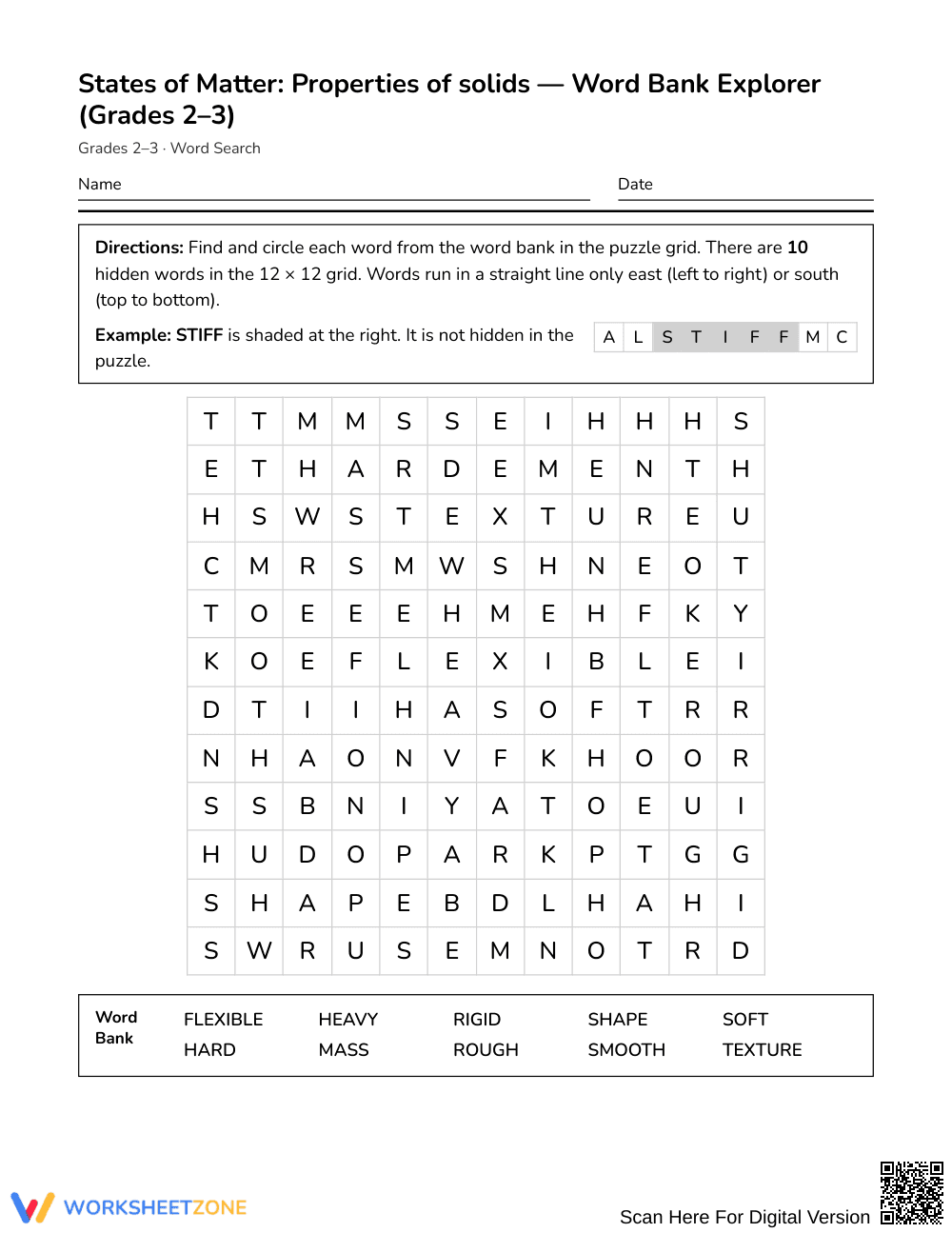

Ready Properties of Solids Word Search | Grades 2–3 Science

Paste this activity's link or code into your existing LMS (Google Classroom, Canvas, Teams, Schoology, Moodle, etc.).
Students can open and work on the activity right away, with no student login required.
You'll still be able to track student progress and results from your teacher account.
This science word search helps Grades 2–3 students identify and master essential vocabulary for describing the physical properties of solids. Learners locate ten foundational terms across a clear puzzle grid, reinforcing key terminology like texture, mass, and rigidity while building domain-specific science reading fluency.
At a Glance
- Grade: Grades 2–3 · Subject: Science
- Standard: Not standards-assessed — vocabulary enrichment
- Skill Focus: Properties of solids
- Format: 1 page · 10 words · Answer key included · PDF
- Best For: Early finishers or science center review
- Time: 15–20 minutes
What's Inside: This printable packet features a 1-page student puzzle containing 10 targeted science terms and a 2-page complete answer key. Each target term is listed in an alphabetical word bank accompanied by an explicit definition, giving students clear semantic context as they search. The clean, distraction-free layout ensures young learners can focus directly on letter pattern recognition without visual clutter.
The activity is built on an accessible 12 × 12 letter grid tailored specifically for early elementary learners. Words run in only two directions: horizontally from left to right (East) and vertically from top to bottom (South). There are no backward or diagonal letter paths, making letter tracking intuitive and manageable. Students reference the alphabetical word bank and accompanying clues to find each vocabulary term, systematically checking off words as they circle them.
This activity provides targeted vocabulary enrichment and is not aligned to a specific state or national science standard. Instead, it supports fundamental physical science units on matter by reinforcing the accurate terminology students need to observe, describe, and categorize solid objects during inquiry-based lessons and classroom investigations.
Use this puzzle directly after introducing properties of matter to reinforce new science definitions, or assign it as an independent station during small-group rotations. To formatively assess understanding, ask students to select two circled words and describe a real solid object in the classroom that exhibits those exact physical traits. Most learners complete the activity in 15 to 20 minutes.
Designed for second and third graders studying physical science, this puzzle supports emerging bilingual learners and developing readers through structured word-bank cues. For students who need extra support, highlight the initial letter of each term before searching. Pair this activity with a hands-on solid object sorting tray or anchor chart illustrating observable physical properties.
Structured vocabulary enrichment strengthens conceptual science understanding by giving young learners multiple exposures to domain-specific terminology. According to Fisher & Frey (2014), intentional word exposure embedded within engaging, structured activities helps primary-grade students internalize technical academic vocabulary needed for informational text comprehension. By isolating target terms such as rigid, texture, and flexible within an uncluttered puzzle grid, this resource supports orthographic mapping and letter sequence recognition. Research synthesized by Fisher & Frey (2014) highlights that pairing accessible orthographic recognition tasks with clear definitions solidifies foundational content knowledge across early elementary learning environments. Consequently, introducing foundational properties of solids through targeted word searches allows second and third grade learners to build confident, automatic recall of essential physical science terminology while developing purposeful scientific literacy habits that carry into hands-on laboratory exploration and descriptive scientific writing.


