




























Views
Downloads



Ready Periodic Thresholds Worksheet | Grade 12 Precalculus

Paste this activity's link or code into your existing LMS (Google Classroom, Canvas, Teams, Schoology, Moodle, etc.).
Students can open and work on the activity right away, with no student login required.
You'll still be able to track student progress and results from your teacher account.
This Grade 12 Precalculus worksheet equips students to model periodic threshold conditions using inverse trigonometric functions and algebraic identity reductions. Students determine boundary times, calculate operational durations, and evaluate real-world threshold constraints across 10 structured problems. Translating periodic equations into actionable intervals solidifies essential sinusoidal modeling skills.
At a Glance
- Grade: 12 · Subject: Precalculus
- Standard:
HSF-TF.B.7— Solve periodic threshold equations and interpret continuous solution intervals in context- Skill Focus: Model a Periodic Threshold Condition
- Format: 4 pages (including solutions) · 10 problems · Full answer key included · PDF
- Best For: Advanced sinusoidal threshold modeling and assessment prep
- Time: 45–60 minutes
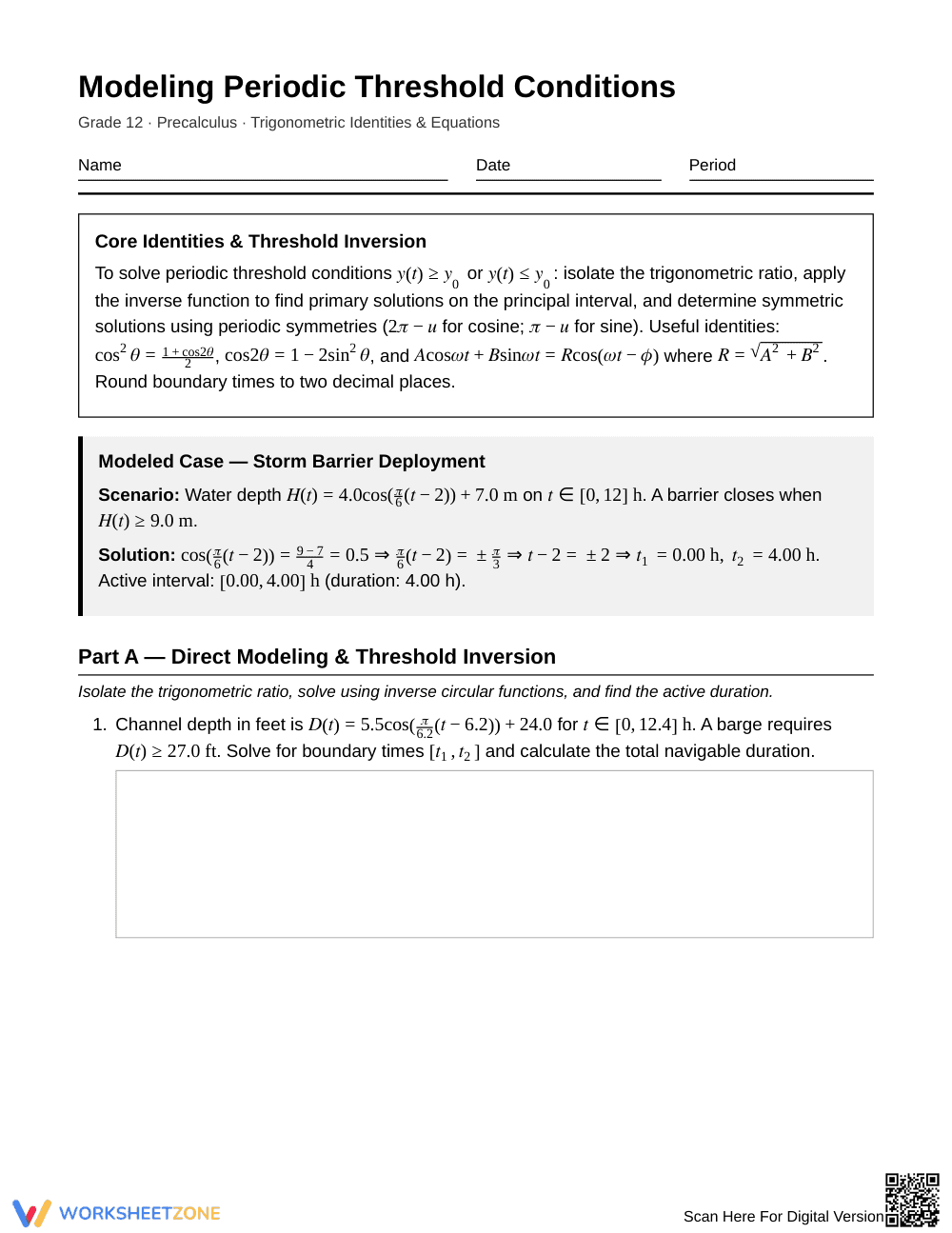
The 4-page printable document opens with a Core Identities reference box and an annotated storm barrier deployment example. Students complete 10 multi-step problems spanning direct circular inversions, identity reductions, and threshold constraints. A complete 2-page answer key provides step-by-step algebraic derivations and interval solutions.
Skill Progression
- Guided Practice (Part A, 2 problems): Direct modeling tasks where students isolate circular trigonometric ratios, invert functions on principal intervals, and calculate active durations.
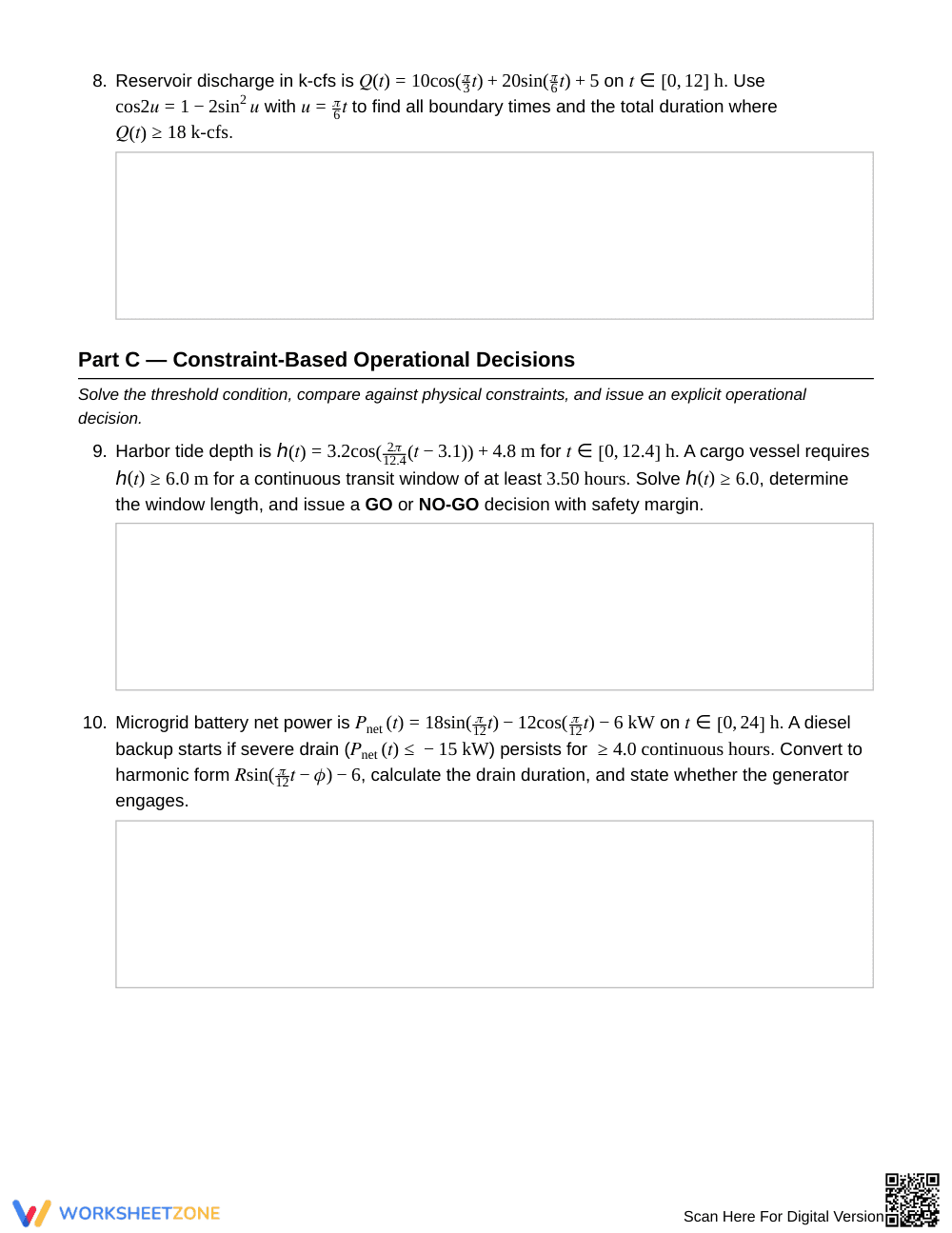
- Supported Practice (Part B, 6 problems): Multi-step modeling items requiring students to apply power-reducing formulas, harmonic combinations, and quadratic factoring before finding threshold intervals.
- Independent Practice (Part C, 2 problems): Operational decision scenarios where learners evaluate threshold intervals against physical constraints to issue GO or NO-GO determinations.
This sequence follows the gradual-release framework (I Do, We Do, You Do), taking learners from guided threshold inversions to autonomous operational analysis.
Standards Alignment
This worksheet aligns directly to HSF-TF.B.7: Solve trigonometric equations that arise in modeling contexts, evaluate solutions using technology, and interpret them contextually. As supporting practice, students apply HSF-TF.C.8 by using trigonometric identities to simplify models before solving. Both standard codes can be copied directly into lesson plans, IEP goals, or district curriculum mapping tools.
How to Use It
Assign this worksheet after direct instruction on inverse trigonometric equations for partner practice or individual assessment. During work time, check Part B to confirm students identify symmetric interval endpoints rather than just principal calculator angles. Expect completion within 45 to 60 minutes.
Who It's For
Designed for Grade 12 Precalculus and Trigonometry students preparing for calculus coursework. Scaffold struggling learners by referencing the storm barrier model; challenge advanced students to write exact radical intervals before approximating. Pair this resource with a summary anchor chart on harmonic linear combinations.
Grounded in the instructional architecture described by Fisher & Frey (2014), this precalculus resource operationalizes standard HSF-TF.B.7 through structured cognitive scaffolding. Students master the plain-English skill of modeling periodic threshold conditions by moving systematically from formulaic inversions to multi-identity reductions and contextual decision-making. Fisher & Frey (2014) demonstrate that intentional gradual-release frameworks significantly increase student independence when tackling complex, multi-step analytical tasks. By coupling explicit worked examples with progressive constraint analysis, the four-page lesson structure bridges the gap between mechanical trigonometric manipulation and authentic STEM problem solving. Learners evaluate sinusoidal boundaries, interpret continuous solution intervals, and verify operational thresholds within rigorous real-world systems such as tidal power generation and electrical circuits. This evidence-based progression ensures that twelfth-grade mathematicians develop enduring algebraic fluency and conceptual understanding necessary for post-secondary calculus, engineering dynamics, and applied mathematical analysis.


