































Ready Percent Composition Worksheet | Grades 9-12 Science

Paste this activity's link or code into your existing LMS (Google Classroom, Canvas, Teams, Schoology, Moodle, etc.).
Students can open and work on the activity right away, with no student login required.
You'll still be able to track student progress and results from your teacher account.
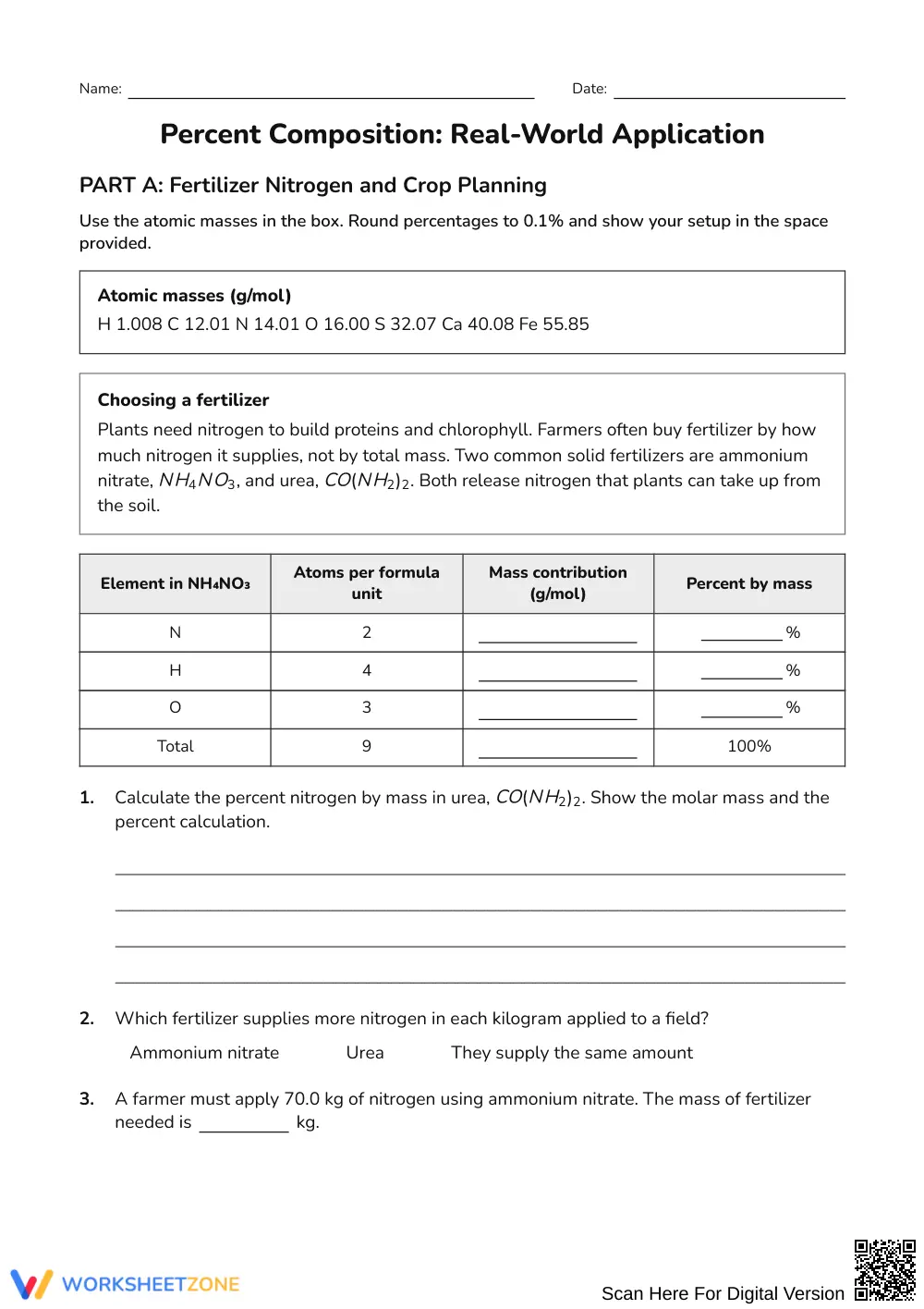
This high school science worksheet connects percent composition calculations directly to authentic chemical and industrial applications. Across 23 structured tasks, students analyze commercial fertilizers, evaluate nutritional supplement labels, interpret iron ore data, and track conservation of mass during fuel combustion to solidify stoichiometric reasoning.
At a Glance
- Grade: Grades 9–12 · Subject: Science
- Standard: High School Chemistry — Calculate percent composition to evaluate real-world chemical formulations and mixtures
- Skill Focus: Real-world application of percent composition
- Format: 4 pages · 23 problems · Answer key included · PDF
- Best For: Quantitative chemistry application and concept review
- Time: 45–60 minutes
What's Inside
This 4-page student worksheet features an atomic mass reference table, structured data tables, a mineral percentage bar graph, and a molecular model diagram. Students complete calculation setups, short-answer evaluations, and multiple-choice conceptual checks. A complete 4-page answer key provides worked-out mathematical steps, complete chemical formulas, and explanatory scoring notes for all 23 items.
Skill Progression
- Guided practice (Part A): Students calculate fertilizer nitrogen percentages using provided molar masses, guided tables, and formula comparisons to evaluate transport efficiency.
- Supported practice (Parts B and C): Learners evaluate supplement labels and interpret iron ore graphs, advancing from simple mass fractions to multi-step ore purity problems.
- Independent practice (Part D): Students analyze molecular models, applying conservation of matter and bond energetics to predict carbon dioxide emissions.
This progression follows an I Do, We Do, You Do model, shifting students from scaffolded reference tables to independent chemical analysis.
Standards Alignment
This resource aligns with high school chemistry standards addressing chemical reactions, conservation of matter, and quantitative formula analysis. Students demonstrate how atomic composition determines macroscopic material properties and environmental outputs. Both standard alignment points and core performance expectations can be copied directly into lesson plans, IEP goals, or district curriculum mapping tools.
How to Use It
Implement this worksheet following direct instruction on molar mass and percent composition. Use Parts A and B as collaborative partner practice, using the supplement question as a formative checkpoint to catch misconceptions between formula mass and elemental mass. Assign Parts C and D for independent practice or homework, with an expected completion time of 45 to 60 minutes.
Who It's For
This worksheet serves general chemistry, honors chemistry, and physical science students requiring applied practice with quantitative formulas. The integrated atomic mass references and structured tables assist emerging problem-solvers, while multi-step ore calculations challenge advanced learners. Pair this activity with a mole-concept laboratory or empirical formula lecture.
Mastering real-world applications of percent composition enables high school chemistry students to bridge micro-level atomic formulas with macro-level chemical quantities. By calculating mass fractions across fertilizers, nutritional supplements, geological ores, and hydrocarbon fuels, learners develop durable quantitative reasoning and conceptual mastery of conservation of mass. According to Fisher & Frey (2014), structured instructional materials that scaffold cognitive load through gradual release allow students to transfer abstract proportional calculations into applied scientific problem-solving with higher retention. This 4-page worksheet guides students across 23 targeted tasks, transitioning from provided molecular masses to complex, multi-step stoichiometric determinations and qualitative justifications. The inclusion of authentic contexts—such as consumer product labeling and industrial transportation efficiency—anchors quantitative chemistry skills in practical phenomena. Consequently, this resource serves as an evidence-based tool for deepening high school chemistry competency and supporting student readiness for advanced laboratory investigations.


