


























Views
Downloads


Ready Parametric & Polar Worksheet | Grade 12 Precalculus
Paste this activity's link or code into your existing LMS (Google Classroom, Canvas, Teams, Schoology, Moodle, etc.).
Students can open and work on the activity right away, with no student login required.
You'll still be able to track student progress and results from your teacher account.
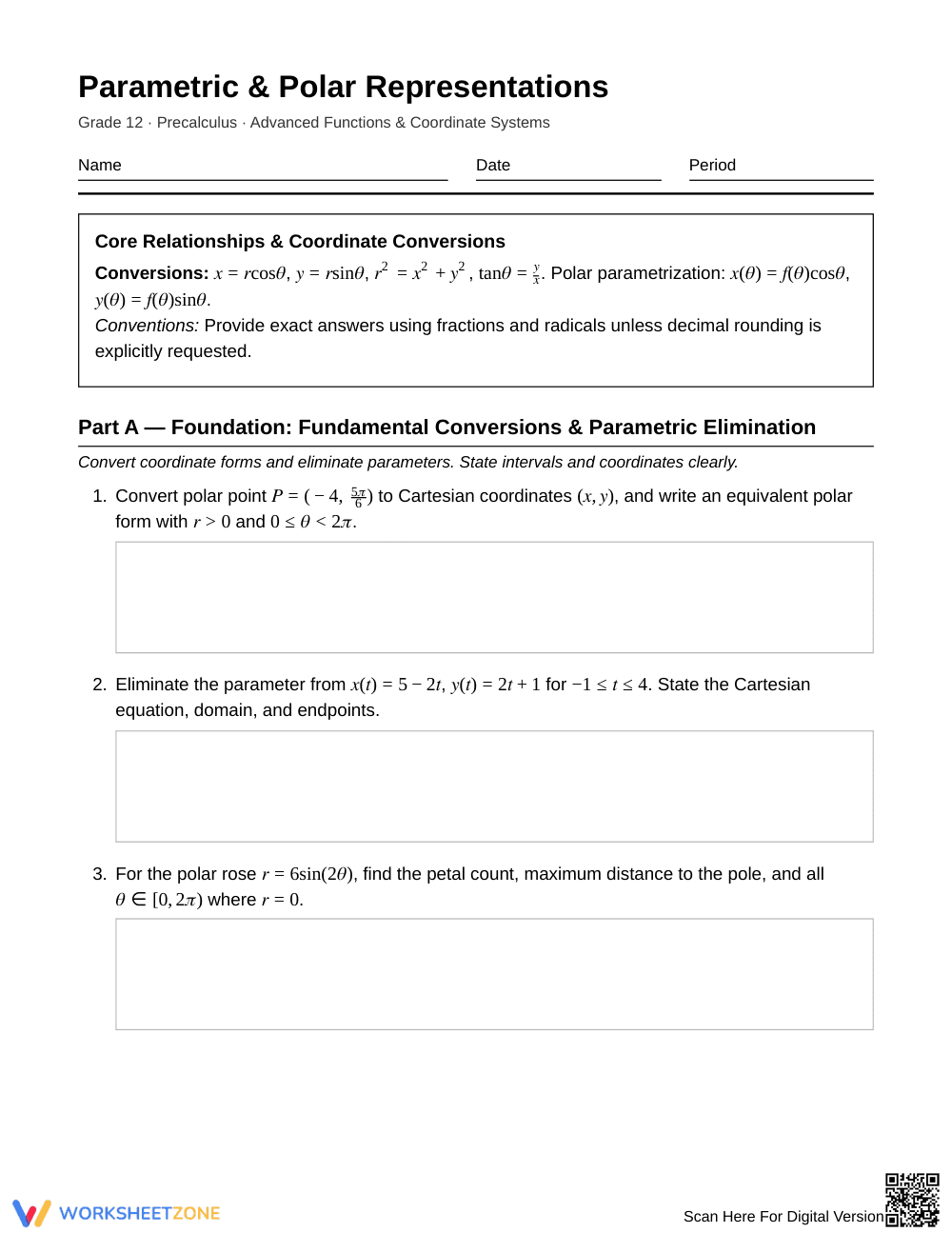
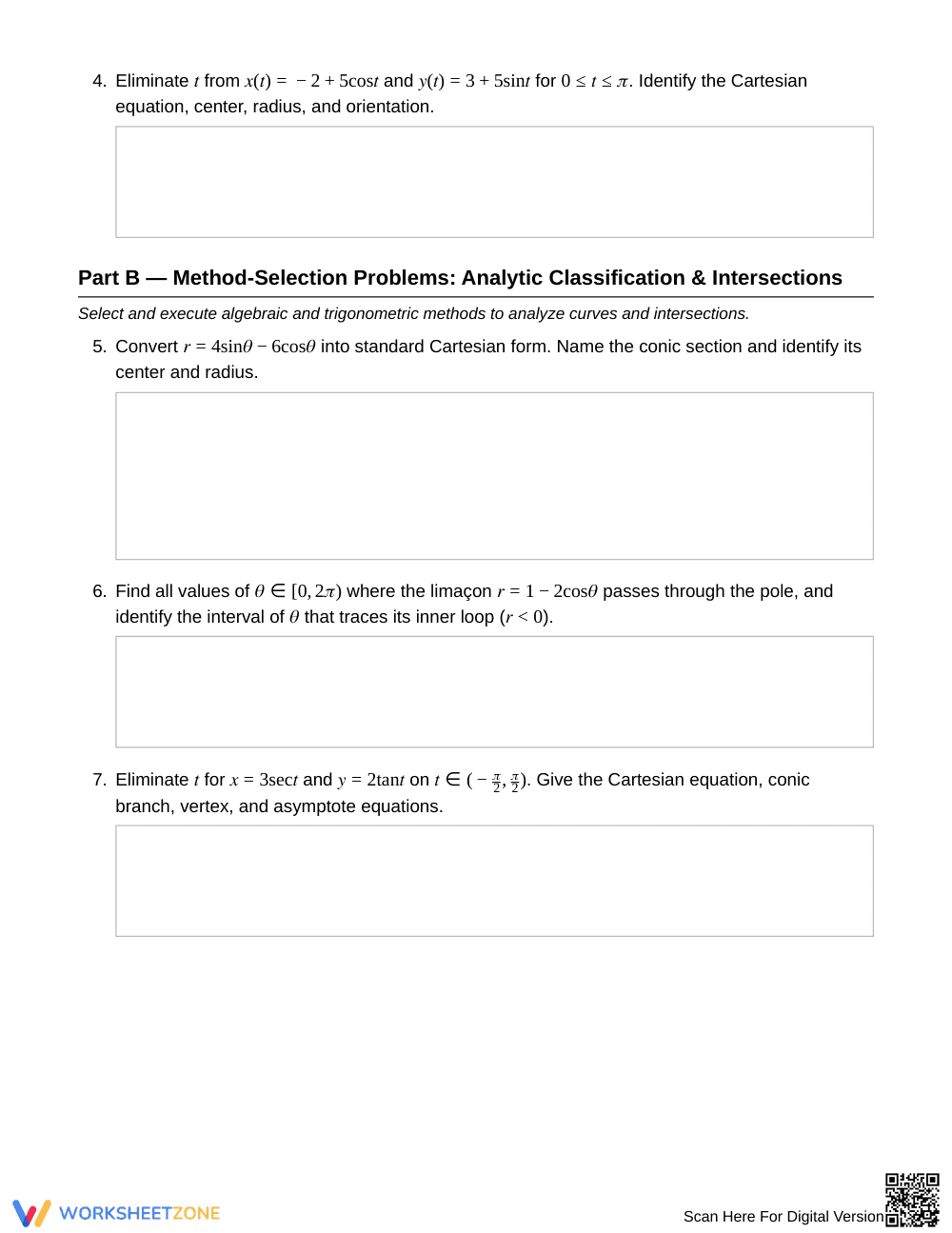
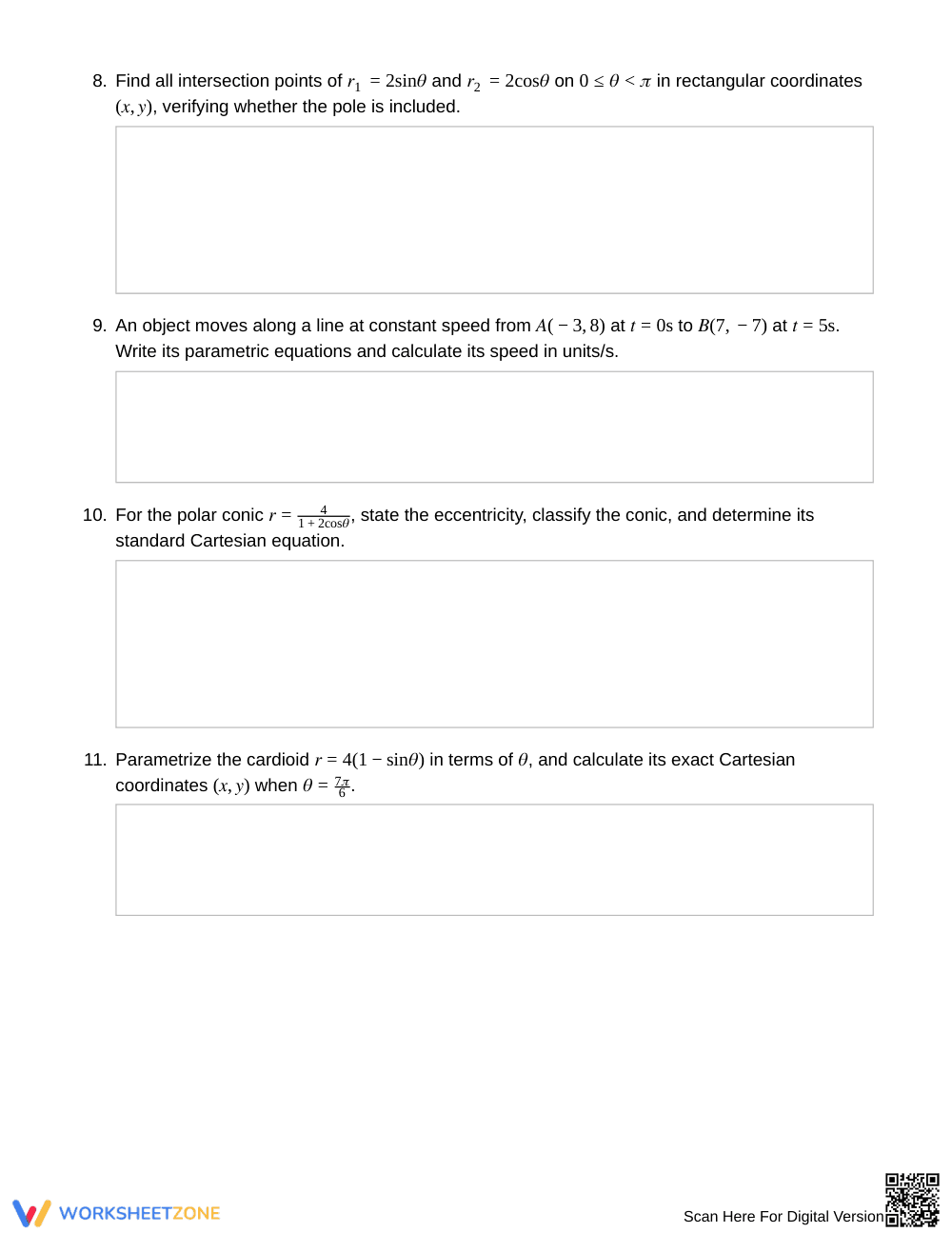
This comprehensive Precalculus worksheet equips Grade 12 students to master parametric and polar representations through coordinate conversions, parameter elimination, and curve classification. High school learners analyze complex non-linear behaviors, translate between algebraic systems, and model real-world trajectory phenomena. Students build the conceptual rigor needed for AP Calculus BC and advanced STEM coursework.
At a Glance
- Grade: 12 · Subject: Precalculus
- Standard: Advanced Mathematics — Analyze polar graphs, convert coordinates, and eliminate parameters in parametric equations
- Skill Focus: Parameter Values and Polar Coordinate Graph Features
- Format: 5 pages · 16 problems · Answer key included · PDF
- Best For: Comprehensive Precalculus review and STEM preparation
- Time: 60–90 instructional minutes
What's Inside
This 5-page activity contains 16 analytical problems across three tiers, paired with a 3-page answer key showing full steps. A reference box supplies conversions and identities. Students work through coordinate conversions, parameter elimination, conic classifications, collision analysis, and physical trajectory models.
Skill Progression
- Guided practice (Part A, 4 problems): Focuses on foundational conversions and parameter elimination with direct reference to the formula box, reinforcing basic substitutions with teacher modeling.
- Supported practice (Part B, 8 problems): Requires method selection to classify conics, locate inner loops and petals, calculate curve intersections, and distinguish collisions from path crossings.
- Independent practice (Part C, 4 problems): Demands autonomous synthesis to model projectile kinematics, acoustic polar gain, radar tracking, and robotic probe motion.
This structure operationalizes gradual release, guiding students from teacher-supported transformations to independent modeling.
Standards Alignment
This resource aligns with Precalculus standards for polar coordinates and parametric representations, requiring students to convert equations between systems, analyze curves, and eliminate parameters. Supporting standards emphasize trigonometric modeling. Both standard codes can be copied directly into lesson plans, IEP goals, or district curriculum mapping tools.
How to Use It
Deploy this 5-page resource after direct instruction for collaborative problem-solving or as pre-exam review. During Part B, formatively check whether students distinguish simultaneous collision from geometric path intersection. Typical completion spans 60 to 90 minutes.
Who It's For
This practice set serves Grade 12 Precalculus students preparing for calculus. Differentiate by assigning Part A and select conics to reinforce fundamentals, reserving Part C motion modeling for advanced learners. Pair directly with graphing calculator curve demonstrations.
According to Fisher & Frey (2014), purposeful instructional scaffolding through guided release accelerates student mastery of complex algebraic structures and analytical representations. This Grade 12 Precalculus worksheet embodies that pedagogical design by developing student competence in parameter elimination and polar coordinate analysis across 16 rigorous mathematical tasks. Rather than presenting disconnected drill exercises, the resource guides learners from fundamental Cartesian conversions to sophisticated multi-step models involving projectile flight, acoustic gain patterns, and robotic arm trajectories. Precalculus curriculum standards prioritize multi-representational fluency, challenging learners to synthesize algebraic, trigonometric, and geometric perspectives when analyzing conics, limaçons, and roses. By deliberately bridging foundational coordinate mechanics with advanced motion modeling, this educational document provides educators with structured instructional evidence that deepens conceptual understanding, supports differentiated remediation, and establishes essential analytical readiness for post-secondary calculus, engineering mathematics, and collegiate physics sequences.


