


























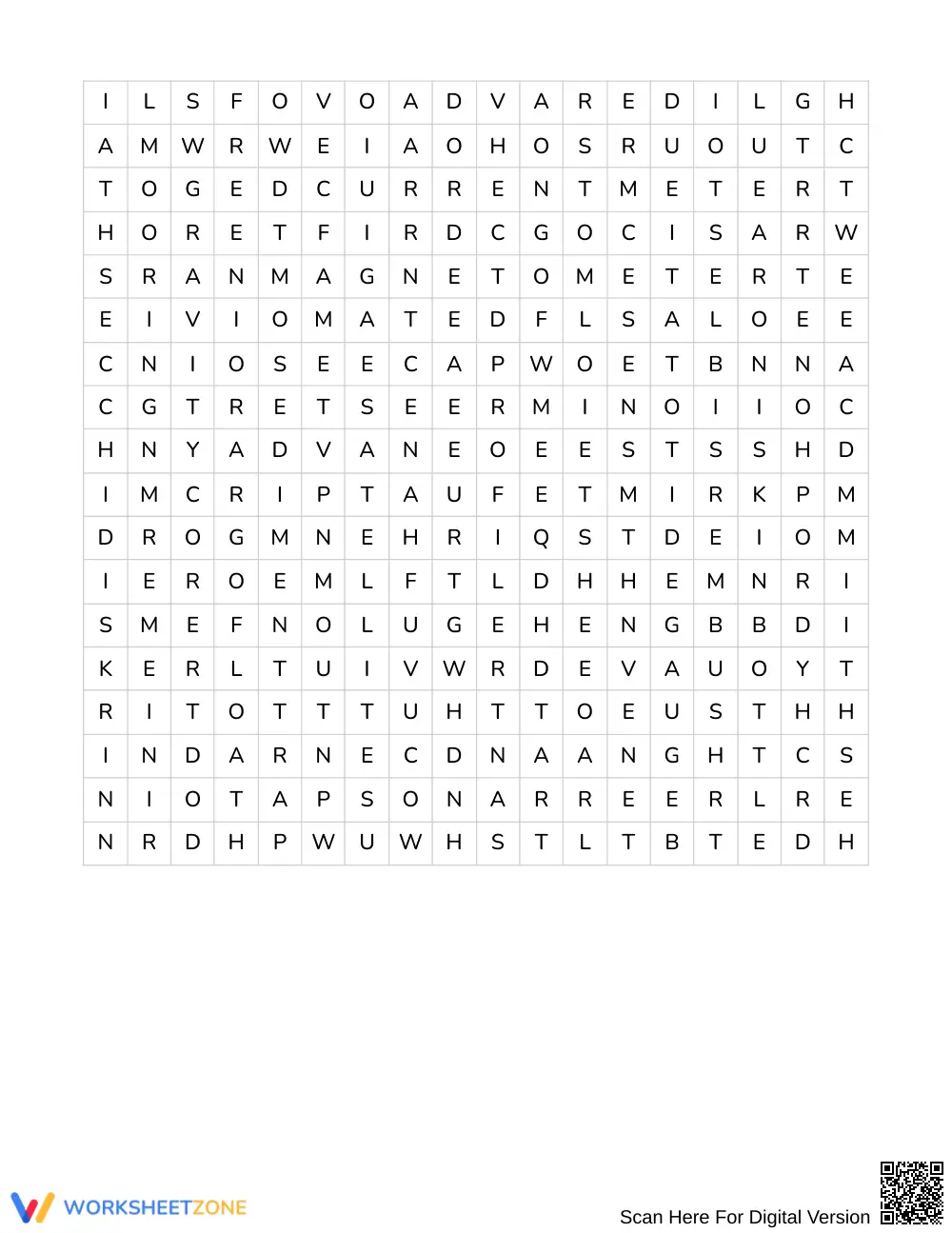

Ready Ocean Observation Word Search | Grades 6–7 Science
Paste this activity's link or code into your existing LMS (Google Classroom, Canvas, Teams, Schoology, Moodle, etc.).
Students can open and work on the activity right away, with no student login required.
You'll still be able to track student progress and results from your teacher account.
This Grades 6–7 science word search reinforces ocean observation tools through an active clue-solving format. Students analyze 16 detailed instrument descriptions to identify key technologies—such as sonar, hydrophones, and Niskin bottles—before finding each term in an 18-by-18 grid. The activity strengthens marine science vocabulary and technical reading comprehension.
At a Glance
- Grade: Grades 6–7 · Subject: Science
- Standard: Not standards-assessed — vocabulary enrichment
- Skill Focus: Ocean observation tools and marine research technology
- Format: 3 pages · 16 words · Complete 4-page answer key included · PDF
- Best For: Middle school marine science vocabulary review and reinforcement
- Time: 25–35 minutes of focused independent or partner work
What's Inside
This 3-page science resource features an ocean observation puzzle without a standard word bank. Students read 16 technical clues defining instruments like the CTD profiler, Argo float, and sediment trap, deducing each term before searching the puzzle. The resource includes the student puzzle page, full clue sheet, and a complete 4-page answer key with highlighted letter placements for quick checking.
Puzzle Mechanics
The puzzle utilizes an 18-by-18 letter grid containing 16 hidden terms. Words run in all eight directions: north, northeast, east, southeast, south, southwest, west, and northwest, including forward, backward, and diagonal alignments. Because no word bank is provided, students rely entirely on the 16 functional clues to identify each oceanographic tool before locating it in the letter grid.
Standards Alignment
This resource is designed for vocabulary enrichment rather than formal standards assessment. It serves as an instructional supplement that introduces and reinforces specialized scientific terms across oceanography and Earth science units, helping students build technical literacy without alignment to a specific state code.
How to Use It
Use this word search during an oceanography unit as an introductory activity or after direct instruction on seafloor exploration as a vocabulary review. During completion, observe whether students struggle to connect functional clues—like acoustic pulses—to specific tools, identifying concepts needing re-teaching. The puzzle takes 25 to 35 minutes of independent or partner work.
Who It's For
This activity is designed for Grades 6–7 science classes studying Earth systems, marine technology, or ocean currents. Support developing readers by allowing collaborative partner work, while challenging advanced students to diagram one tool's operational depth. Pair this puzzle with an introductory text or anchor chart on marine research vessels.
Integrating targeted ocean observation tool vocabulary into middle school science instruction bridges the gap between abstract marine concepts and concrete scientific instrumentation. According to Fisher & Frey (2014), intentional vocabulary acquisition that connects domain-specific definitions to active student retrieval significantly enhances long-term conceptual retention and disciplinary literacy. By removing the traditional word bank and requiring students to interpret functional scientific clues—such as identifying acoustic pulses as sonar or deep profiling probes as Argo floats—this puzzle transforms passive letter searching into active semantic processing. Students in Grades 6–7 must synthesize technical details about marine sensors, autonomous underwater vehicles, and seafloor sampling devices before locating each term across an 18-by-18 grid. This dual-demand task strengthens both scientific terminology retention and orthographic pattern recognition, providing educators with an engaging, rigorous tool to reinforce marine science knowledge across Earth systems curricula.


