































Ready Neutralization Model Worksheet | Grades 9–12 Science

Paste this activity's link or code into your existing LMS (Google Classroom, Canvas, Teams, Schoology, Moodle, etc.).
Students can open and work on the activity right away, with no student login required.
You'll still be able to track student progress and results from your teacher account.
Students use this worksheet to construct, complete, and revise particle models of neutralization reactions, reinforcing their ability to visualize ionic exchanges and predict energy changes while practicing quantitative calculations through guided examples, data interpretation, and error‑analysis activities that align with high‑school chemistry standards and promote deeper conceptual mastery.
At a Glance
- Grade: Grades 9–12 (High School) · Subject: Science
- Standard:
— Construct and revise detailed particle models of neutralization reactions, showing ions and water formation- Skill Focus: Model building, revision, and interpretation of energy changes
- Format: 4 printable pages • 21 varied problems • Answer key included • PDF ready for distribution
- Best For: Lab‑based inquiry, concept review, and assessment preparation
- Time: Approximately 45–60 minutes for completion
What's Inside
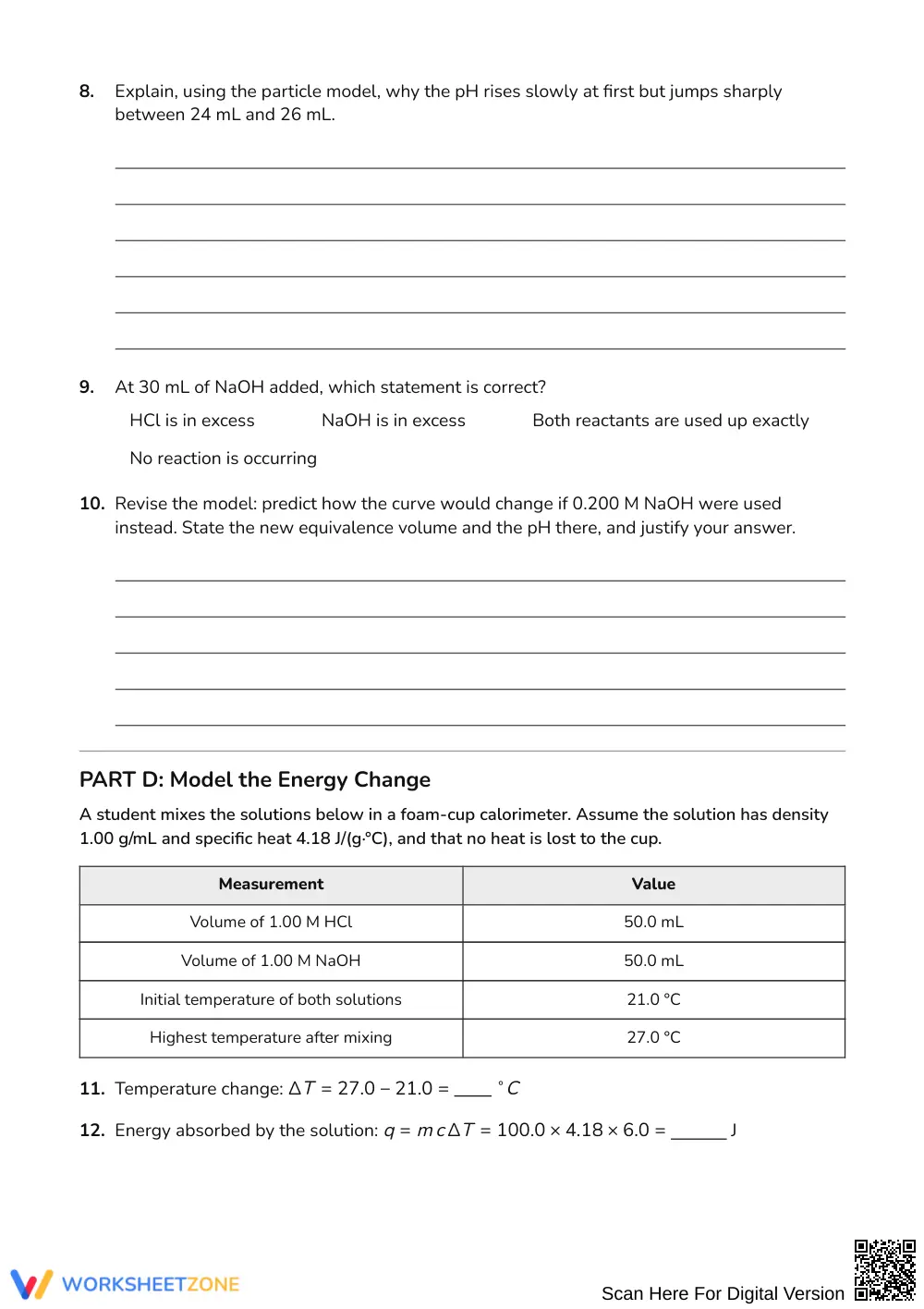
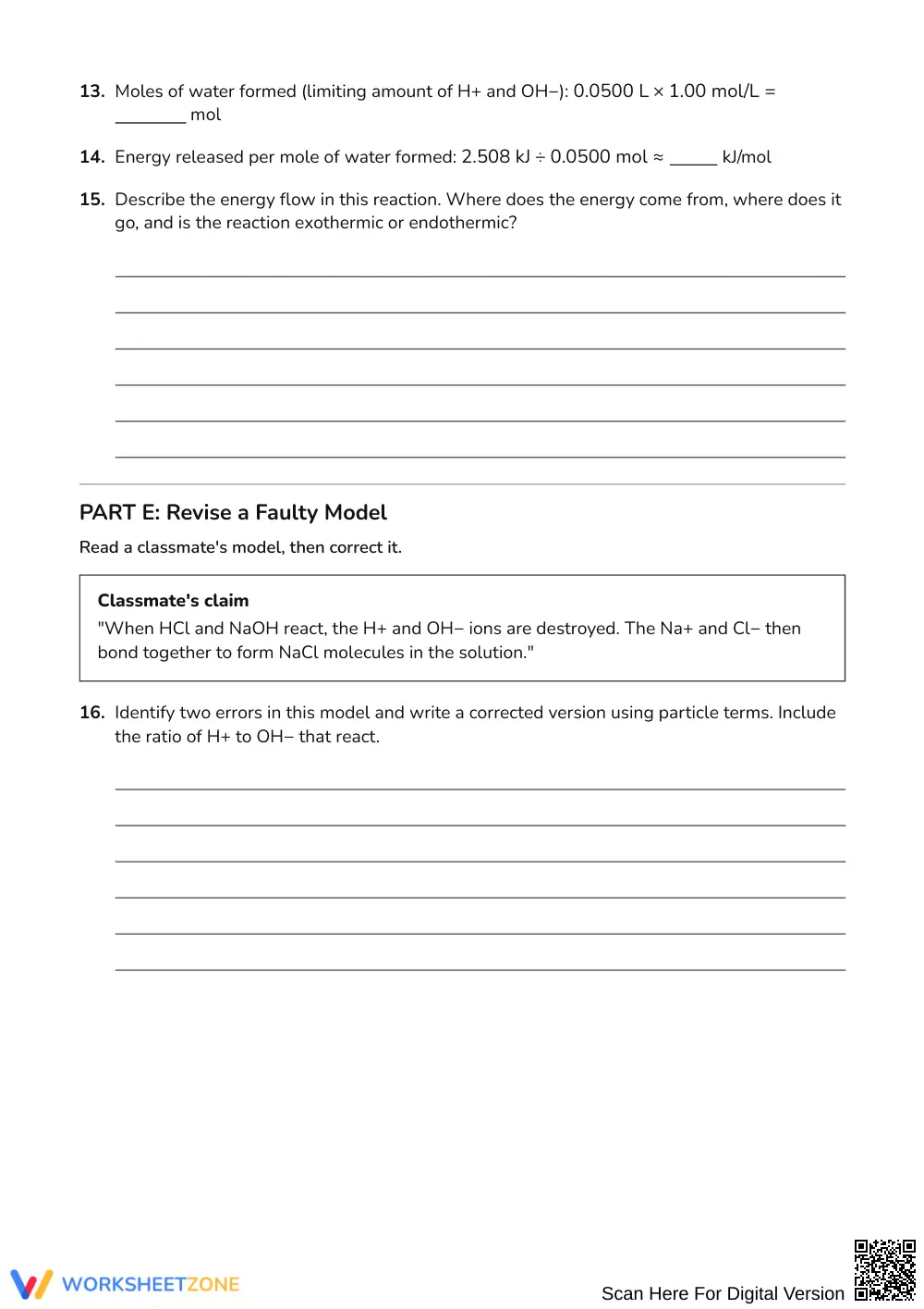
The worksheet contains five parts: Part A asks students to draw particle models and write the net ionic equation; Part B provides a table for acid‑base pairing, stoichiometric coefficients, and mole‑ratio questions; Part C features a titration graph for data‑driven model testing; Part D guides energy‑change calculations using calorimetry data; Part E requires critique and correction of a peer’s faulty model. All four printable pages include an answer key on the back.
Skill Progression
- Guided practice – 7 problems in Part A with worked example and particle‑model template.
- Supported practice – 8 problems across Parts B and C with partial scaffolds such as coefficient tables and graph prompts.
- Independent practice – 6 problems in Parts D and E requiring full written explanations and model revisions.
The sequence follows the classic I Do, We Do, You Do release model.
Standards Alignment
Students construct, complete, or revise a model of neutralization reactions showing components, relationships, flows, or changes. This aligns with the overarching high‑school chemistry standard for chemical reaction modeling. Both statements can be copied directly into lesson plans, IEP goals, or district curriculum mapping tools.
How to Use It
Use Case 1 – Before a lab on acid‑base titration, have students complete Parts A and B as a pre‑lab activity to solidify particle‑level understanding; observe their ability to write net ionic equations as a quick formative check (2‑3 minutes). Use Case 2 – After the experiment, assign Parts C through E for post‑lab analysis; students interpret the titration curve, calculate energy release, and correct peer misconceptions, typically requiring 30‑40 minutes.
Who It's For
This worksheet is designed for high‑school students in grades 9–12 taking a general science or chemistry course. It supports mixed‑ability classes by offering clear step‑by‑step prompts, a built‑in word bank for common ions, and optional extension questions for advanced learners. Pair it with a standard lab on acid‑base neutralization or an anchor chart of the ion‑exchange process for seamless integration.
Research shows that explicit particle‑model instruction improves students’ ability to reason about chemical reactions (Fisher & Frey 2014). This worksheet operationalizes that approach by requiring learners to construct, revise, and justify neutralization models across multiple contexts, from stoichiometric tables to calorimetry calculations. The tasks align with the high‑school chemistry standard that calls for students to model neutralization reactions, providing a coherent pathway from representation to quantitative analysis. By integrating visual, numerical, and explanatory components, the worksheet supports deeper conceptual change and prepares students for laboratory success. Teachers can confidently assign it as a formative assessment that yields immediate evidence of student understanding. The inclusion of a peer‑model critique in Part E encourages metacognitive reflection, a practice linked to higher achievement in science (EdReports 2024). Additionally, the energy‑flow analysis connects chemical concepts to real‑world phenomena, reinforcing relevance and motivation.


