































Ready Neutralization Data Worksheet | Grades 9-12 Science

Paste this activity's link or code into your existing LMS (Google Classroom, Canvas, Teams, Schoology, Moodle, etc.).
Students can open and work on the activity right away, with no student login required.
You'll still be able to track student progress and results from your teacher account.
This high school chemistry worksheet equips students to master data table analysis across neutralization reactions and titration curves. Students interpret pH shifts, analyze particulate models, and calculate thermochemical energy changes from experimental calorimetry tables, transforming raw laboratory measurements into evidence-based scientific explanations of acid-base chemical processes.
At a Glance
- Grade: Grades 9–12 · Subject: Science
- Standard: High School Physical Science — Interpret laboratory data tables to model neutralization reactions and energy transfers
- Skill Focus: Data Table Analysis
- Format: 4 pages · 24 problems · Answer key included · PDF
- Best For: Titration data analysis and calorimetry review
- Time: 45–60 minutes
What's Inside
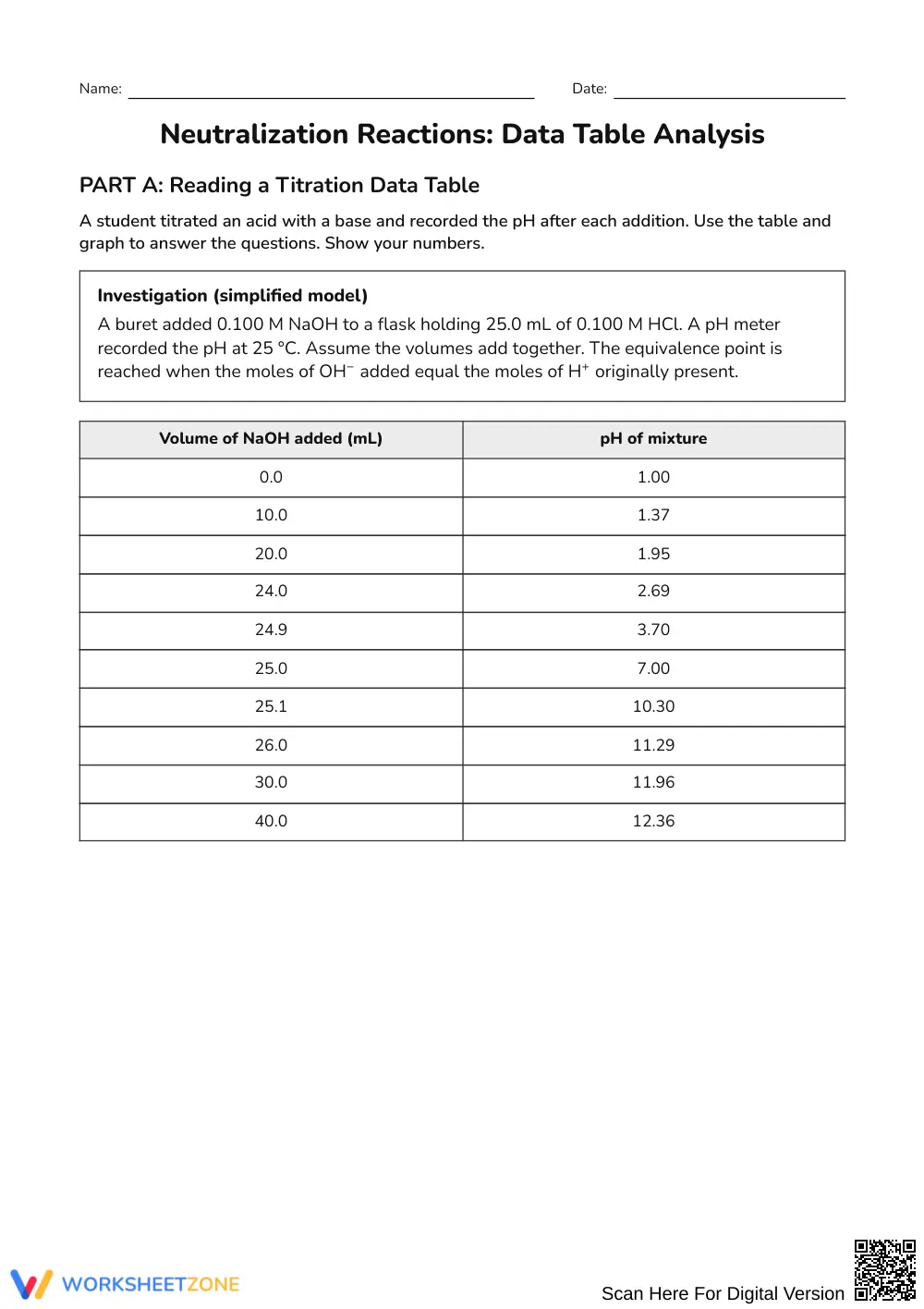
The 4-page student worksheet provides 24 structured analytical tasks organized into three distinct investigation components. Students interact with quantitative titration datasets, ionic neutralization models, and multi-trial calorimetry tables. A complete 4-page teacher answer key provides full mathematical steps, molar calculations, temperature change comparisons, and complete claim-evidence-reasoning sample responses for immediate grading.
Skill Progression
- Guided Practice (Part A, Tasks 1–8): Students inspect a structured titration data table and pH curve, using explicit buret volumes to track equivalence point transitions with strong numerical scaffolds.
- Supported Practice (Part B, Tasks 9–16): Learners examine submicroscopic particle representations, identifying spectator ions, salt formulas, and stoichiometric mole ratios of produced water.
- Independent Practice (Part C, Tasks 17–24): Students independently manipulate three calorimetry trials, computing heat transfer, enthalpy per mole, and writing rigorous claim-evidence-reasoning arguments.
This intentional sequence mirrors the gradual-release framework, scaffolding conceptual chemistry analysis from explicit table observations to autonomous thermochemical evaluation.
Standards Alignment
This worksheet aligns with high school physical science standards requiring quantitative evaluation of chemical reactions, stoichiometric neutralization, and thermal energy conservation. Students calculate reaction enthalpies and explain microscopic ion interactions. Both standard codes can be copied directly into lesson plans, IEP goals, or district curriculum mapping tools.
How to Use It
Deploy this resource during guided classroom practice immediately after introducing strong acid-strong base titrations, or assign it following a wet-lab investigation to reinforce quantitative data analysis. During work time, formatively assess whether students recognize that temperature change depends on reactant mass and liberated heat by checking Trial 2 explanations. Expected student completion time is 45 to 60 minutes.
Who It's For
This worksheet serves general chemistry, honors chemistry, and introductory physical science students needing rigorous analytical data practice. Scaffolded data tables support emerging learners through clearly defined variables, while multi-step enthalpy calculations challenge advanced students. Pair this activity directly with an acid-base titration lab or an enthalpy demonstration.
According to Fisher & Frey (2014), structured data analysis tasks that transition through purposeful gradual release build enduring scientific literacy and conceptual mastery in secondary learners. This 4-page science worksheet delivers targeted data table analysis across 24 scaffolded problems, prompting high school students to interrogate titration values, model particle interactions, and quantify reaction enthalpies. By navigating from guided observation of pH shifts at equivalence points to independent thermochemical calculations and claim-evidence-reasoning synthesis, learners systematically bridge abstract chemical equations with empirical evidence. Educational research emphasizes that working directly with multi-trial experimental tables deepens analytical reasoning and quantitative fluency far more effectively than memorizing isolated formulas. High school teachers gain an efficient, standards-aligned instructional tool complete with a 4-page step-by-step answer key that accelerates diagnostic feedback and accurately measures student progression toward chemistry mastery.


