


























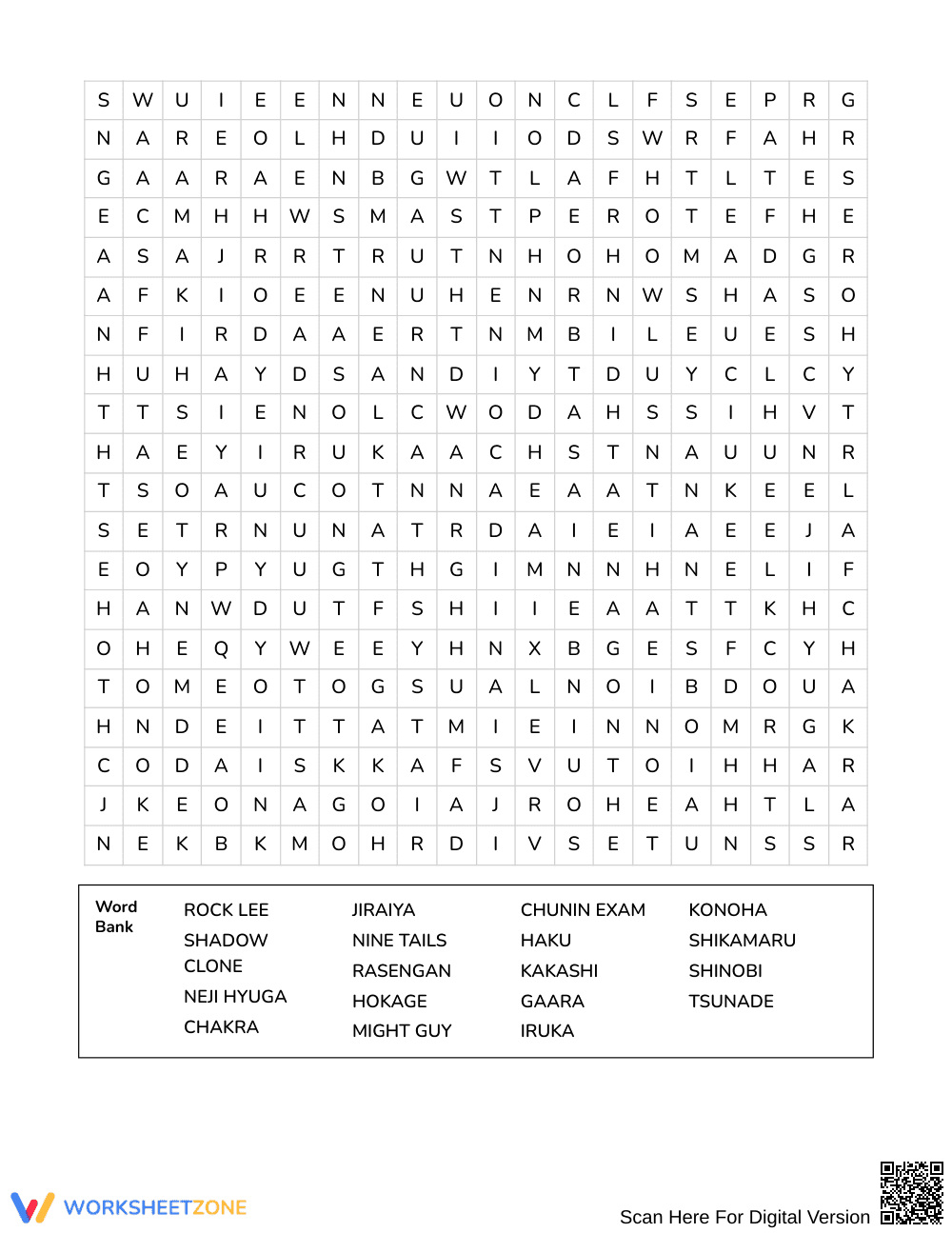

Ready Naruto Character Word Search | Grades 7–8 ELA
Paste this activity's link or code into your existing LMS (Google Classroom, Canvas, Teams, Schoology, Moodle, etc.).
Students can open and work on the activity right away, with no student login required.
You'll still be able to track student progress and results from your teacher account.
This early-series narrative review word search strengthens character recall and vocabulary recognition for Grades 7–8 English Language Arts students. By matching detailed narrative clues to prominent characters, jutsu, and world-building concepts from the anime series, students actively retrieve key literary elements and reinforce reading comprehension skills through engaging print puzzle play.
At a Glance
- Grade: Grades 7–8 · Subject: English Language Arts (ELA)
- Standard: Not standards-assessed — vocabulary enrichment
- Skill Focus: Early-series character identification and narrative review
- Format: 3 pages · 18 hidden words · Full answer key included · PDF document
- Best For: Independent vocabulary review, early finisher work, and literacy stations
- Time: 20–30 minutes
What's Inside
This 3-page printable puzzle activity includes 18 vocabulary words paired with descriptive story clues, alongside a comprehensive 4-page answer key. Rather than relying on a simple word list, the activity features a shuffled word bank that challenges students to connect definitions to specific characters and narrative milestones before locating them in the puzzle grid.
Puzzle Structure and Mechanics
The activity centers on a dense 20 x 20 letter grid designed to test visual scanning and orthographic awareness. All 18 hidden words are arranged in eight possible directions: north, northeast, east, southeast, south, southwest, west, and northwest. Students read each narrative clue to identify the targeted character or jutsu concept, check the shuffled word bank to verify the spelling, and circle the matching sequence across the horizontal, vertical, and diagonal letter paths.
Standards Alignment
This resource serves as targeted vocabulary enrichment and is not aligned to a specific Common Core or state academic standard. It functions as an engaging supplementary review tool designed to build contextual literacy, literary recall, and domain-specific terminology through popular culture connections.
How to Use It
This word search fits smoothly into daily instructional routines:
- Post-Unit Celebration: Assign the puzzle after completing a character study to review archetypes and story tropes.
- Sub Plan or Station: Use the activity as a self-directed review task during literacy rotations.
Observe whether students solve clues before searching to gauge plot recall. Most students finish all 18 words in 20 to 30 minutes.
Who It's For
This puzzle is tailored for middle school learners in Grades 7–8 who enjoy manga, graphic novels, and high-interest fiction. For students requiring extra assistance, teachers can highlight the first letter of each hidden term or allow partner decoding. Pair this activity directly with an introductory lesson on characterization or an anchor chart highlighting heroic archetypes.
Designed for Grades 7–8 English Language Arts classrooms, this 18-word search delivers targeted vocabulary enrichment and narrative character review without formal standard alignment constraints. According to Fisher & Frey (2014), engaging middle school students with high-interest, clue-based word puzzles successfully activates background schema, deepens domain-specific terminology recall, and promotes collaborative academic discourse. The print-ready 3-page format challenges learners to interpret 18 distinct narrative descriptions spanning early story arcs, locating vocabulary hidden across eight directional orientations within a 20 x 20 letter grid. A comprehensive 4-page answer key provides clear visual solutions for rapid educator evaluation, self-checking, or peer grading. By bridging popular graphic novel narratives with active orthographic decoding, the resource supports reading comprehension, reinforces spelling patterns, and sustains meaningful student engagement during independent practice, literacy center rotations, and supplementary enrichment sessions across the academic term.


