




























Views
Downloads

Ready Money Terms Word Search | Grades 7–8 Social Studies

Paste this activity's link or code into your existing LMS (Google Classroom, Canvas, Teams, Schoology, Moodle, etc.).
Students can open and work on the activity right away, with no student login required.
You'll still be able to track student progress and results from your teacher account.
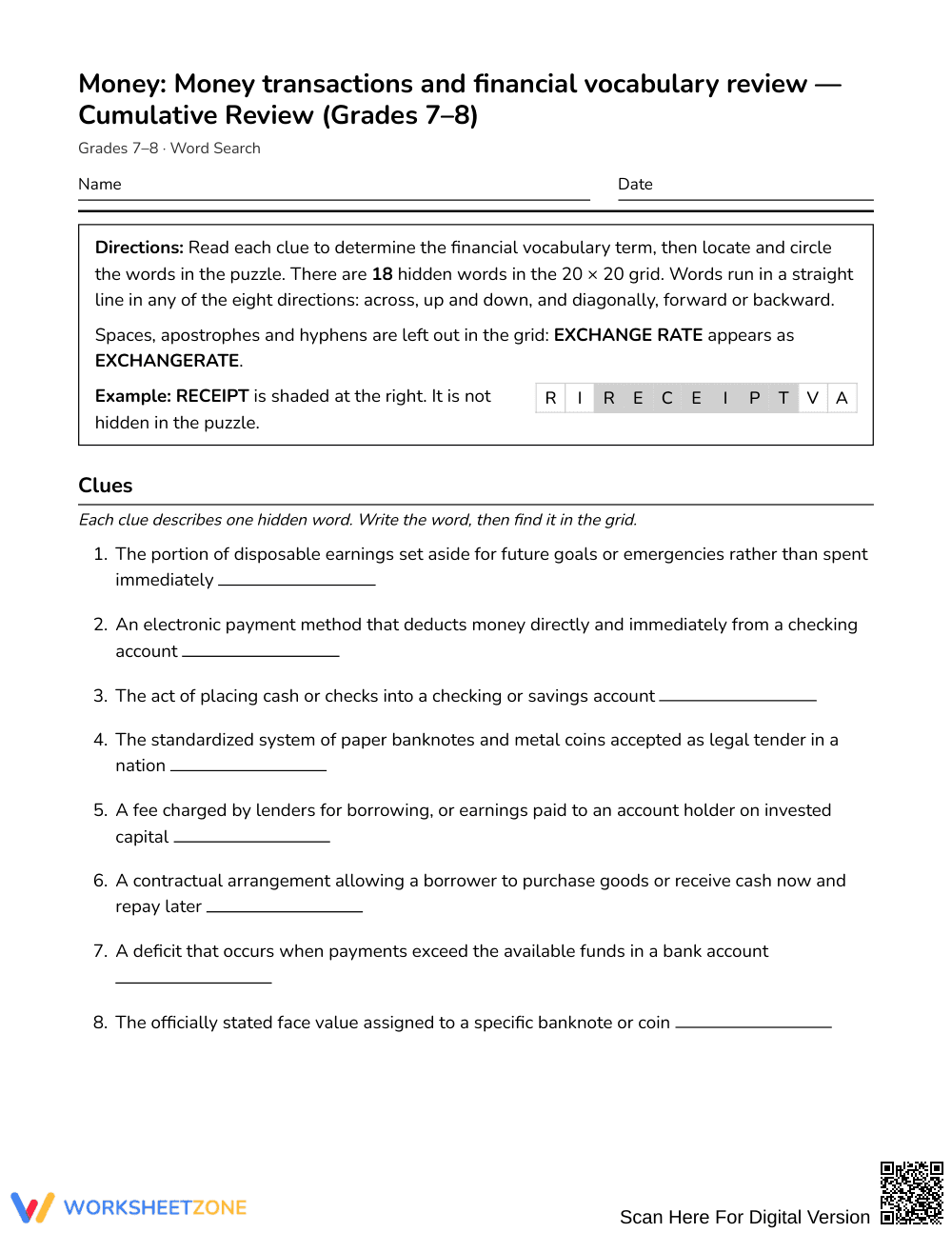
This Grades 7–8 economics word search reinforces financial literacy by challenging learners to identify and define critical banking terms. Students review core concepts such as transactions, interest, and credit while locating hidden terms. It strengthens subject-specific vocabulary comprehension and equips middle schoolers with foundational money management terminology for practical, real-world financial decision-making.
At a Glance
- Grade: Grades 7–8 · Subject: Social Studies
- Standard: Not standards-assessed — vocabulary enrichment
- Skill Focus: Money transactions and foundational personal financial vocabulary review
- Format: 3 pages · 18 words · 4-page answer key included · PDF
- Best For: Middle school economics unit review, sub plans, and financial literacy practice
- Time: 20–30 minutes
What's Inside
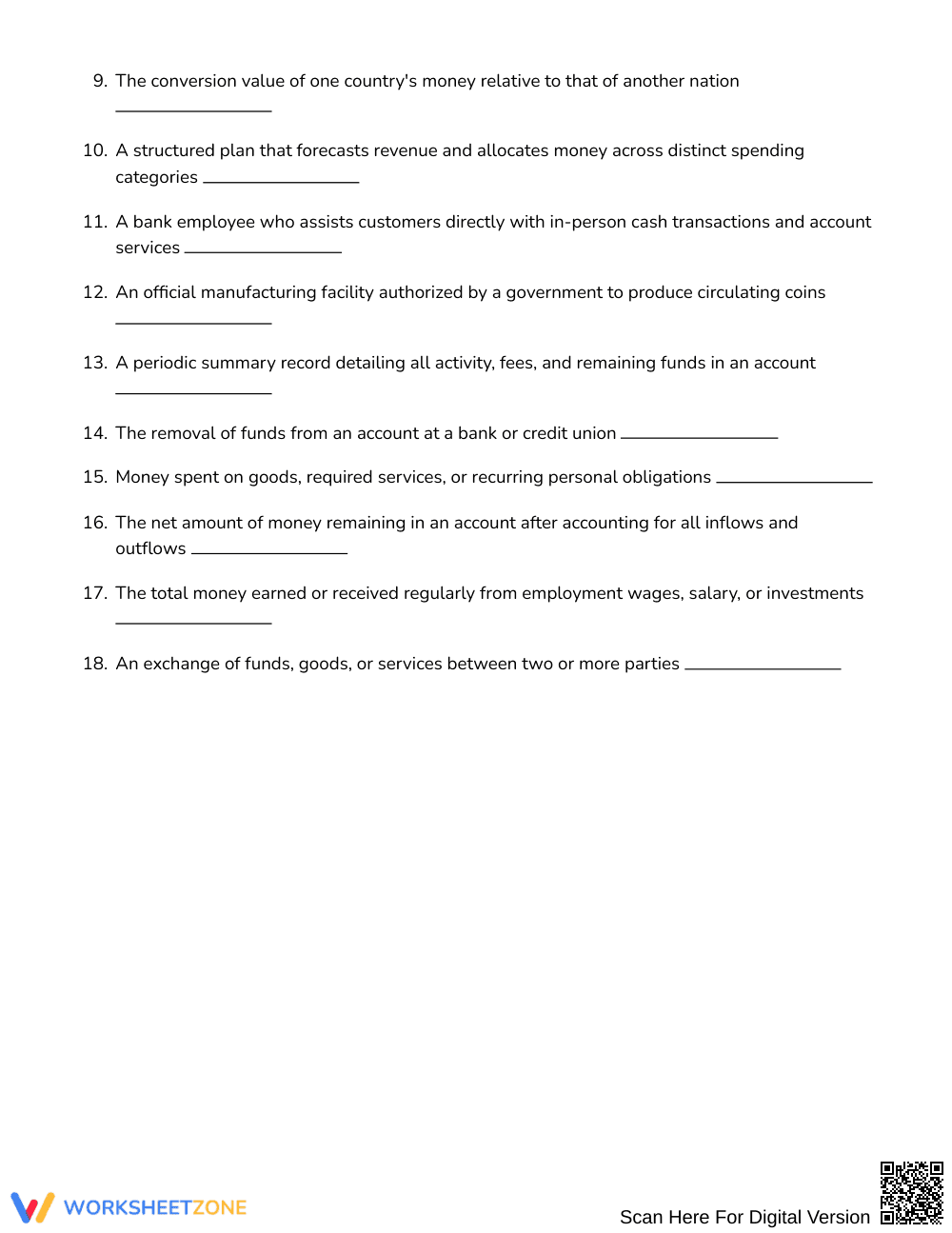
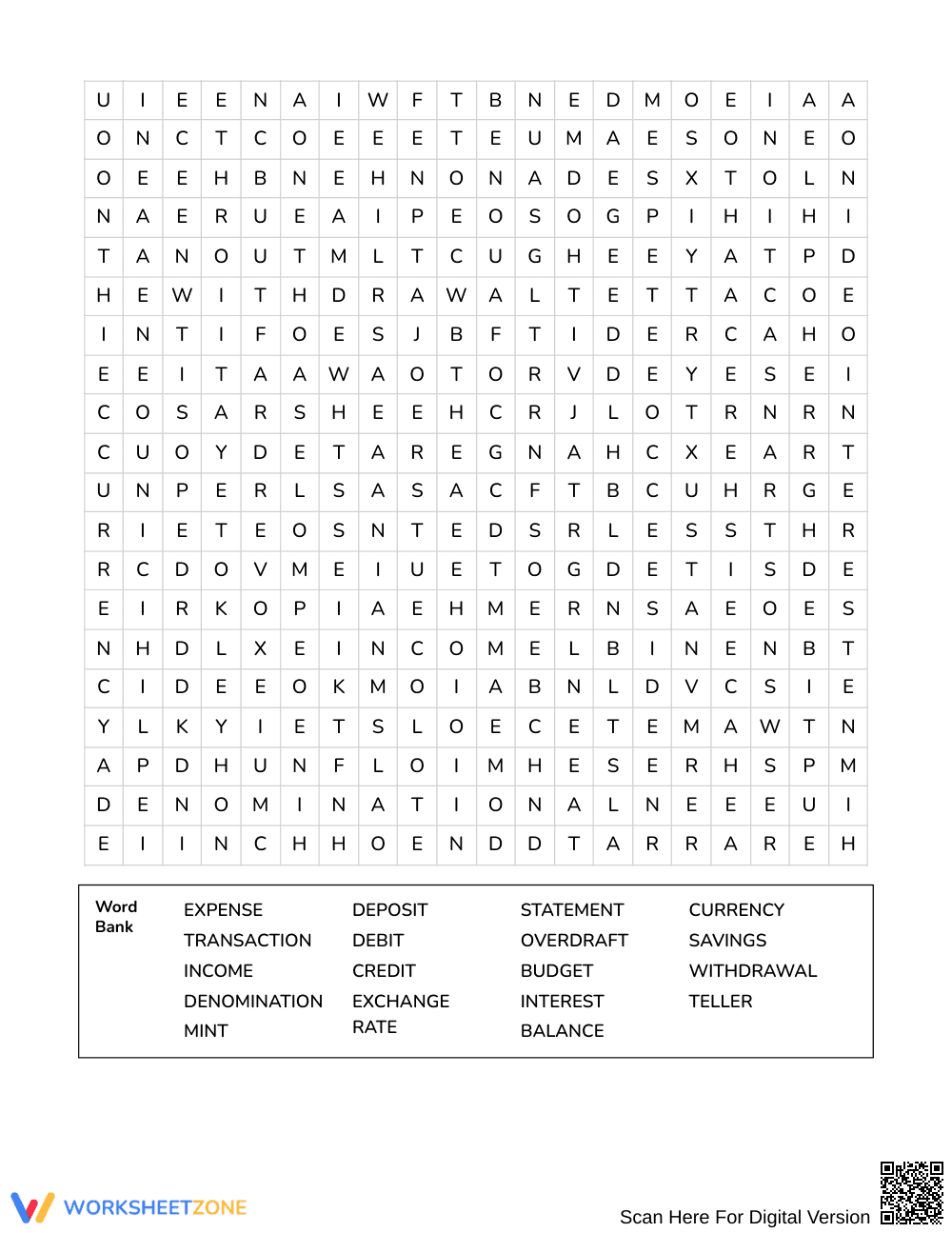
This 3-page printable activity features a full-page word search puzzle paired with structured definitional clues for all 18 vocabulary words. Rather than merely scanning a list, students read thorough definitions to match concepts like overdraft, denomination, and exchange rate before finding them. The document includes a shuffled word bank for flexible scaffolding and comes with a complete 4-page answer key highlighting every word location across the puzzle grid.
Puzzle Mechanics
This activity challenges students with a dense 20 x 20 letter grid containing 18 hidden financial terms. Words run in all 8 compass directions: north, northeast, east, southeast, south, southwest, west, and northwest, including reverse and diagonal orientations. Students use detailed economic clues alongside a shuffled word bank to identify terms before locating them in the puzzle grid.
Standards Alignment
This resource serves as targeted vocabulary enrichment and is not aligned to a specific state or national content standard. It provides supplemental domain-specific language practice designed to support middle school social studies, consumer economics, and personal finance instructional units.
How to Use It
Deploy this word search during an economics unit review or as an engaging entry task after direct instruction on personal banking. Teachers can assess vocabulary mastery formatively by asking students to explain how two found terms—such as deposit and withdrawal—interact during a real-world transaction. Typical completion requires 20 to 30 minutes of focused independent or partner work.
Who It's For
This activity is designed for Grades 7–8 social studies and introductory business students developing financial literacy. Differentiate by having emerging readers highlight the shuffled word bank first, while advanced learners solve the puzzle using only the conceptual clues. Pair this resource with a hands-on checkbook balancing lesson or budgeting simulation.
Academic vocabulary acquisition is central to disciplinary literacy and conceptual mastery in middle school social studies. According to Fisher & Frey (2014), intentional exposure to domain-specific terminology through varied print contexts directly strengthens reading comprehension and long-term retention of complex informational texts. This non-standards-assessed vocabulary enrichment activity reinforces 18 foundational banking and money transaction concepts through paired definitional clues and spatial puzzle solving. By requiring learners to connect formal definitions—such as interest, currency, and overdraft—with orthographic word recognition across a 20 x 20 grid, students deepen their semantic networks. The inclusion of bidirectional and diagonal word orientations exercises active visual scanning and sustained cognitive focus. Educators can utilize this 3-page resource to bridge abstract personal finance concepts with concrete vocabulary fluency, establishing the necessary linguistic groundwork for future economics coursework, personal budgeting tasks, and civic numeracy.


