































Ready Marine Conservation Word Search | Grades 6–7 Science

Paste this activity's link or code into your existing LMS (Google Classroom, Canvas, Teams, Schoology, Moodle, etc.).
Students can open and work on the activity right away, with no student login required.
You'll still be able to track student progress and results from your teacher account.
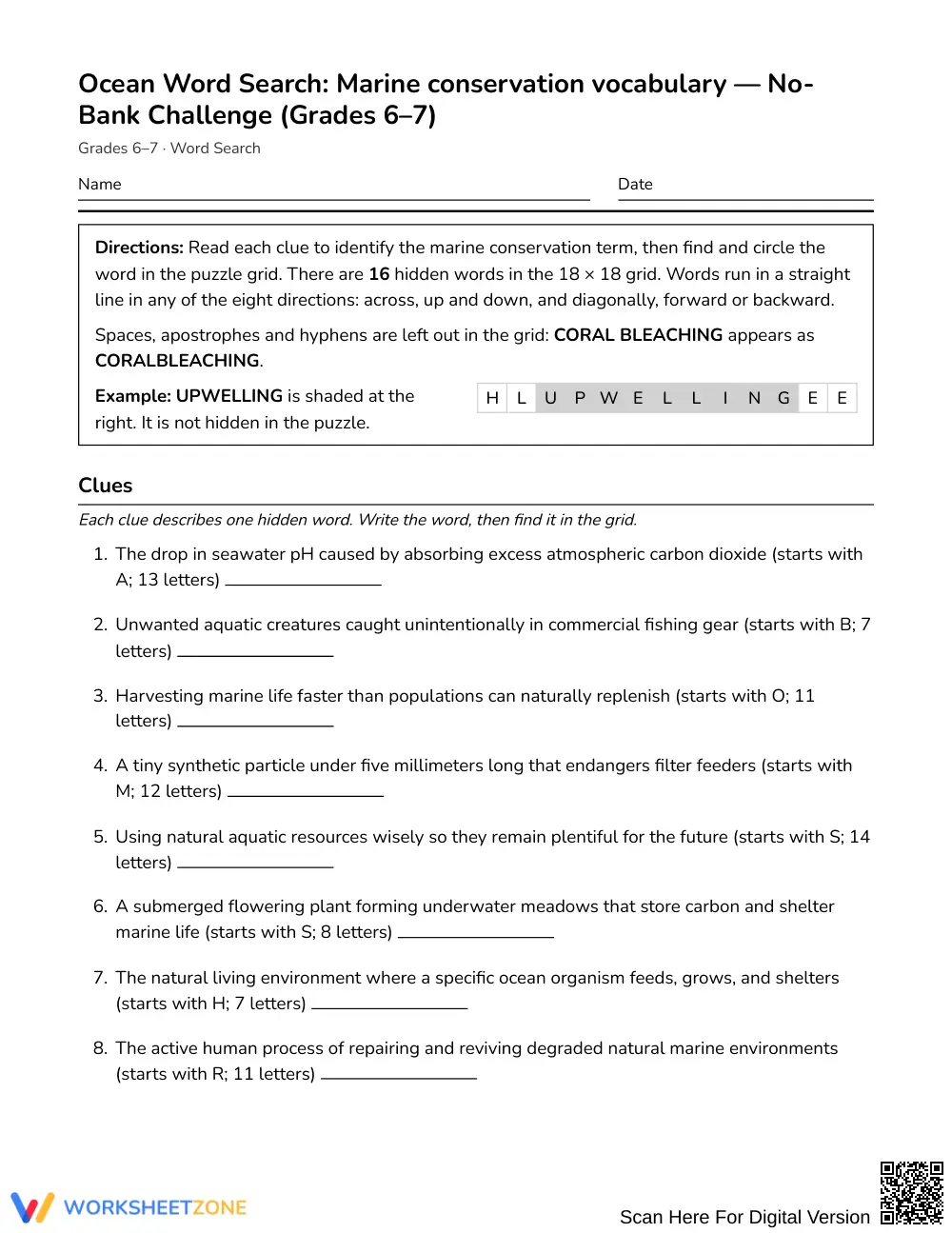
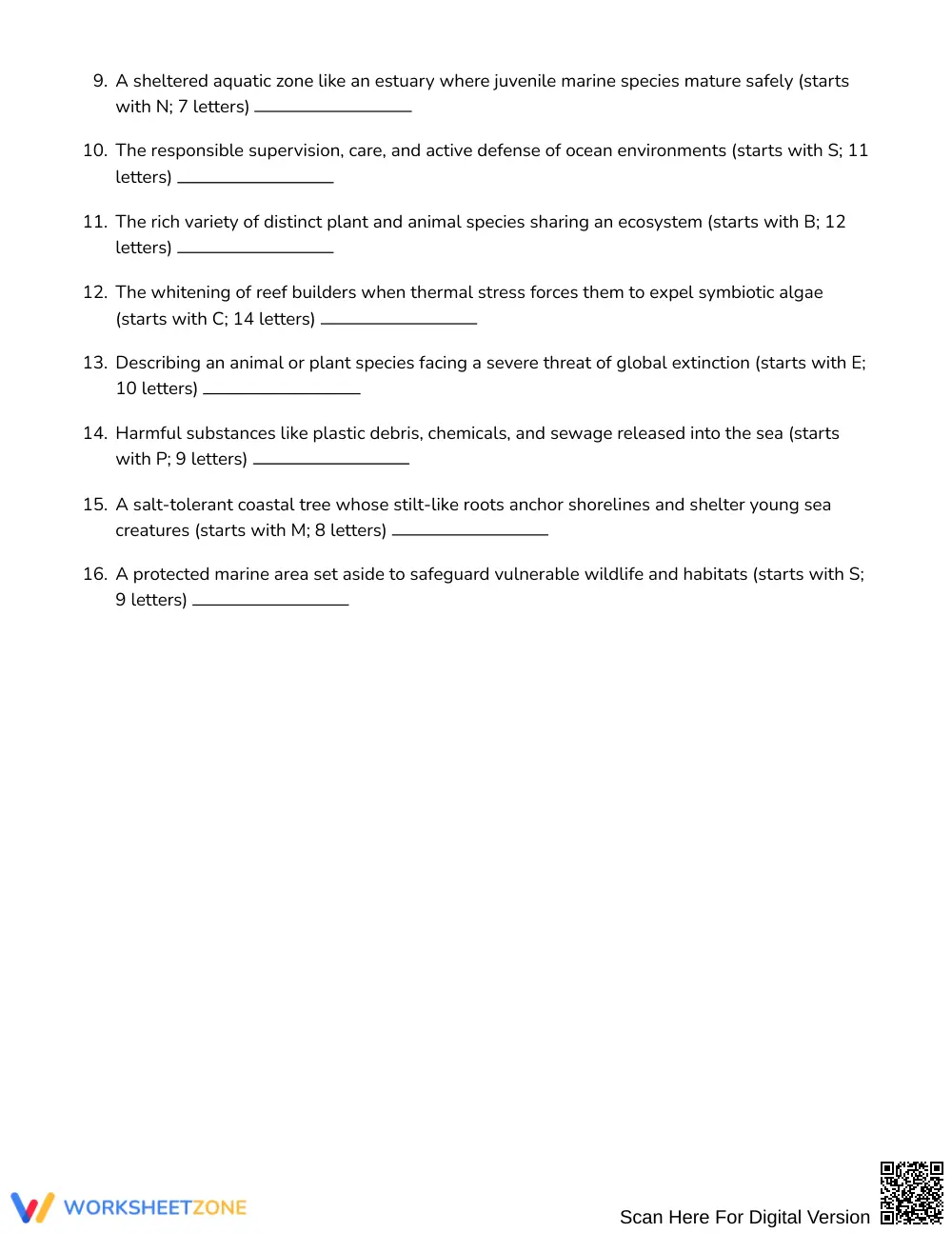
This marine conservation word search reinforces science literacy by challenging students to connect ecological definitions with key terms. Learners read clues to identify 16 essential vocabulary words before locating them within an 18 by 18 grid, building scientific retention through active recall rather than passive matching.
At a Glance
- Grade: Grades 6–7 · Subject: Middle School Science
- Standard: Not standards-assessed — vocabulary enrichment
- Skill Focus: Marine conservation vocabulary, ocean health, and environmental stewardship
- Format: 3 printable pages · 16 hidden words · Full answer key included · Printable PDF
- Best For: Vocabulary enrichment, ocean units, and sub plans
- Time: 20–30 focused classroom minutes
What's Inside
This 3-page printable science resource contains a clue-based puzzle designed without a traditional word bank. Students analyze 16 concise definitions covering key ecological topics like acidification, coral bleaching, bycatch, and mangrove habitats to identify each term. The document includes a 4-page answer key showing exact letter coordinates and highlighted word paths for effortless verification.
Puzzle Mechanics and Structure
Operating without a standard word bank, this puzzle requires students to deduce terms from clues before searching. All 16 words hide within an 18 by 18 letter grid. Vocabulary terms run in all eight compass directions: horizontally (East, West), vertically (North, South), and diagonally (Northeast, Southeast, Northwest, Southwest), introducing engaging spatial challenge.
Standards Alignment
This word search serves as vocabulary enrichment and is not aligned to a specific academic standard. It provides supplementary domain-specific language practice for middle school environmental science, marine biology, and ecology units, reinforcing conceptual familiarity alongside any general life science curriculum.
How to Use It in the Classroom
This activity integrates smoothly across several instructional moments:
- Mid-Unit Practice: Distribute the puzzle after direct instruction on aquatic ecosystems. Students solve clues in pairs before scanning the grid. Observe which terms—such as acidification or bycatch—prompt hesitation to guide subsequent review. Completion takes 20 to 30 minutes.
- Independent Extension or Sub Plans: Assign the puzzle as a self-guided review task following an ecology lesson. The clue-first format ensures meaningful academic engagement without requiring teacher preparation.
Target Audience and Adaptations
Designed for Grades 6–7 science students, this word search reinforces marine terminology and human impact concepts. Support English learners by pairing the worksheet with an ocean food web anchor chart. Advanced learners can write sentences illustrating how two discovered terms interact. This puzzle pairs naturally with an informational text on ocean stewardship.
This Grades 6–7 science word search provides targeted vocabulary enrichment focused on essential marine conservation concepts, including ocean acidification, biodiversity, and ecosystem stewardship. Rather than relying on passive letter scanning, the clue-driven format requires students to retrieve definitions and connect domain-specific terms to ecological processes. According to Fisher & Frey (2014), intentional academic vocabulary instruction that integrates definitional knowledge with active student processing substantially strengthens reading comprehension and disciplinary literacy in middle school science classrooms. By requiring learners to analyze 16 scientific clues before locating hidden terms across an 18 by 18 grid, this resource reinforces precise scientific terminology and orthographic memory. Teachers can deploy this 3-page printable activity during oceanography units, sub plans, or review stations to evaluate student familiarity with environmental science language. The complete answer key supports immediate feedback, making this an efficient, research-grounded tool for middle grades science vocabulary acquisition.


