


























Views
Downloads




Ready Logarithm Equations Worksheet | Grade 11 Algebra II
Paste this activity's link or code into your existing LMS (Google Classroom, Canvas, Teams, Schoology, Moodle, etc.).
Students can open and work on the activity right away, with no student login required.
You'll still be able to track student progress and results from your teacher account.
This Grade 11 algebra worksheet strengthens fluency in logarithmic properties, inverse functions, and exponential modeling. Students apply base identities, solve logarithmic equations, test for extraneous roots, and analyze real-world applications. The problem set bridges procedural mechanics with contextual modeling to deepen functional understanding.
At a Glance
- Grade: 11 · Subject: Algebra II
- Standard:
HSF-BF.B.5— Use inverse properties between logarithms and exponents to solve equations- Skill Focus: Mix Properties, Equations, and Interpretation
- Format: 5 pages · 16 problems · Answer key included · PDF
- Best For: Post-instruction practice and exam prep
- Time: 45–60 minutes
Across 5 pages, this resource delivers 16 tasks organized into three parts. A Core Principles & Reference Guide anchors student work with operational rules and inverse identities. Tasks range from exact-value evaluations and graphical inverse reflections to multi-step equations and contextual word problems. A full 5-page answer key provides step-by-step solutions.
Skill Progression
- Guided Practice (Part A, 4 problems): Students evaluate logarithms, determine domains, identify vertical asymptotes, and reflect exponential coordinates across y = x.
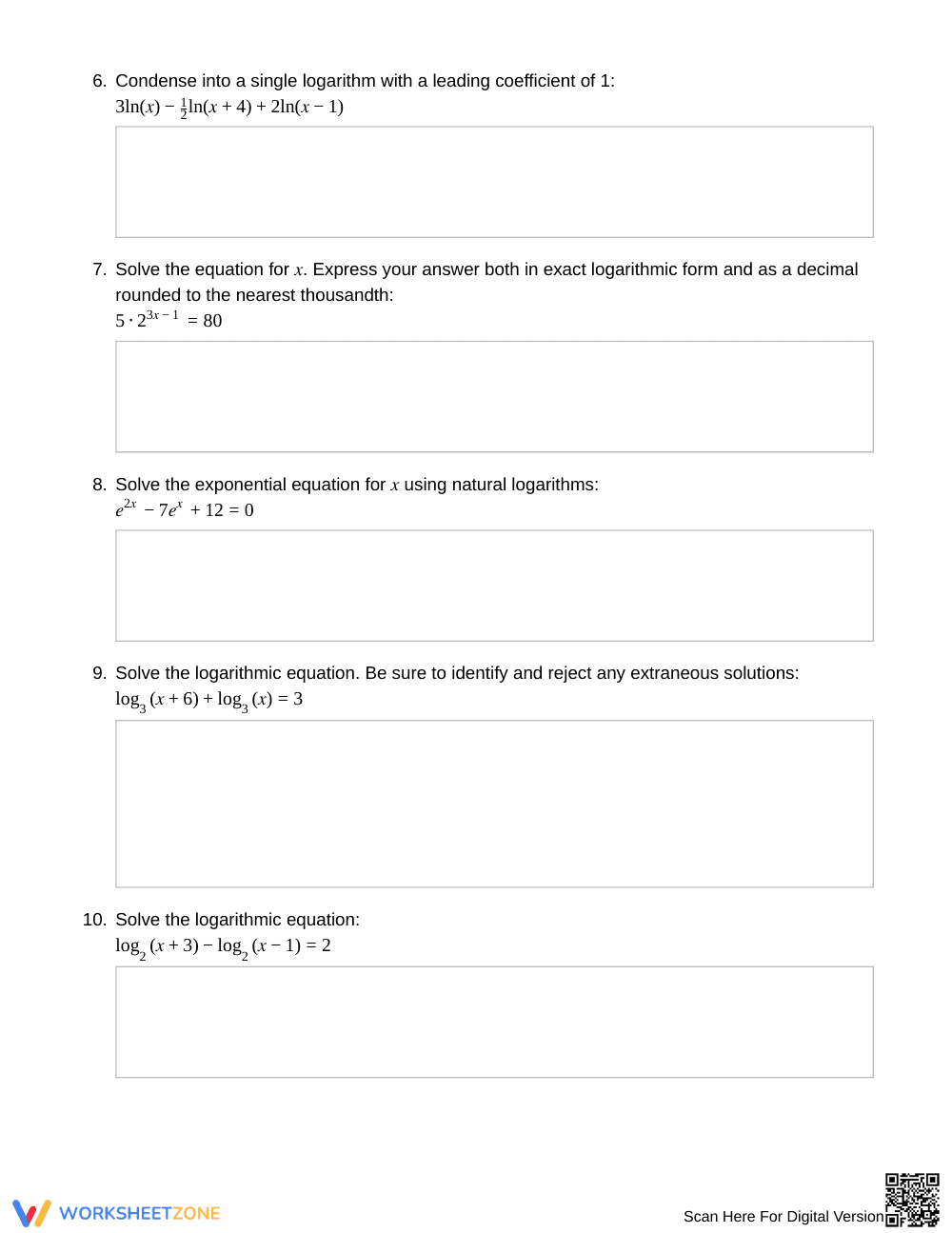
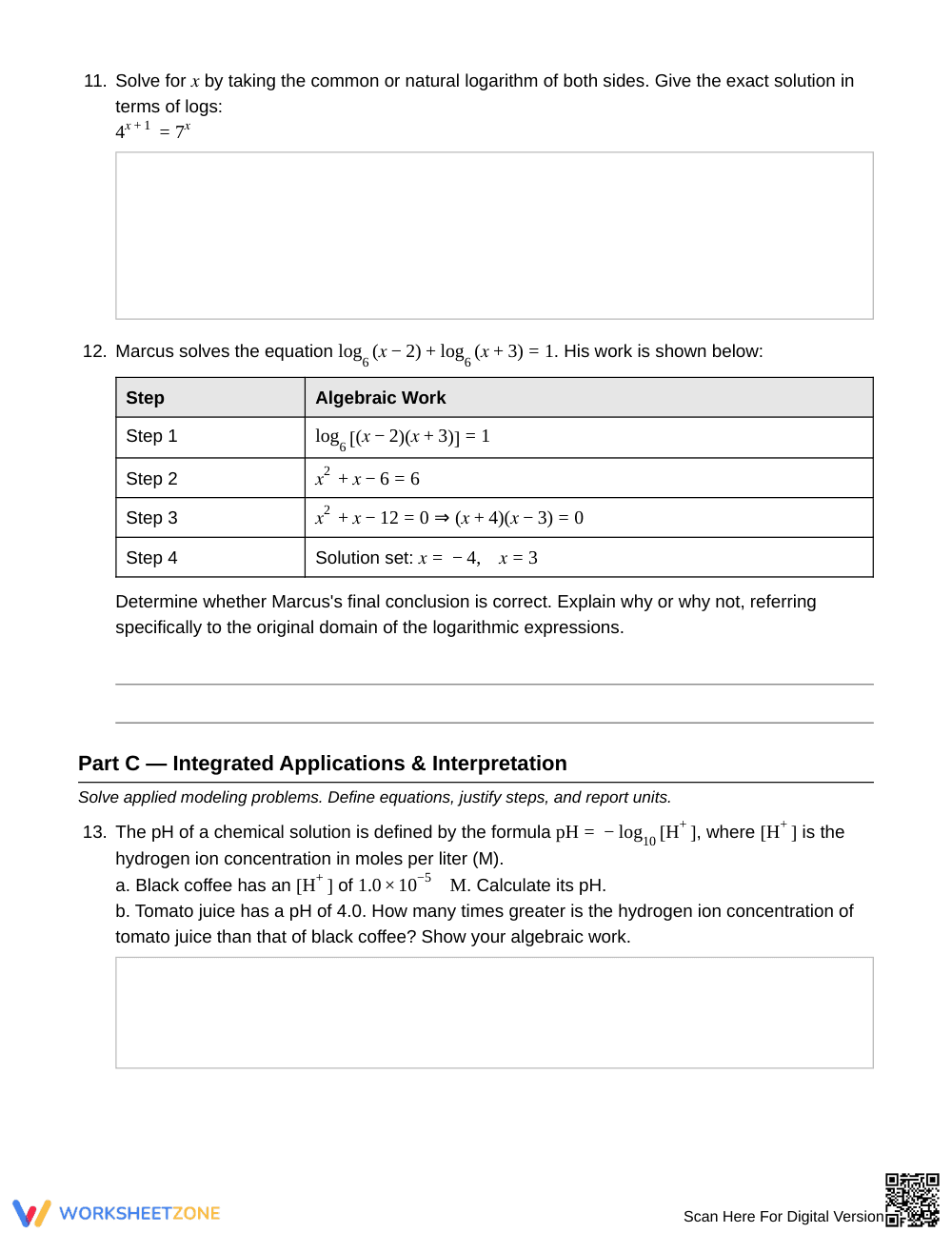
- Supported Practice (Part B, 8 problems): Learners solve logarithmic equations using operational properties, change-of-base methods, and quadratic forms while identifying extraneous roots.
- Independent Practice (Part C, 4 problems): Students autonomously model authentic scenarios, including radioactive decay, continuous interest, decibel intensity, and population recovery.
This gradual-release sequence guides students from foundational inverse mechanics to independent contextual application.
Standards Alignment
This worksheet aligns directly with `HSF-BF.B.5`, focusing on using the inverse relationship between exponents and logarithms to solve equations. Supporting standard `HSF-LE.A.4` is reinforced as students isolate variables in exponential growth and decay models. Both standard codes can be copied directly into lesson plans, IEP goals, or district curriculum mapping tools.
How to Use It
Assign this resource following direct instruction on logarithmic properties or as a comprehensive pre-exam review. For formative checks during practice, monitor how students verify solution domains in Part B to eliminate extraneous roots. Completion typically takes 45 to 60 minutes.
Who It's For
This worksheet serves Grade 11 Algebra II or Integrated Math III students preparing for advanced functional analysis. For differentiation, provide struggling learners with extra time to review the reference guide, while advanced students explore alternative change-of-base methods. Pair this practice with an exponential and logarithmic graphing anchor chart.
Mastering logarithmic relationships requires students to connect inverse properties with rigorous symbolic manipulation. Aligned with standard HSF-BF.B.5, this 16-task worksheet develops procedural fluency and analytical reasoning by requiring learners to solve logarithmic equations, eliminate extraneous roots, and model exponential phenomena. According to Fisher & Frey (2014), structured instructional progressions that guide students from foundational inverse concepts to autonomous modeling reduce mathematical errors while building schema retention. When high school learners encounter multi-step equations with unequal bases or quadratic structures, deliberate scaffolds like reference summaries and algebraic domain checks help them systematically isolate variables and verify validity. Contextual radioactive decay, sound intensity, and continuous interest applications further demonstrate practical quantitative utility. Consequently, secondary educators can use this five-page resource to evaluate algebraic mastery, support differentiated intervention, and ensure standard-aligned curriculum preparation for precalculus course objectives.


