




























Views
Downloads



Ready Limiting Reagent Claims Worksheet | Grade 11 Chemistry

Paste this activity's link or code into your existing LMS (Google Classroom, Canvas, Teams, Schoology, Moodle, etc.).
Students can open and work on the activity right away, with no student login required.
You'll still be able to track student progress and results from your teacher account.
This worksheet teaches Grade 11 chemistry students to identify a limiting reagent and defend that conclusion with evidence. Students choose relevant data, calculate theoretical yield and leftover reactant, and critique competing claims using moles and particle reasoning.
At a Glance
- Grade: 11 · Subject: Chemistry
- Standard: Stoichiometry — compare reactant moles, justify the limiting reagent, and evaluate yield claims.
- Skill Focus: Defend a limiting-reagent conclusion
- Format: 5 pages · 8 problems · Answer key included · PDF
- Best For: Stoichiometry reasoning and review practice
- Time: 45–60 minutes
What's Inside
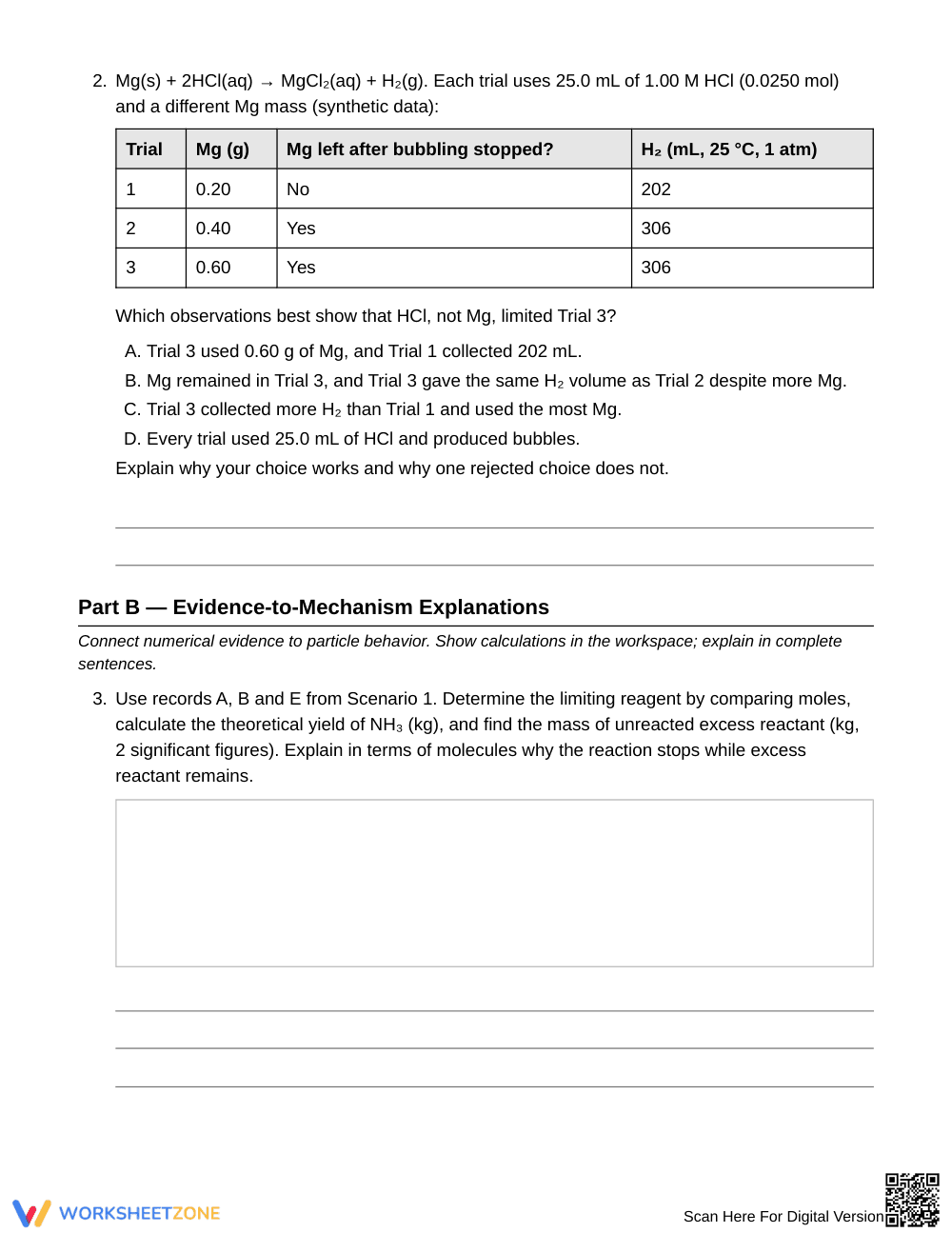
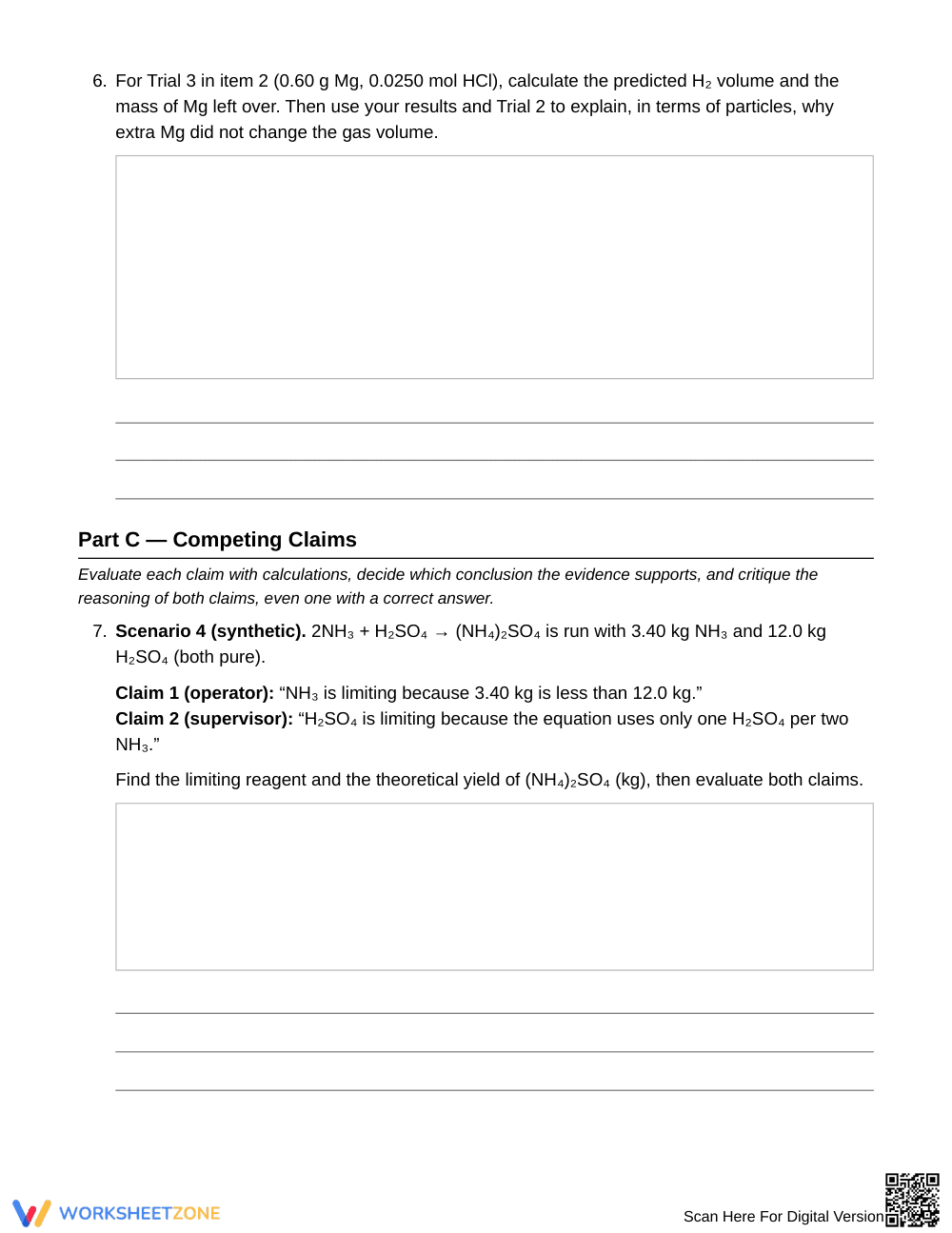
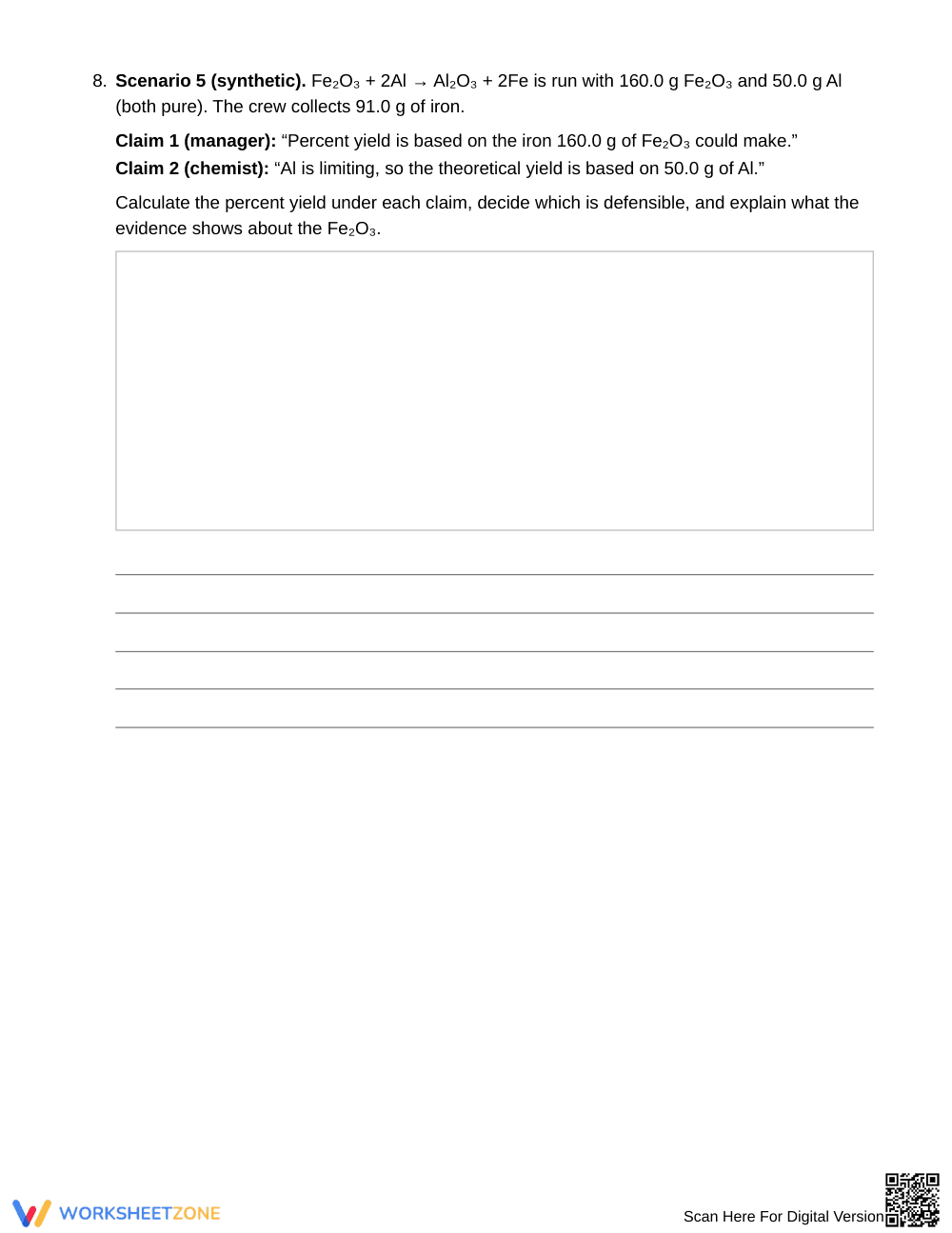
The packet has 8 tasks in three parts, built around five synthetic scenarios: ammonia synthesis, magnesium with hydrochloric acid, a particle model of aluminum oxide, limestone with acid, and thermite iron production. A constants box lists molar masses, the percent-yield formula, and gas molar volume. Students use data tables, a multiple-choice evidence item, calculation workspace, and written explanations. The 3-page answer key includes worked solutions and model reasoning.
Skill Progression
- Guided practice (2 problems, Part A): Students pick the records that matter and explain why pressure and temperature do not. They also select the observations that show HCl limited a trial.
- Supported practice (4 problems, Part B): Students calculate moles, theoretical yield, excess mass, and percent yield. Each calculation is followed by a particle-level explanation of why the reaction stops.
- Independent practice (2 problems, Part C): Students test two competing claims in each scenario with their own calculations. They critique the reasoning even when a claim reaches the right answer.
This sequence follows a gradual-release model: I Do, We Do, You Do.
Standards Alignment
No standard code was supplied for this worksheet. The content addresses the stoichiometry expectation that students use mole ratios from balanced equations to find limiting reagents, theoretical yield, excess reactant, and percent yield. It also asks students to support claims with evidence and reasoning. Teachers can map these tasks to their state or district stoichiometry standard in lesson plans, IEP goals, or curriculum mapping tools.
How to Use It
- After direct instruction: Assign Parts A and B as in-class practice once students have seen mole-ratio problems. Circulate and check whether students convert to moles before comparing reactants.
- Before a unit assessment: Assign Part C as a review discussion task. Pairs defend one claim aloud, then write a critique.
Formative tip: watch for students who compare raw masses, as in the operator's claim in Scenario 4. Expect 45–60 minutes for the full packet, or about 20 minutes per part.
Who It's For
This worksheet suits Grade 11 chemistry students who can already balance equations and convert between grams and moles. Struggling students can complete Part A and the first Part B task with the answer key as a check. Advanced students can take on Part C alone. Pair it with a short lesson on mole-ratio reasoning or a limiting-reagent particle diagram anchor chart.
Defend a Limiting-Reagent Conclusion is a Grade 11 chemistry stoichiometry worksheet in which students identify the limiting reagent, calculate theoretical yield and leftover reactant, and critique competing claims using mole comparisons and particle reasoning. Its 8 tasks move from selecting relevant evidence, through calculation with explanation, to independent evaluation of claims. This structure reflects the gradual release of responsibility described by Fisher & Frey (2014), in which students move from guided to independent work as they take ownership of the reasoning. Five synthetic scenarios supply realistic data, and a 3-page answer key provides worked solutions. Teachers can use the packet for practice, review, or formative checks of whether students justify conclusions with moles rather than raw masses.


