































Ready Justify Sampling Worksheet | Grade 12 Statistics

Paste this activity's link or code into your existing LMS (Google Classroom, Canvas, Teams, Schoology, Moodle, etc.).
Students can open and work on the activity right away, with no student login required.
You'll still be able to track student progress and results from your teacher account.
This worksheet teaches Grade 12 Statistics students to choose a sampling or randomization method and defend it against a stated goal. Students work through one school survey scenario, specify procedures, and separate what data show from conjecture, so they can justify designs with evidence.
At a Glance
- Grade: 12 · Subject: Statistics
- Standard:
HSS-IC.B.3— Explain how random sampling and random assignment support different conclusions- Skill Focus: Justify a sampling method for a goal
- Format: 5 pages · 8 problems · Answer key included · PDF
- Best For: Sampling unit practice and review
- Time: 45–60 minutes
What's Inside
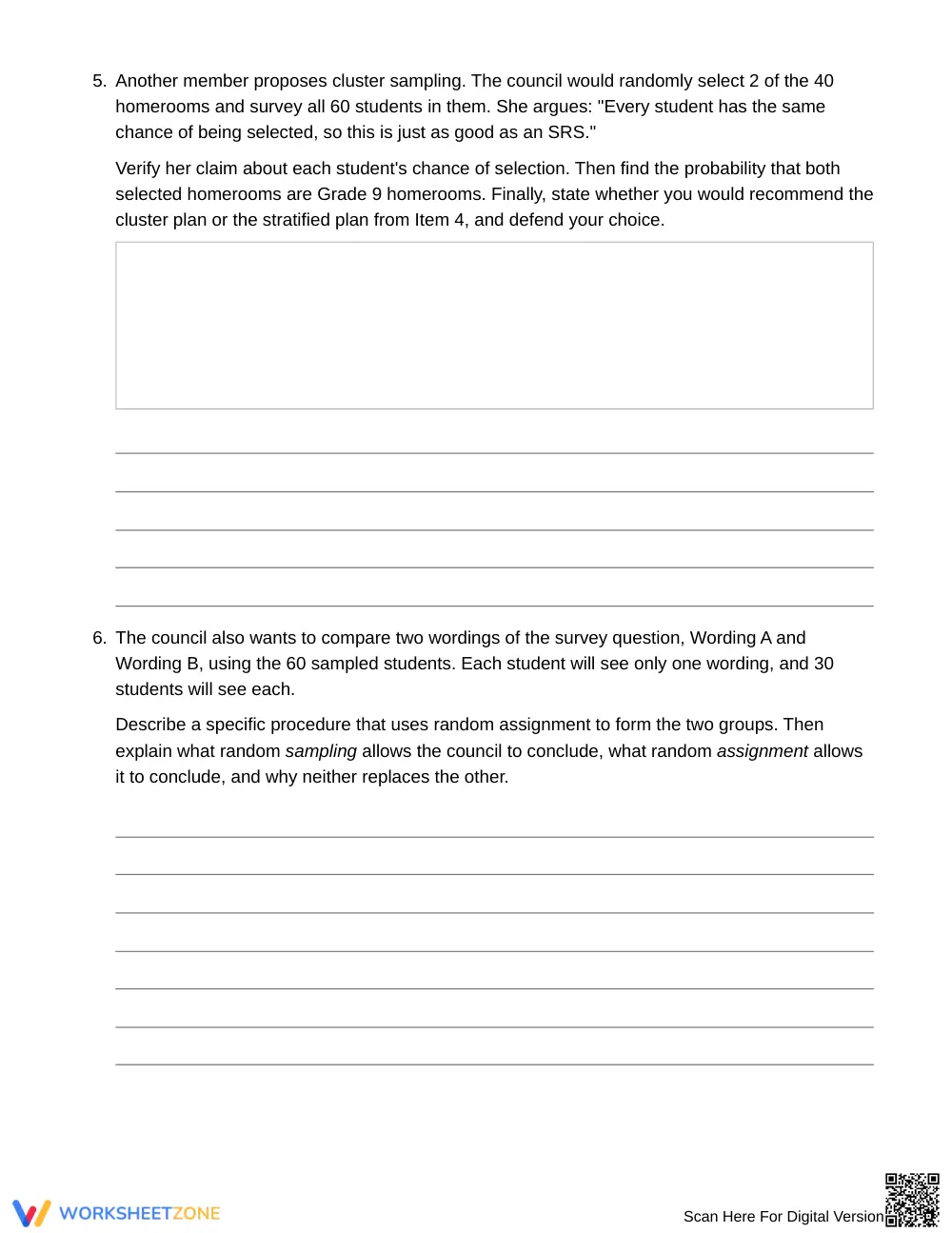
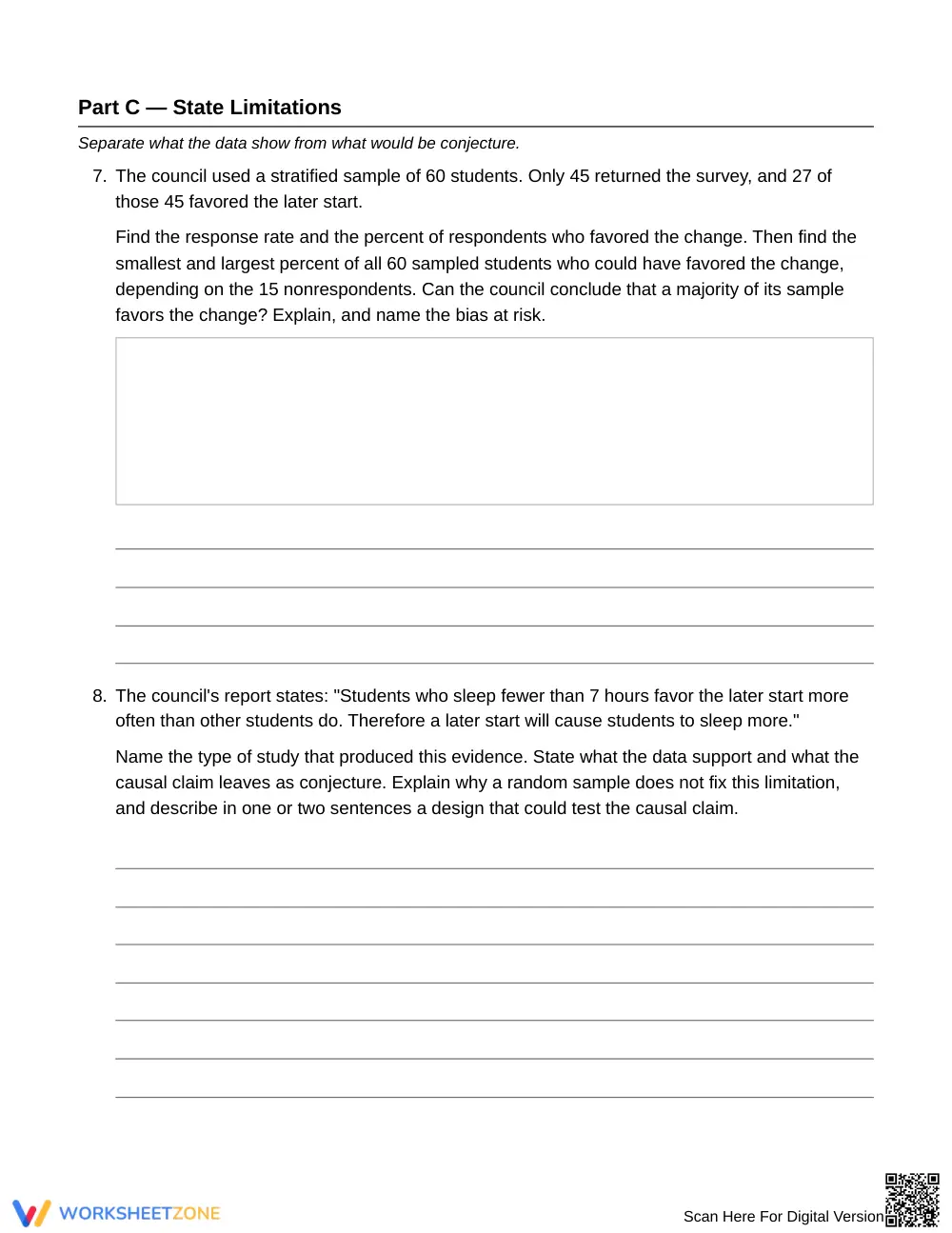
The 5-page PDF has 8 tasks in three parts: Establish Assumptions, Defend Design Decisions, and State Limitations. Students complete a definitions table, list random-digit selections, fill a proportional allocation table, check a cluster-sampling claim, and write random assignment procedures. A definitions box separates evidence from conjecture. A 4-page answer key follows.
Skill Progression
- Guided practice: Tasks 1–2 build the population, frame, unit, and parameter with a fill-in table and the definitions box.
- Supported practice: Tasks 3–6 apply SRS, stratified, cluster, and random assignment procedures using given formulas and data.
- Independent practice: Tasks 7–8 ask for nonresponse bounds, bias, and a critique of a causal claim.
The sequence follows a gradual-release pattern: I Do, We Do, You Do.
Standards Alignment
HSS-IC.B.3: Recognize the purposes of and differences among sample surveys, experiments, and observational studies; explain how randomization relates to each. This standard code can be copied directly into lesson plans, IEP goals, or district curriculum mapping tools.
How to Use It
- After direct instruction on sampling designs, assign Parts A and B as in-class practice.
- For end-of-unit review, assign all 8 tasks and treat Part C as a short assessment.
Formative tip: while students work, listen for whether they confuse random sampling with random assignment. Expect 45–60 minutes.
Who It's For
Grade 12 students in an introductory statistics course studying sampling methods and bias. Students who struggle with writing can answer Part A orally first, and advanced students can propose their own design for the final task. Pair it with an anchor chart comparing surveys, experiments, and observational studies.
HSS-IC.B.3 asks students to recognize the purposes of sample surveys, experiments, and observational studies and explain how randomization relates to each. This Grade 12 Statistics worksheet turns that standard into eight tasks built on one Lakeview High School start-time survey. Students define population, frame, unit, and parameter, select a simple random sample from a table of random digits, allocate a stratified sample, test a cluster-sampling claim with probability, and design a random assignment procedure. They also quantify nonresponse bias and identify why an observational result cannot support a causal claim. Fisher & Frey (2014) describe gradual release of responsibility, moving from modeled to guided to independent work, as a structure for building such reasoning, and this worksheet moves from setup to design to critique. A four-page answer key supports quick scoring, error analysis, and student feedback.


