




























Ready Juneteenth Word Search | Grades 4–5 Social Studies
Paste this activity's link or code into your existing LMS (Google Classroom, Canvas, Teams, Schoology, Moodle, etc.).
Students can open and work on the activity right away, with no student login required.
You'll still be able to track student progress and results from your teacher account.
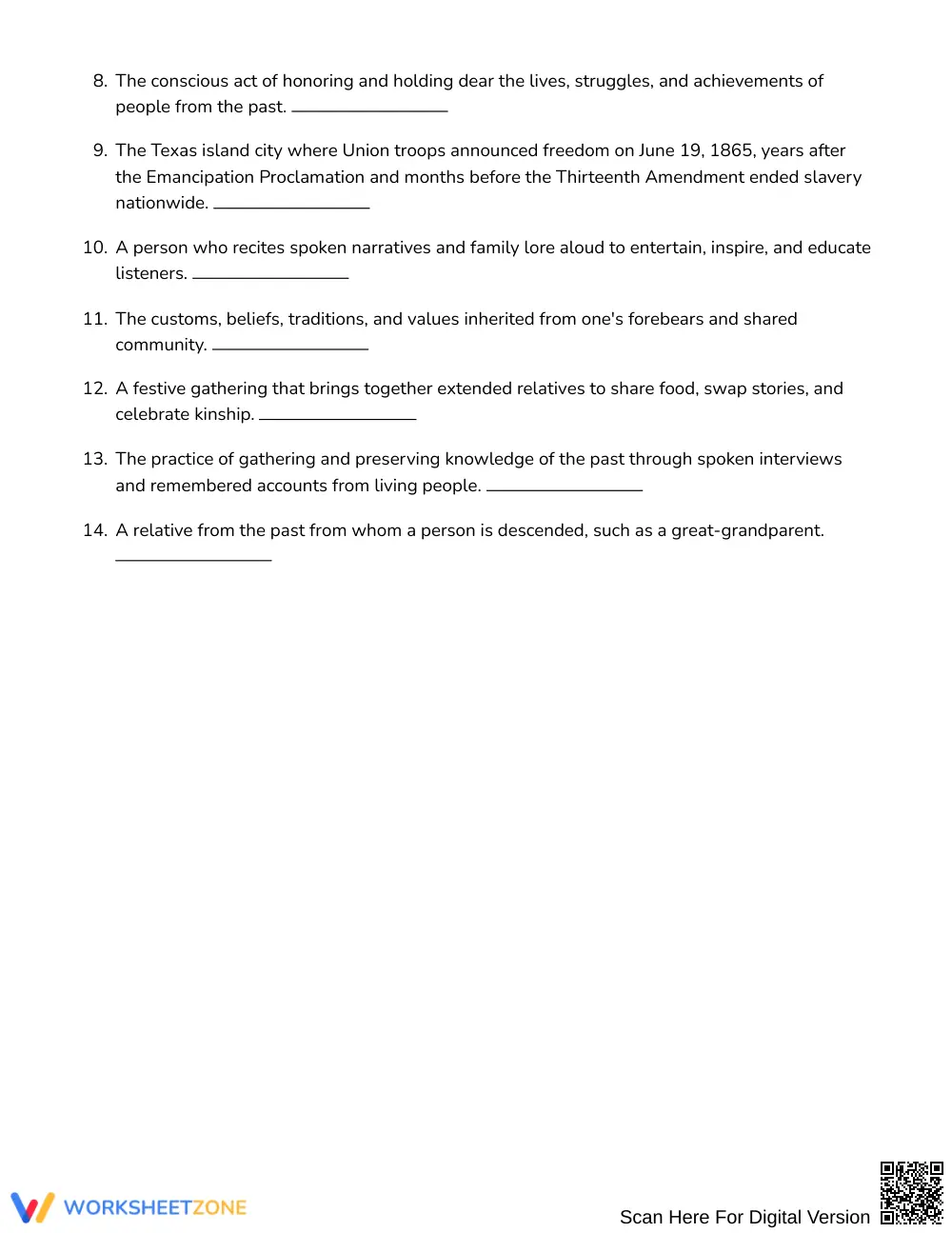
This Grades 4–5 Social Studies word search reinforces cultural vocabulary centered on Juneteenth family histories and oral traditions. Students read contextual historical clues to identify 14 key terms, connecting concepts like genealogy and community remembrance before locating each hidden word across the letter grid.
At a Glance
- Grade: Grades 4–5 · Subject: Social Studies
- Standard: Not standards-assessed — vocabulary enrichment through clue-based historical word study
- Skill Focus: Family histories, genealogy, and African American oral traditions
- Format: 3 pages · 14 words · Full answer key included · Printable PDF
- Best For: Juneteenth holiday cultural vocabulary enrichment and independent practice
- Time: 20–30 minutes
What's Inside
This 3-page printable activity features 14 thematic vocabulary words paired with rich informational clues. Rather than relying solely on a simple search list, learners read detailed descriptions for terms such as griot, genealogy, heirloom, and Galveston. The resource includes a shuffled word bank, clear student directions, and a complete 3-page answer key showing exact letter coordinates for quick verification.
Puzzle Structure and Mechanics
The activity is built on a 16 x 16 letter grid designed to engage upper elementary learners without unnecessary visual fatigue. Words are hidden in four specific directions: northeast (NE), east (E), southeast (SE), and south (S). Students review the clue detective definitions, confirm the term from the shuffled word bank, and track the target words through the grid.
Standards Alignment
This activity serves as dedicated vocabulary enrichment rather than a standards-assessed testing worksheet. It is not aligned to a formal state or Common Core standard code, functioning instead as a supplemental resource that strengthens historical vocabulary and cultural literacy during units on African American heritage and Juneteenth.
How to Use It
Deploy this word search during a Juneteenth unit as an engaging opening activity or as independent enrichment following direct instruction on Emancipation history. Teachers can monitor formative understanding by noting whether students can identify vocabulary words directly from the clues before scanning the grid. Most fourth and fifth graders will complete the puzzle in 20 to 30 minutes.
Who It's For
Designed for Grades 4–5 Social Studies classrooms, this resource supports diverse learners through built-in definition clues that reinforce reading comprehension alongside historical inquiry. It pairs naturally with children's literature about Juneteenth, anchor charts on African American oral storytellers, or family genealogy interview projects that prompt students to document their own traditions.
According to Fisher & Frey (2014), intentional content-area vocabulary acquisition flourishes when learners encounter domain-specific terms within meaningful context rather than through isolated rote memorization. This Grades 4–5 word search applies that instructional principle directly to the social studies exploration of family histories and oral traditions surrounding Juneteenth. By requiring students to read detailed definitional clues before locating 14 historical vocabulary words—including vital cultural concepts such as oral history, griot, testimony, and remembrance—the activity strengthens foundational comprehension without the cognitive barrier of decontextualized search grids. While intentionally not standards-assessed to provide flexible enrichment across diverse state curriculum frameworks, the intentional design ensures authentic, rigorous exposure to African American cultural heritage concepts. Educators obtain an engaging, evidence-informed tool that bridges historical awareness and language development, supporting long-term retention as upper elementary students examine how communities preserve generational memory across time.


