


























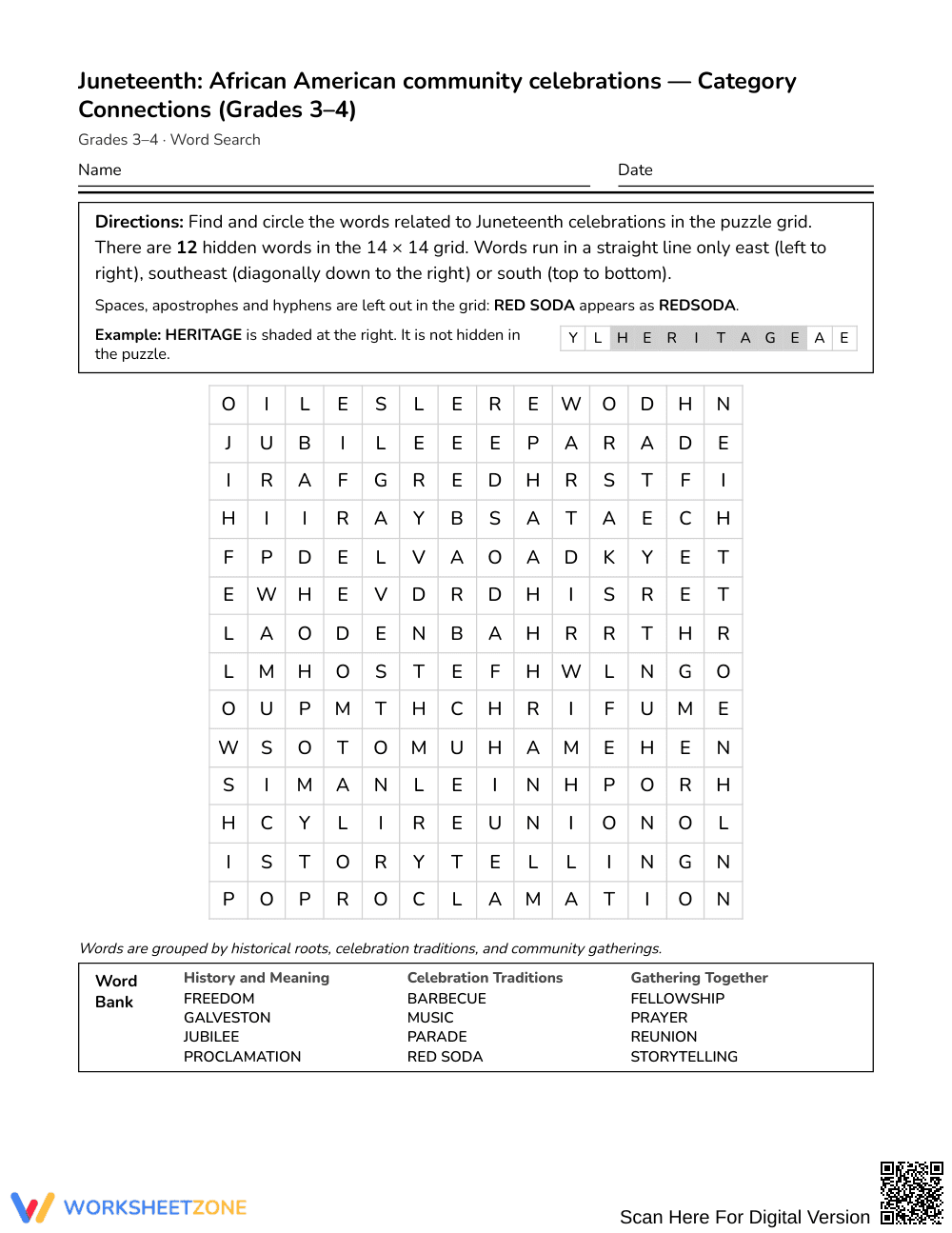

Ready Juneteenth Word Search | Grades 3–4 Social Studies
Paste this activity's link or code into your existing LMS (Google Classroom, Canvas, Teams, Schoology, Moodle, etc.).
Students can open and work on the activity right away, with no student login required.
You'll still be able to track student progress and results from your teacher account.
This Juneteenth word search introduces students in Grades 3–4 to key historical concepts and cultural traditions surrounding African American community celebrations. Learners strengthen social studies vocabulary and pattern recognition by locating twelve celebration terms grouped by historical significance, holiday customs, and communal fellowship in an accessible puzzle format.
At a Glance
- Grade: Grades 3–4 elementary learners · Subject: Social Studies
- Standard: Not standards-assessed — vocabulary enrichment
- Skill Focus: African American community celebrations and historical Juneteenth traditions
- Format: 1 student page · 12 hidden vocabulary words · Full answer key included · PDF document
- Best For: Juneteenth cultural vocabulary building, holiday stations, and independent practice
- Time: 15–25 minutes of focused puzzle-solving time
What's Inside
This activity provides a single-page printable student worksheet alongside a detailed three-page answer key that highlights exact letter coordinates. The worksheet presents a categorized word bank that groups twelve target terms under three distinct headings: History and Meaning, Celebration Traditions, and Gathering Together. This structure helps students connect individual terms to broader historical and cultural contexts.
How the Puzzle Works
The puzzle is structured to provide an engaging, age-appropriate challenge for elementary learners:
- Grid Dimensions: A compact 14 × 14 letter grid keeps word searches manageable and visual tracking focused.
- Search Directions: Words run in three accessible directions: East (left-to-right), Southeast (diagonal down), and South (vertical down), avoiding backward or upward orientations.
- Thematic Word Bank: Words are arranged conceptually rather than alphabetically, reinforcing meaning as students search for terms like Galveston, Jubilee, and Fellowship.
Standards Alignment
This resource serves as supplemental vocabulary enrichment and is not aligned to an individual state or national standard. It supports cultural literacy and social studies background knowledge by familiarizing students with historical milestones and community traditions associated with Juneteenth celebrations.
How to Use It
This activity functions effectively as an introductory hook prior to direct instruction on Emancipation, activating background knowledge about holiday traditions. Alternatively, assign it after a class read-aloud as an independent station task where students discuss how terms like barbecue and red soda symbolize celebration. During seatwork, observe whether students scan systematically by row or track letter clusters. Completion time ranges between 15 and 20 minutes.
Who It's For
This word search is designed for Grade 3 and Grade 4 elementary students exploring American history, Black history, and civic holidays. Pair this activity directly with an informational passage or a picture book detailing the events of June 19, 1865, in Galveston, Texas, to deepen conceptual comprehension.
Vocabulary acquisition in elementary social studies relies heavily on repeated, contextual exposure to domain-specific terminology. According to Fisher & Frey (2014), intentional word exposure coupled with thematic categorization significantly strengthens reading comprehension and conceptual retention across informational content areas. This 1-page word search supports Grade 3 and Grade 4 learners in building foundational familiarity with African American community celebrations and historical Juneteenth traditions. By categorizing twelve essential terms across historical roots, cultural customs, and community gatherings, the activity encourages active visual scanning and word recognition without cognitive overload. While designed strictly as non-assessed vocabulary enrichment rather than a formal standards-aligned measure, the resource provides an engaging entry point for classroom discussions regarding freedom, resilience, and civic heritage. Educators can reference this structured vocabulary resource when designing culturally responsive holiday units and introductory social studies learning centers.


