

































Ready Indirect Surveying Worksheet | Grade 12 Precalculus

Paste this activity's link or code into your existing LMS (Google Classroom, Canvas, Teams, Schoology, Moodle, etc.).
Students can open and work on the activity right away, with no student login required.
You'll still be able to track student progress and results from your teacher account.
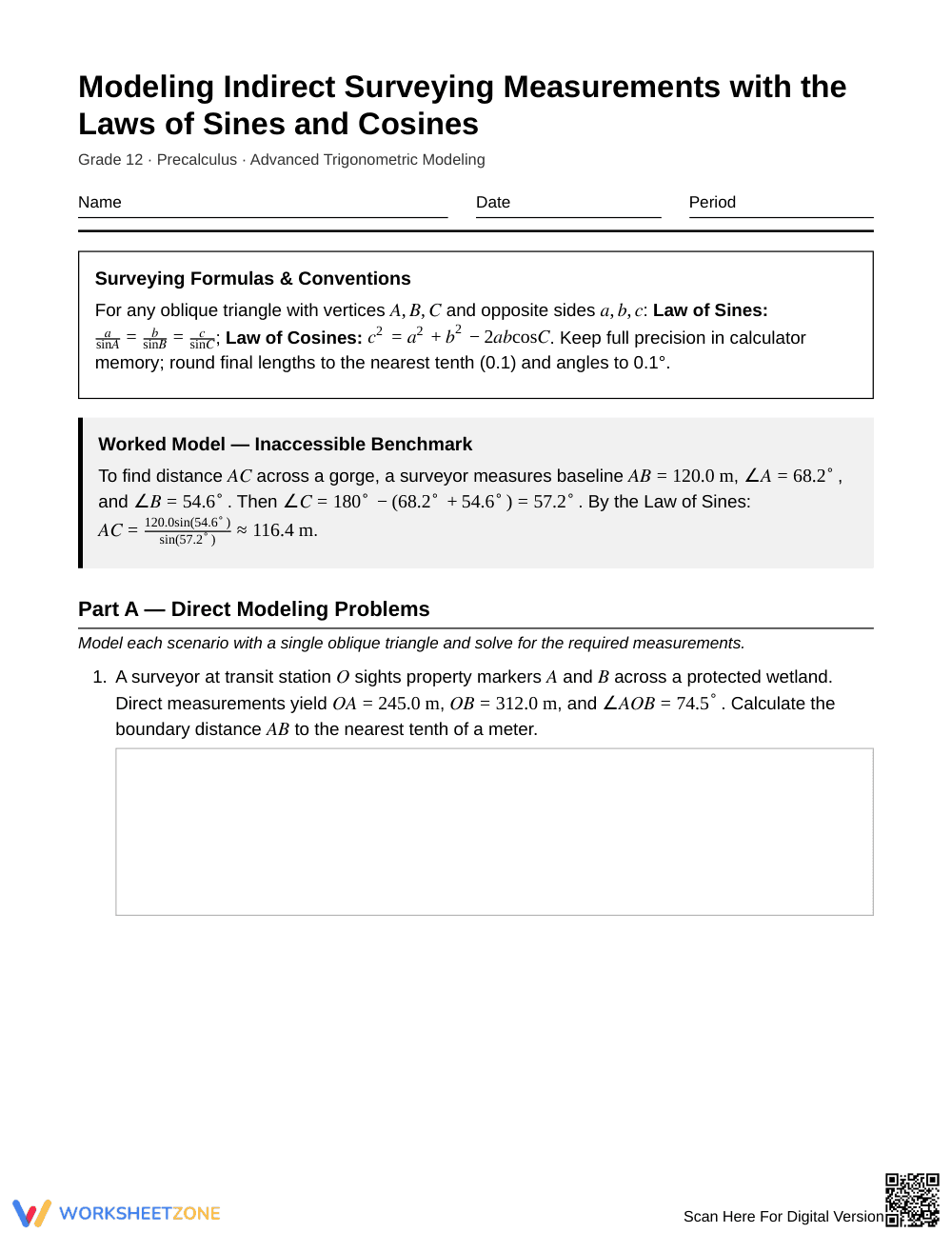
This advanced trigonometry resource trains twelfth-grade students to model real-world indirect surveying measurements using oblique triangle trigonometry. Learners apply the Law of Sines and the Law of Cosines to calculate inaccessible distances, resolve multi-triangle field traverses, and analyze measurement error across 10 authentic civil engineering and geographic scenarios.
At a Glance
- Grade: 12 · Subject: Precalculus
- Standard:
HSG-SRT.D.11— Apply the Law of Sines and Law of Cosines to indirect measurement problems- Skill Focus: Indirect Surveying Measurement Modeling
- Format: 4 pages · 10 problems · Answer key included · PDF
- Best For: Advanced trigonometry practice and technical modeling
- Time: 45–60 minutes
What's Inside
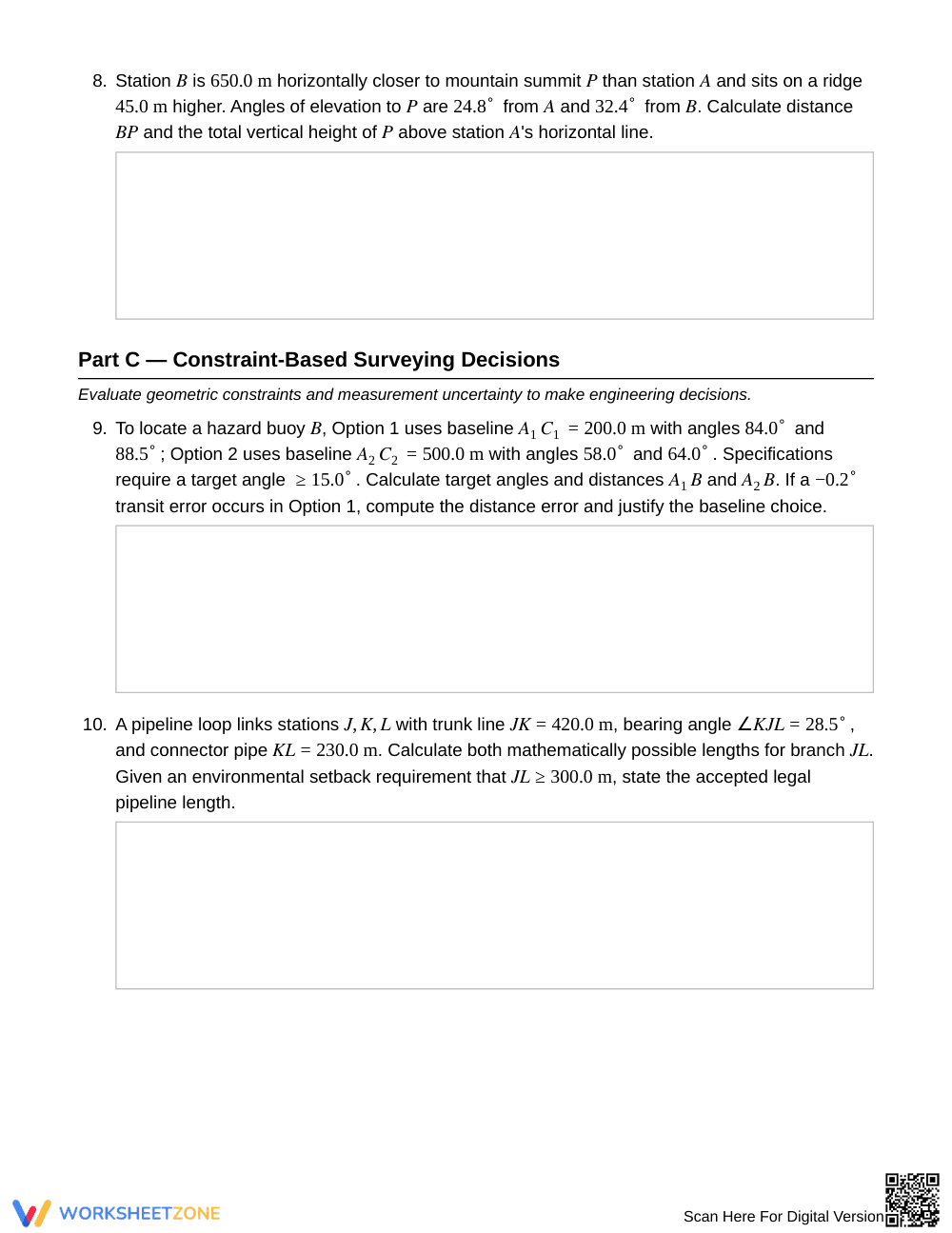
This 4-page worksheet includes a reference formula box, a fully worked oblique triangle model, and 10 multi-step modeling problems across three sections. Students encounter baseline measurements, composite traverses, incline elevations, ambiguous case verifications, and engineering error sensitivity calculations. A 2-page answer key provides intermediate calculations and rounded solutions.
Skill Progression
- Guided practice (Part A, 2 problems): Direct modeling setups establish transit baselines using the formula reference and worked example.
- Supported practice (Part B, 6 problems): Multi-step field scenarios require students to decompose complex traverses, calculate elevations on sloping ground, and evaluate ambiguous cases.
- Independent practice (Part C, 2 problems): Unscaffolded tasks challenge learners to evaluate transit measurement errors and verify legal property setbacks.
This progression follows the gradual release of responsibility model, guiding students toward independent engineering analysis.
Standards Alignment
The primary focus aligns to `HSG-SRT.D.11`: Understand and apply the Law of Sines and Law of Cosines to solve applied problems in oblique triangles. Supporting standard `HSG-MG.A.3` addresses geometric modeling in design problems. Both standard codes can be copied directly into lesson plans, IEP goals, or district curriculum mapping tools.
How to Use It
Deploy this worksheet after direct instruction on oblique triangle formulas or as an applied collaborative problem-solving lab. During work time, check students' preliminary triangle sketches; learners frequently confuse angles of elevation along sloped inclines. Most twelfth-grade Precalculus classes complete the 10 problems in 45 to 60 minutes.
Who It's For
This resource serves Grade 12 Precalculus students mastering advanced trigonometry applications. Offer coordinate grids for learners needing structural support on multi-step drawings. Pair this worksheet with an anchor chart illustrating Law of Sines ambiguous case criteria.
Grounded in the instructional architecture described by Fisher & Frey (2014), this precalculus modeling worksheet reinforces standard HSG-SRT.D.11 by guiding students through indirect surveying measurement modeling using the Law of Sines and Law of Cosines. High school seniors often struggle to transfer abstract trigonometry formulas to unstructured physical problems. By shifting instructional weight from isolated drills to authentic civil engineering tasks, the resource develops deep geometric reasoning. Students calculate inaccessible baselines, verify ambiguous boundary parcels, and quantify angular transit errors under professional survey constraints. The intentional gradual release model provides students with clear structural exemplars before requiring independent decomposition of composite traverses and real-world environmental setbacks. As Fisher & Frey (2014) demonstrate, systematically phasing out instructional scaffolds ensures learners internalize problem-solving schema, enabling twelfth-grade mathematicians to attain verifiable procedural fluency and conceptual mastery when tackling complex geometric modeling across STEM disciplines.


