


























Views
Downloads



Ready Independence Decision Worksheet | Grade 12 Statistics
Paste this activity's link or code into your existing LMS (Google Classroom, Canvas, Teams, Schoology, Moodle, etc.).
Students can open and work on the activity right away, with no student login required.
You'll still be able to track student progress and results from your teacher account.
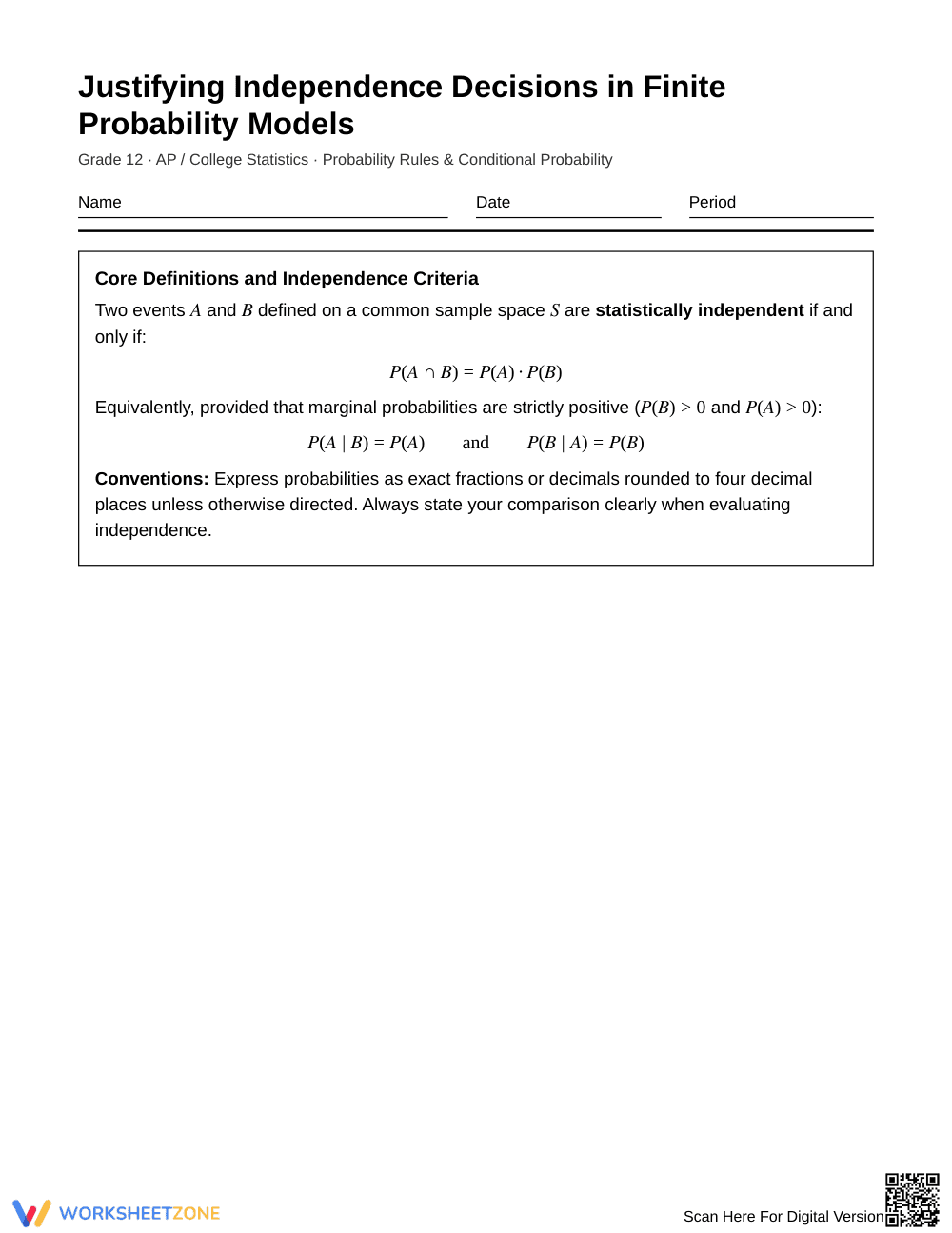
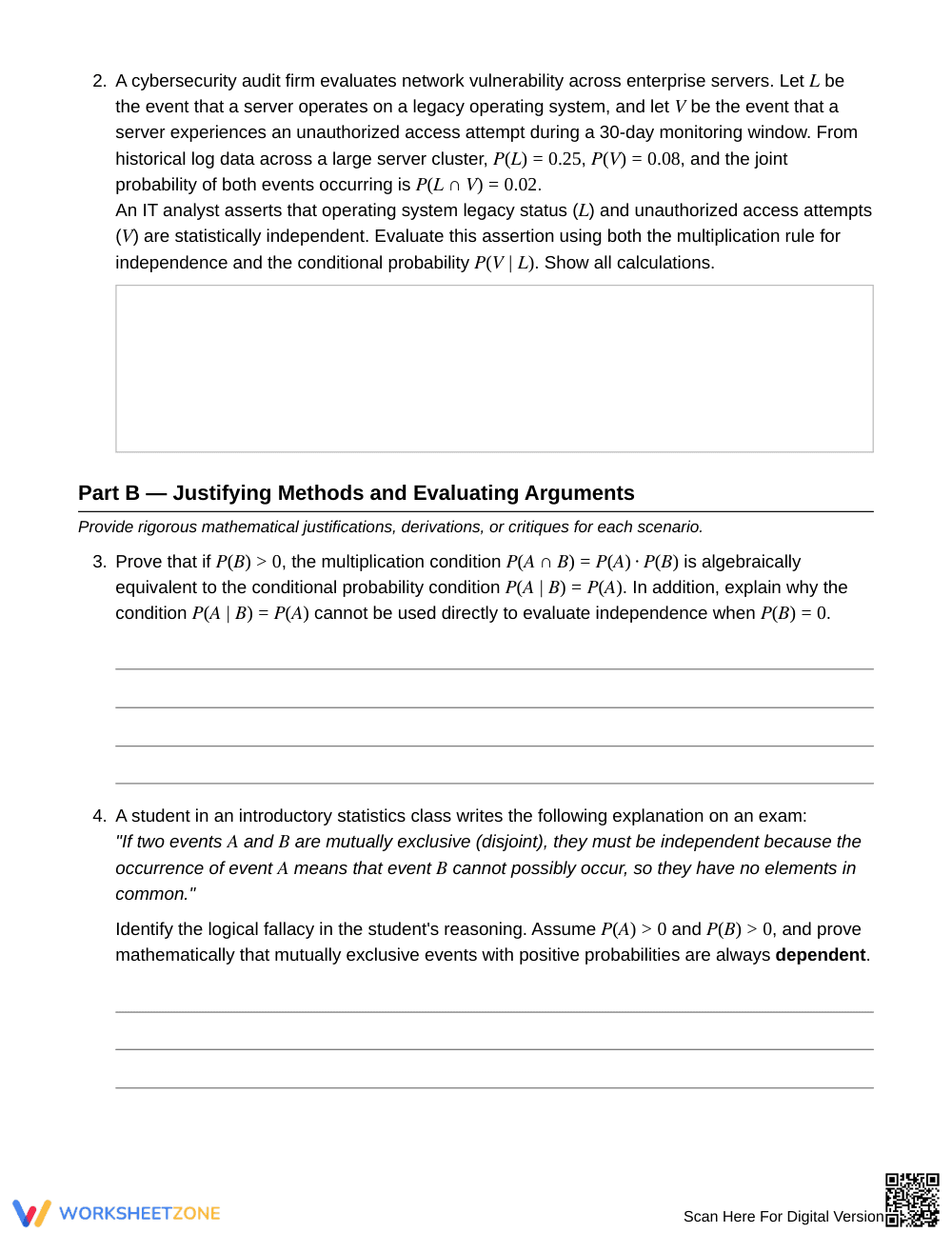
This probability worksheet equips Grade 12 statistics students to evaluate and justify whether two events are statistically independent. Students apply formal probability rules, compare joint and marginal distributions in contingency tables, critique common mutual exclusivity fallacies, and construct custom models demonstrating mathematical dependence.
At a Glance
- Grade: 12 · Subject: Statistics
- Standard:
HSS-CP.A.2— Determine whether two events are statistically independent using multiplication and conditional probability rules- Skill Focus: Justify an Independence Decision in Probability
- Format: 5 pages · 8 multi-part problems · Answer key included · PDF
- Best For: AP Statistics probability unit review and assessment prep
- Time: 45–60 minutes
This 5-page worksheet delivers 8 analytical problems grounded in real-world contexts, including automated optical chip inspection and server cybersecurity audits. Students complete formal proofs, calculate theoretical probabilities, and resolve misconceptions using a 2×2 contingency matrix. A complete 4-page answer key provides step-by-step arithmetic and model written explanations.
Skill Progression
- Guided practice (Part A, Problems 1–2): Students test independence claims using contingency tables and server logs, comparing joint and marginal probability products.
- Supported practice (Part B, Problems 3–6): Students prove algebraic equivalences, refute mutual exclusivity misconceptions, calculate missing joint values, and evaluate redundant sensor systems.
- Independent practice (Part C, Problems 7–8): Students analyze zero-probability boundary conditions and construct a dependent 2×2 distribution with equal 0.50 marginals.
This sequence follows gradual release principles, shifting students from guided numerical checks to independent theoretical modeling.
Standards Alignment
This resource aligns directly with `HSS-CP.A.2`: Understand that two events A and B are independent if the probability of A and B occurring together is the product of their probabilities, using this characterization to determine independence. It additionally supports `HSS-CP.A.3` by evaluating conditional probabilities P(A|B). Both standard codes can be copied directly into lesson plans, IEP goals, or district curriculum mapping tools.
How to Use It
Assign this worksheet following direct instruction on conditional probability as an AP exam review task or collaborative problem set. During class, monitor Part B to ensure students distinguish disjoint events from independent events rather than conflating them. Students typically complete all 8 tasks within 45 to 60 minutes.
Who It's For
This worksheet serves Grade 12 students in AP Statistics or college-level probability. Formula definitions support developing learners, while proof-based items challenge advanced students. Pair this resource with a two-way frequency table lesson or probability formula reference sheet.
According to EdReports 2024 instructional alignment criteria, high-quality secondary mathematics materials must demand both procedural computation and conceptual mathematical defense when evaluating categorical data distributions. This Grade 12 probability resource targets standard `HSS-CP.A.2` by teaching students to justify an independence decision through rigorous comparison of joint probabilities against the product of marginal probabilities. Rather than relying on superficial heuristic assumptions, students examine empirical contingency tables, verify algebraic equivalences between conditional probabilities and multiplication rules, and evaluate boundary conditions where disjoint events create strict mathematical dependence. Incorporating explicit counterexample construction ensures students move beyond mechanical formula substitution into genuine mathematical modeling and critical analysis. The eight structured analytical tasks provide educators with clear, observable evidence of student mastery, confirming that learners can articulate why probability distributions satisfy statistical independence across both theoretical and applied data contexts.


