
































Ready Half-Life Calculation Worksheet | Grades 9-12 Science

Paste this activity's link or code into your existing LMS (Google Classroom, Canvas, Teams, Schoology, Moodle, etc.).
Students can open and work on the activity right away, with no student login required.
You'll still be able to track student progress and results from your teacher account.
Mastering nuclear decay requires students to grasp both sequential logic and quantitative patterns. This comprehensive science worksheet guides high school students through half-life calculations by breaking decay into structured sequential steps. Learners sequence procedures, analyze particle models, plot exponential decay curves, and calculate isotope ages across four progressive stages of instruction.
At a Glance
- Grade: Grades 9–12 · Subject: High School Physical Science
- Standard: Scientific Modeling — Model radioactive decay processes and calculate isotope half-life stages quantitatively
- Skill Focus: Half-life sequencing, decay curve modeling, and quantitative problem solving
- Format: 4 pages · 29 problems · Answer key included · PDF
- Best For: Core nuclear chemistry and physics unit practice
- Time: 45–60 minutes
What's Inside
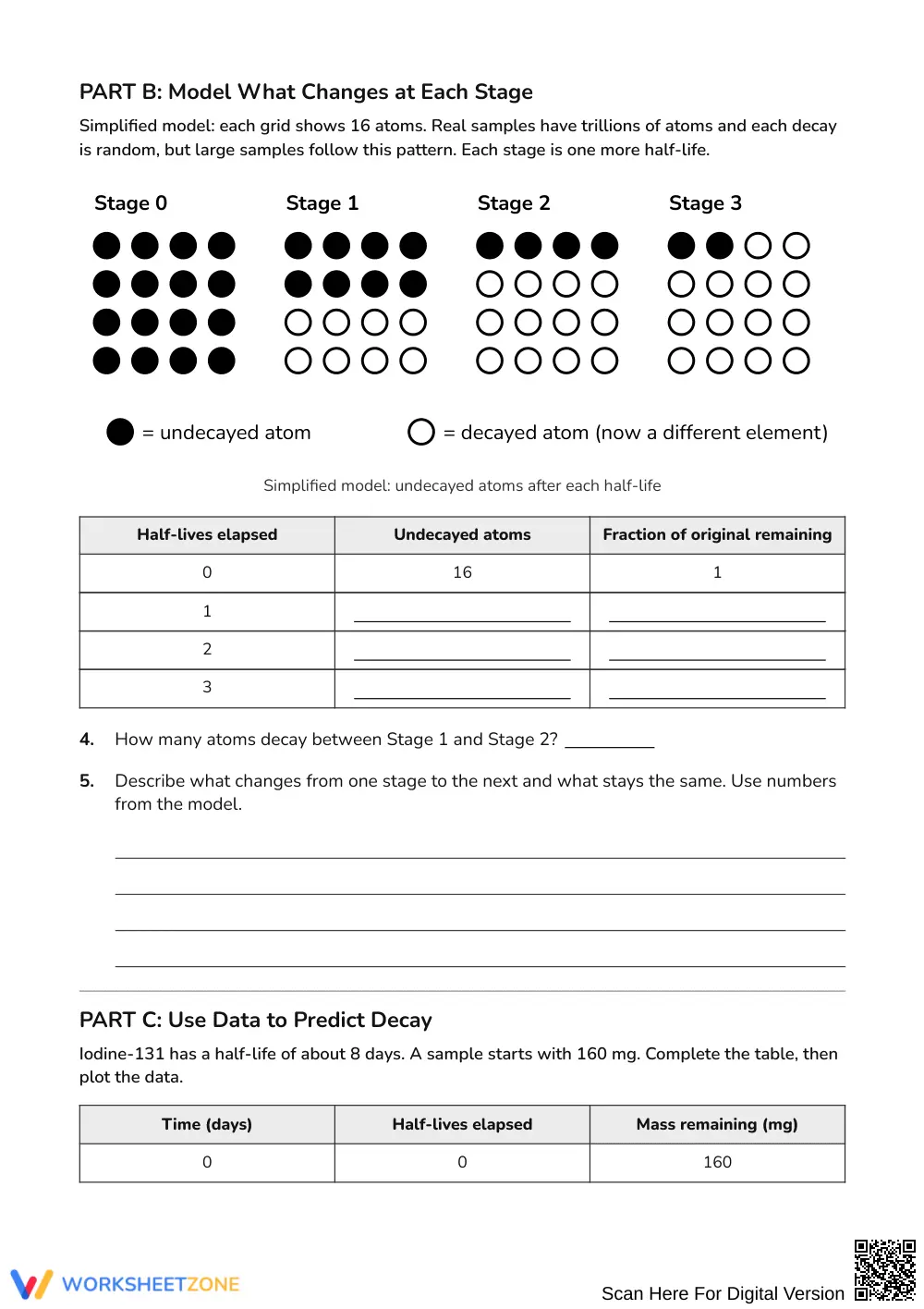
This 4-page print-and-go resource contains 29 targeted tasks distributed across four distinct instructional sections. Students interact with ordering prompts, visual atom grid models, data tables, and graphing grids. A complete 4-page answer key provides worked-out solutions, model explanations, and final numerical values for immediate evaluation.
Skill Progression
- Guided Practice (Part A): Students sequence the five algorithmic steps of a half-life calculation using technetium-99m and justify procedural dependencies.
- Supported Practice (Parts B & C): Learners analyze 16-atom visual decay grids and complete an 8-day Iodine-131 decay table before plotting an exponential curve.
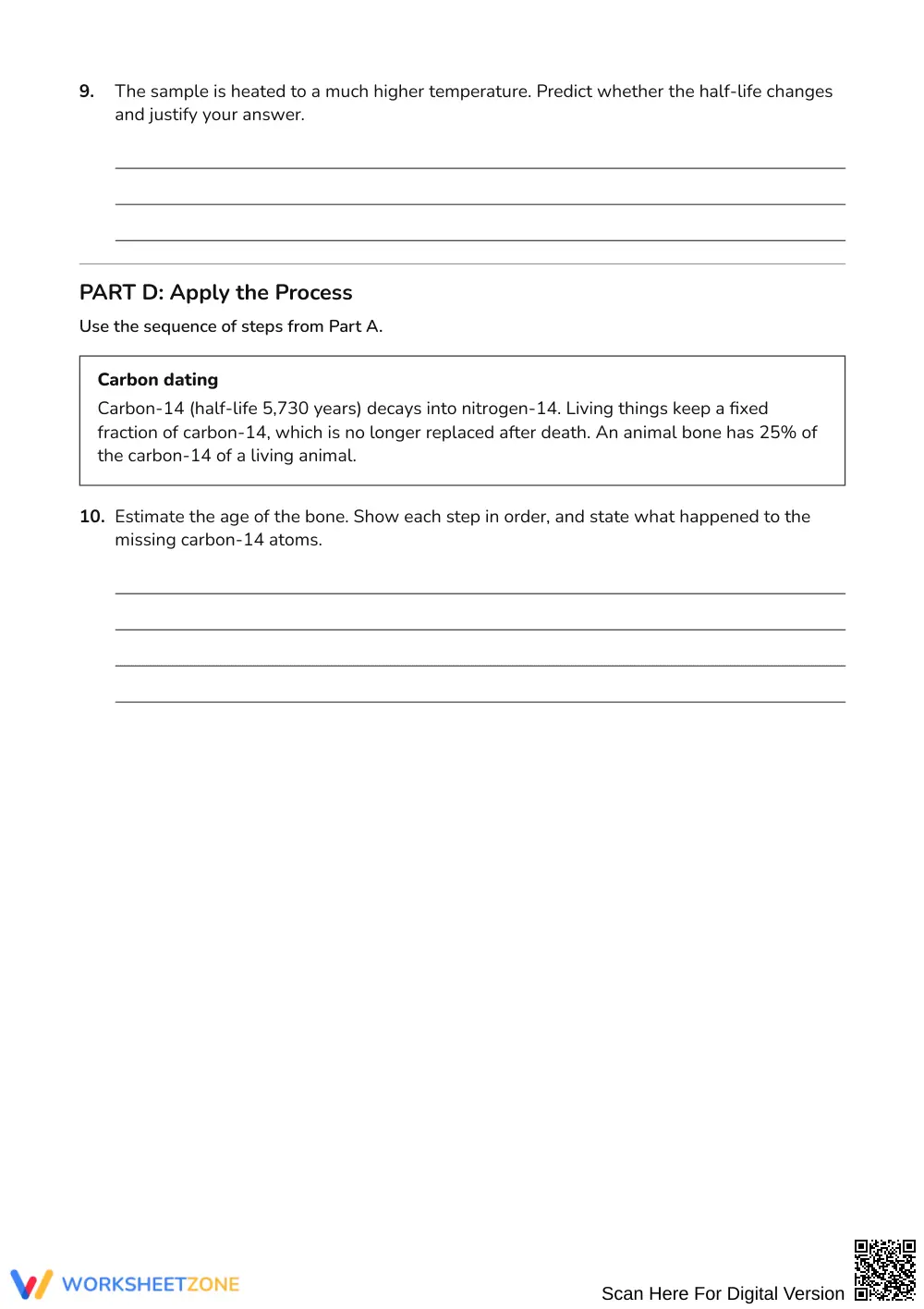
- Independent Practice (Part D): Students independently execute the learned multi-step protocol to determine bone age via carbon-14 dating.
This structured progression reflects the gradual-release framework, moving learners from conceptual ordering to fully independent quantitative execution.
Standards Alignment
This worksheet aligns with high school physical science performance expectations for nuclear processes and radioactive decay. Students construct models to illustrate changes in the composition of the nucleus of an atom and energy released during the decay process. The quantitative problem-solving tasks reinforce mathematical representations of exponential half-life rates. Both standard descriptions can be copied directly into lesson plans, IEP goals, or district curriculum mapping tools.
How to Use It
Assign Part A and Part B directly after direct instruction on nuclear decay to check conceptual comprehension before introducing logarithmic formulas. Use Part C and Part D as paired partner work during class or as independent homework. During work time, check whether students recognize that constant decay fraction yields decreasing decayed mass. Typical completion time is 45 to 60 minutes.
Who It's For
This resource supports on-level high school chemistry, physical science, and physics students learning nuclear decay. Scaffolded step-ordering aids struggling learners who need a concrete algorithm, while data prediction questions stretch advanced students. Pair this worksheet with an introductory nuclear decay anchor chart or direct instruction lecture on isotopes.
Structured problem sequencing is essential for developing procedural fluency and conceptual understanding in high school nuclear chemistry. According to Fisher & Frey (2014), gradual release of responsibility frameworks significantly improve student retention when decomposing complex multi-step science tasks into explicit, sequential stages. This worksheet applies that pedagogical model directly to radioactive decay and half-life calculations across 29 structured items. By prompting students to initially organize procedural steps, analyze visual atom models, graph exponential decay data, and independently solve carbon dating problems, the material scaffolds cognitive load systematically. Students not only compute numerical values but also articulate why decay rates remain constant despite diminishing absolute mass. Research confirms that integrating visual modeling with algorithmic practice ensures deeper scientific literacy and prevents common misconceptions regarding nuclear stability, making this resource an effective instructional tool for high school science classrooms.


