


























Views
Downloads

Ready Factor a Monic Trinomial Worksheet | Grade 9 Algebra I
Paste this activity's link or code into your existing LMS (Google Classroom, Canvas, Teams, Schoology, Moodle, etc.).
Students can open and work on the activity right away, with no student login required.
You'll still be able to track student progress and results from your teacher account.
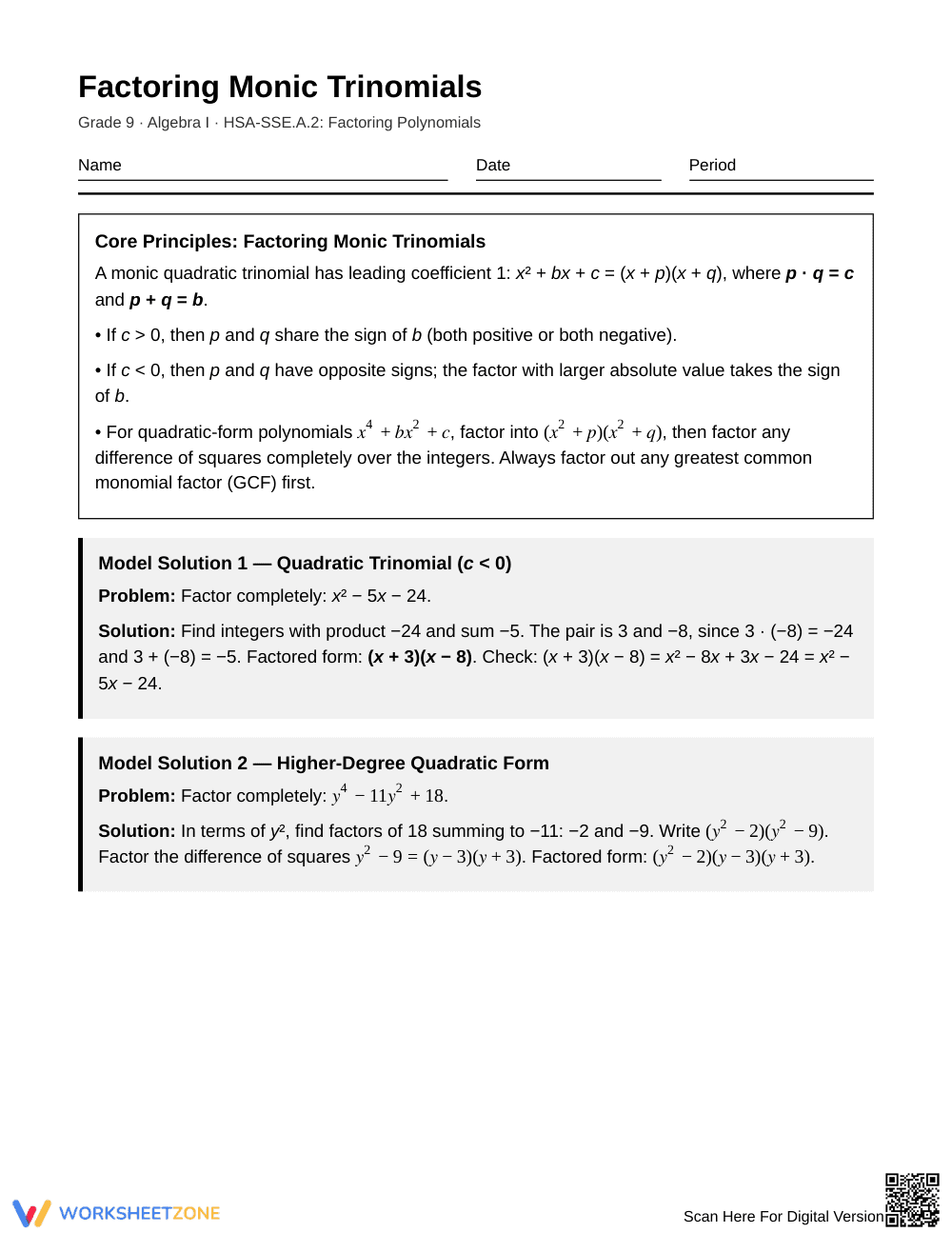
Students master factoring monic trinomials with this focused worksheet, moving from guided examples to independent challenges that reinforce the core algebraic skill of breaking down quadratic expressions into linear factors. Each problem builds confidence and deepens conceptual understanding, preparing learners for upcoming assessments and real‑world applications.
At a Glance
- Grade: 9 · Subject: Algebra I
- Standard:
HSA-SSE.A.2— Factor monic quadratic trinomials over the integers, reinforcing algebraic structure- Skill Focus: Factor a Monic Trinomial
- Format: 4 pages · 12 problems · Answer key included · PDF
- Best For: Guided practice and mastery of factoring – Ideal for classroom drills, homework, and test prep
- Time: 30–45 minutes
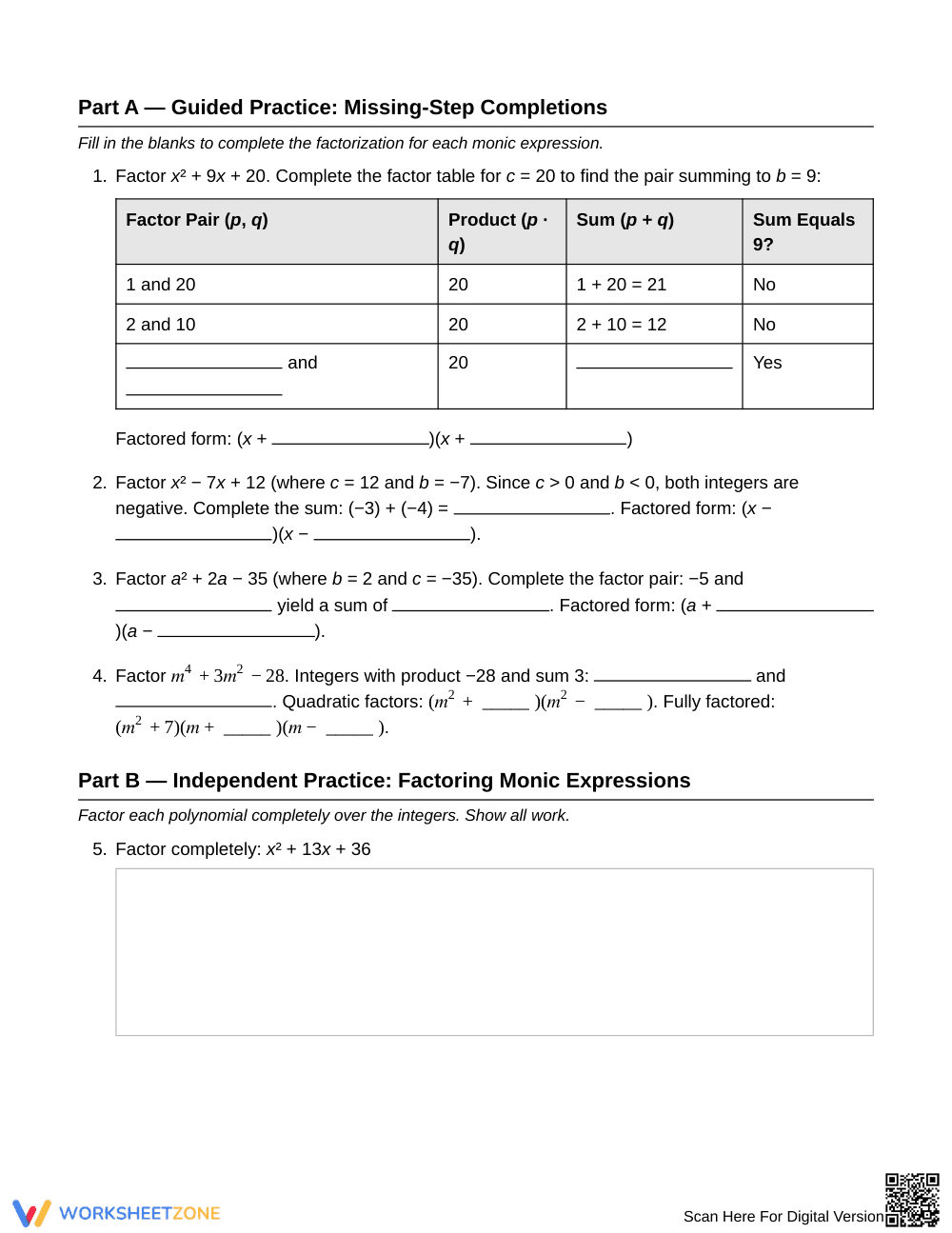
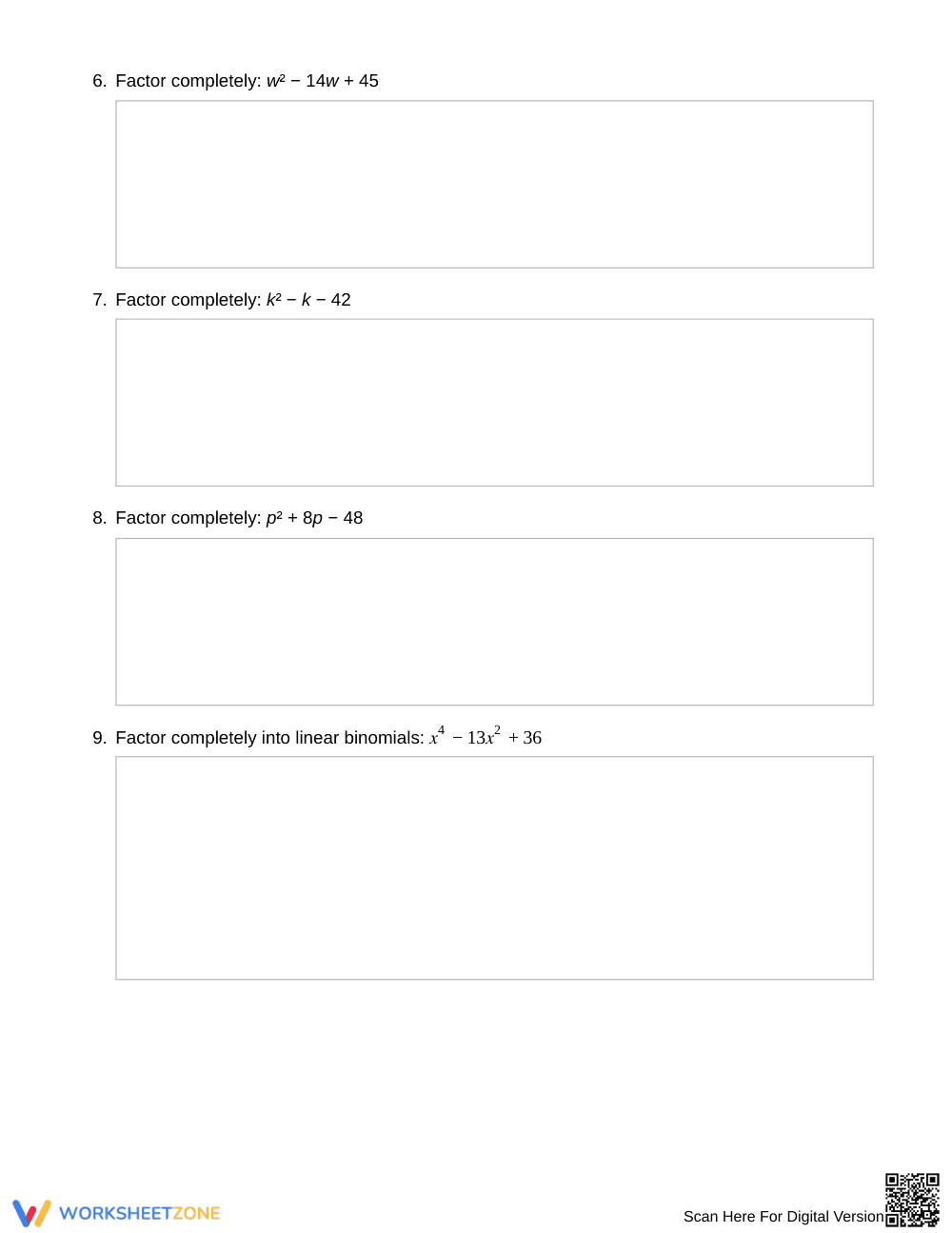
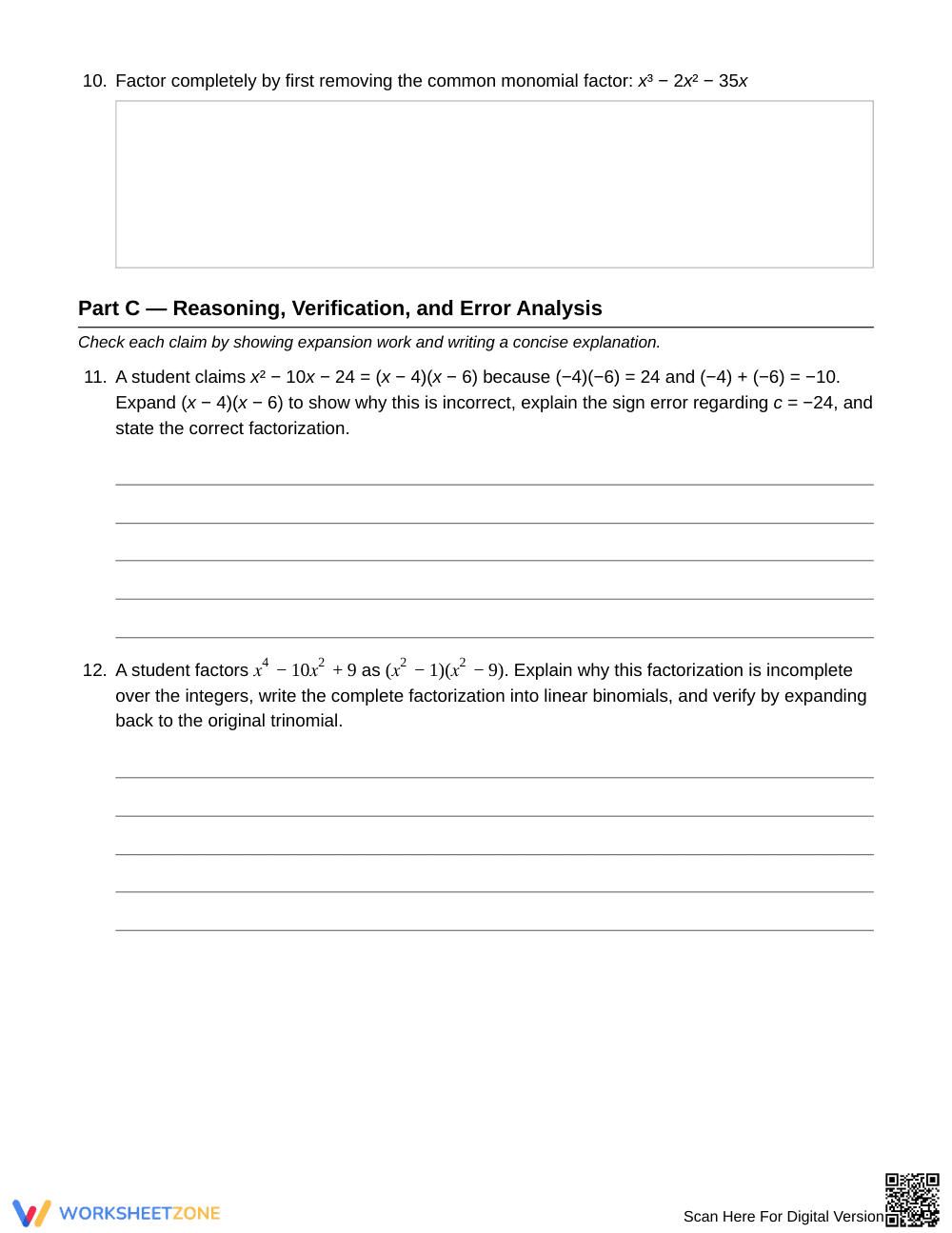
The worksheet spans four pages and contains twelve problems divided into guided practice, independent practice, and a reasoning section. An answer key occupies two pages. Students encounter missing‑step tables, complete‑the‑factor boxes, and error‑analysis prompts, with a model solution provided for each example.
Skill Progression
- Guided practice (4 problems): students fill in factor tables with provided pair lists, using the rule box as scaffold.
- Supported practice (4 problems): students complete full factorization blanks, relying on a word bank of common factor pairs.
- Independent practice (4 problems): students factor higher‑degree expressions and justify each step without prompts.
The sequence follows the classic I Do, We Do, You Do gradual‑release model.
Standards Alignment
`HSA-SSE.A.2` – Use factoring to rewrite monic quadratic trinomials as a product of linear binomials over the integers. Both standard codes can be copied directly into lesson plans, IEP goals, or district curriculum mapping tools.
How to Use It
- Before direct instruction: assign the guided‑practice section as a quick warm‑up to activate prior knowledge; observe which factor‑pair strategies students recall.
- During a lesson on factoring: use the independent‑practice problems for a formative check; collect a few responses to gauge mastery and provide immediate feedback.
Each activity typically requires 10–15 minutes, fitting neatly into a 45‑minute class block.
Who It's For
This resource targets Grade 9 Algebra I students who have learned basic multiplication facts and are ready to apply them to polynomial factoring. While the worksheet is single‑level, teachers can easily adjust difficulty by providing additional hints or extending the higher‑order problems. Pair it with an anchor chart of common factor‑pair patterns for seamless reinforcement.
Research indicates that explicit factor-pair instruction paired with systematic guided practice significantly improves procedural fluency and conceptual understanding in secondary mathematics (Fisher & Frey, 2014). When novice algebra students learn to identify factor pairs systematically, they reduce cognitive load and build the mental frameworks necessary for solving quadratic equations. Aligning structured classroom activities to standard HSA-SSE.A.2 ensures that students meet the rigorous Common Core expectation to factor monic quadratic trinomials, providing an essential foundation for subsequent units on graphing parabolas, finding zeros, and simplifying rational expressions. Furthermore, offering deliberate practice with scaffolded support allows educators to identify common misconceptions early, such as sign errors with negative constant terms. By integrating this four-page worksheet into regular instruction, educators deliver targeted, evidence-based practice that strengthens mathematical reasoning, reinforces structural awareness, and builds long-term student confidence in polynomial manipulation across diverse secondary learning environments.


