




























Views
Downloads


Ready Executive Duties Word Search | Grade 6 Social Studies

Paste this activity's link or code into your existing LMS (Google Classroom, Canvas, Teams, Schoology, Moodle, etc.).
Students can open and work on the activity right away, with no student login required.
You'll still be able to track student progress and results from your teacher account.
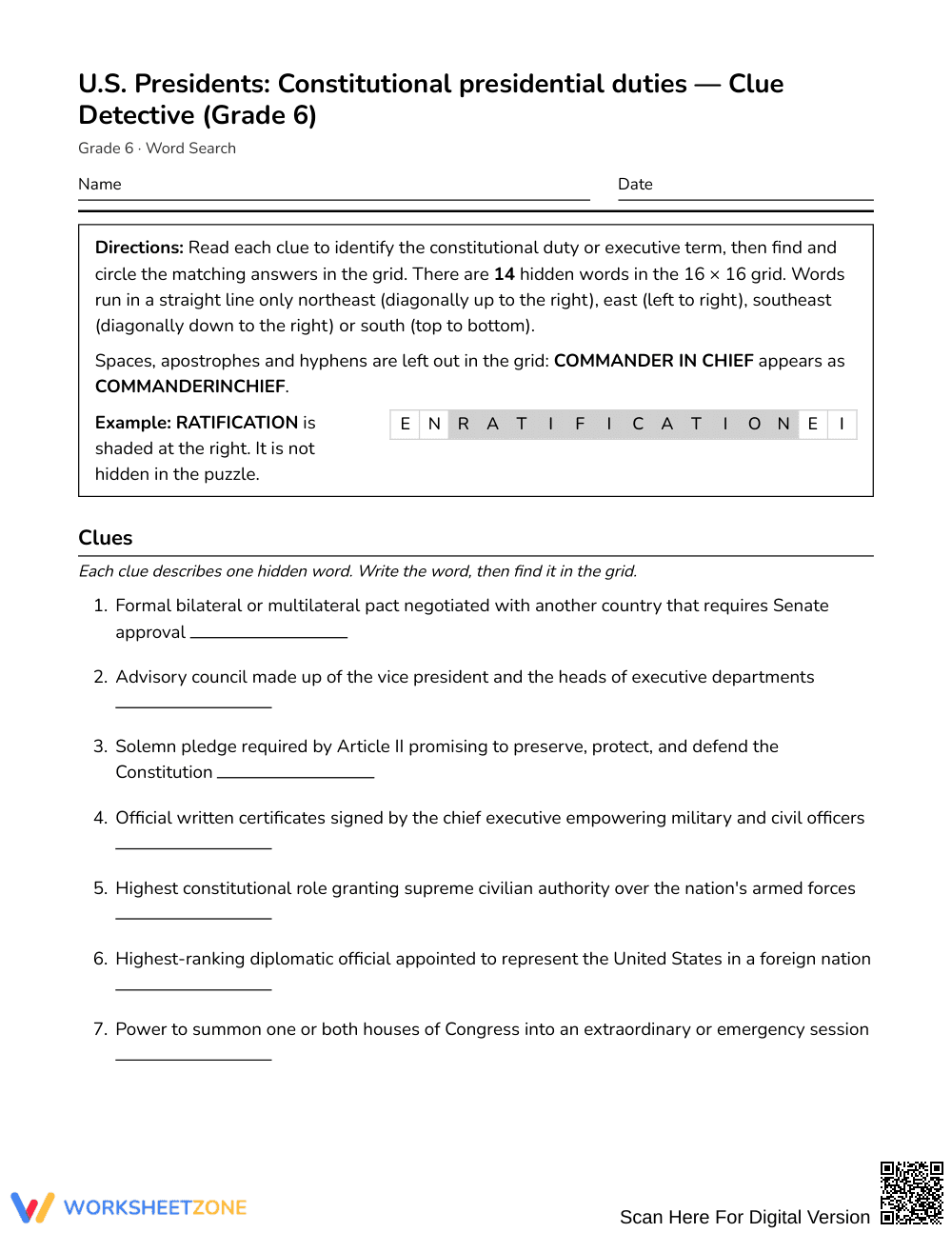
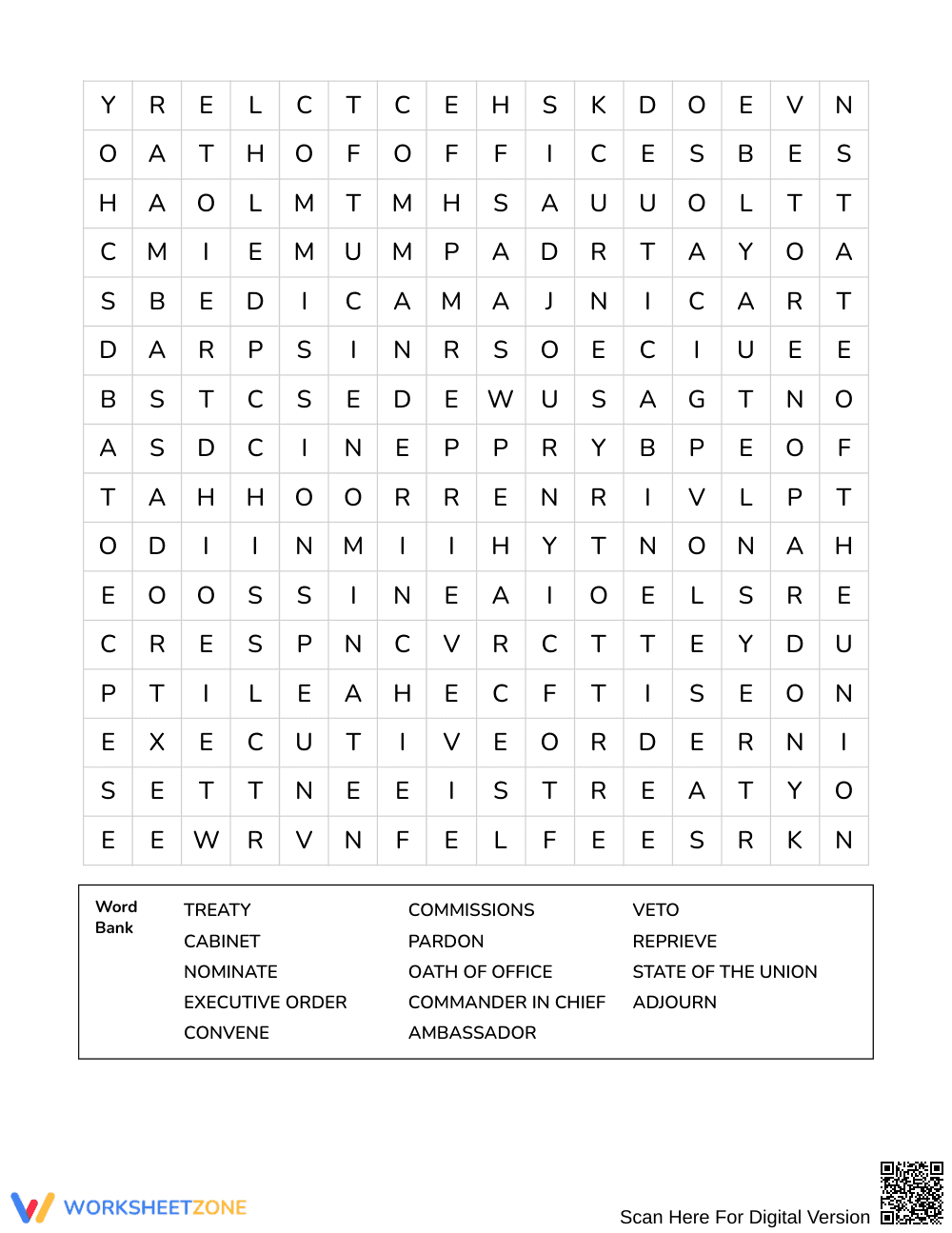
This Grade 6 civics word search reinforces constitutional presidential duties through active vocabulary retrieval. Students read 14 constitutional clues defining executive powers, identify key Article II terms, and locate them in the puzzle grid. The activity pairs content mastery with engagement, helping learners comprehend the American presidency.
At a Glance
- Grade: Grade 6 · Subject: Social Studies (Civics)
- Standard: Not standards-assessed — executive branch civics vocabulary enrichment and concept review
- Skill Focus: Constitutional presidential duties and executive powers
- Format: 3 pages · 14 words · Full answer key included · Printable PDF
- Best For: Unit review, vocabulary stations, or emergency sub plans
- Time: 20–30 minutes of independent practice
What's Inside
The 3-page PDF features 14 high-utility civics terms grounded in Article II of the U.S. Constitution. Rather than searching an ordinary word list, students solve definitional clues for terms like veto, treaty, pardon, and commander in chief. A complete 3-page answer key provides clear solution paths for efficient teacher review.
Puzzle Mechanics
Students navigate a 16 × 16 letter grid containing 14 embedded vocabulary terms. Hidden words run across four directions: northeast (NE), east (E), southeast (SE), and south (S). This directional structure maintains accessible scanning without backward or upward orientations. Students deduce target words from clues before searching the grid, transforming word-finding into meaningful retrieval practice.
Standards Alignment
This social studies activity is designed for vocabulary enrichment and is not aligned to a standard. It strengthens domain-specific civic literacy by familiarizing Grade 6 students with essential Article II terminology, including cabinet appointments, executive orders, and the State of the Union. Teachers can integrate this puzzle to support broader units on constitutional government.
How to Use It
Assign this word search after direct instruction on the executive branch for independent reinforcement or station work. For formative assessment, observe whether students identify terms from the clues before searching or rely primarily on letter matching. Expect students to complete the 14-word puzzle in 20 to 30 minutes.
Who It's For
This resource is built for Grade 6 social studies students learning the structure of the presidency. For differentiation, provide English learners with an Article II reference sheet to support clue comprehension. Pair this activity with an introductory reading on presidential roles or a constitutional checks-and-balances graphic organizer.
Civic vocabulary acquisition requires students to encounter domain-specific terms within meaningful instructional contexts rather than through rote memorization. Research by Fisher & Frey (2014) highlights that purposeful vocabulary tasks combining contextual definitions with active processing significantly increase retention of specialized academic language across middle school content areas. By requiring Grade 6 learners to analyze constitutional clues before locating 14 hidden executive terms, this word search bridges reading comprehension and civics concept mastery. The puzzle reinforces essential terminology regarding constitutional presidential duties, Article II executive powers, and separation of powers frameworks. Integrating definitional clues with structured spatial scanning allows students to consolidate abstract governmental mechanisms into lasting conceptual knowledge. Educators can utilize this 3-page printable activity during social studies units to ensure middle school learners build the foundational civic literacy necessary for evaluating presidential responsibilities and democratic governance.


