































Ready Evidence Sharing Word Search | Grades 6–7 Science

Paste this activity's link or code into your existing LMS (Google Classroom, Canvas, Teams, Schoology, Moodle, etc.).
Students can open and work on the activity right away, with no student login required.
You'll still be able to track student progress and results from your teacher account.
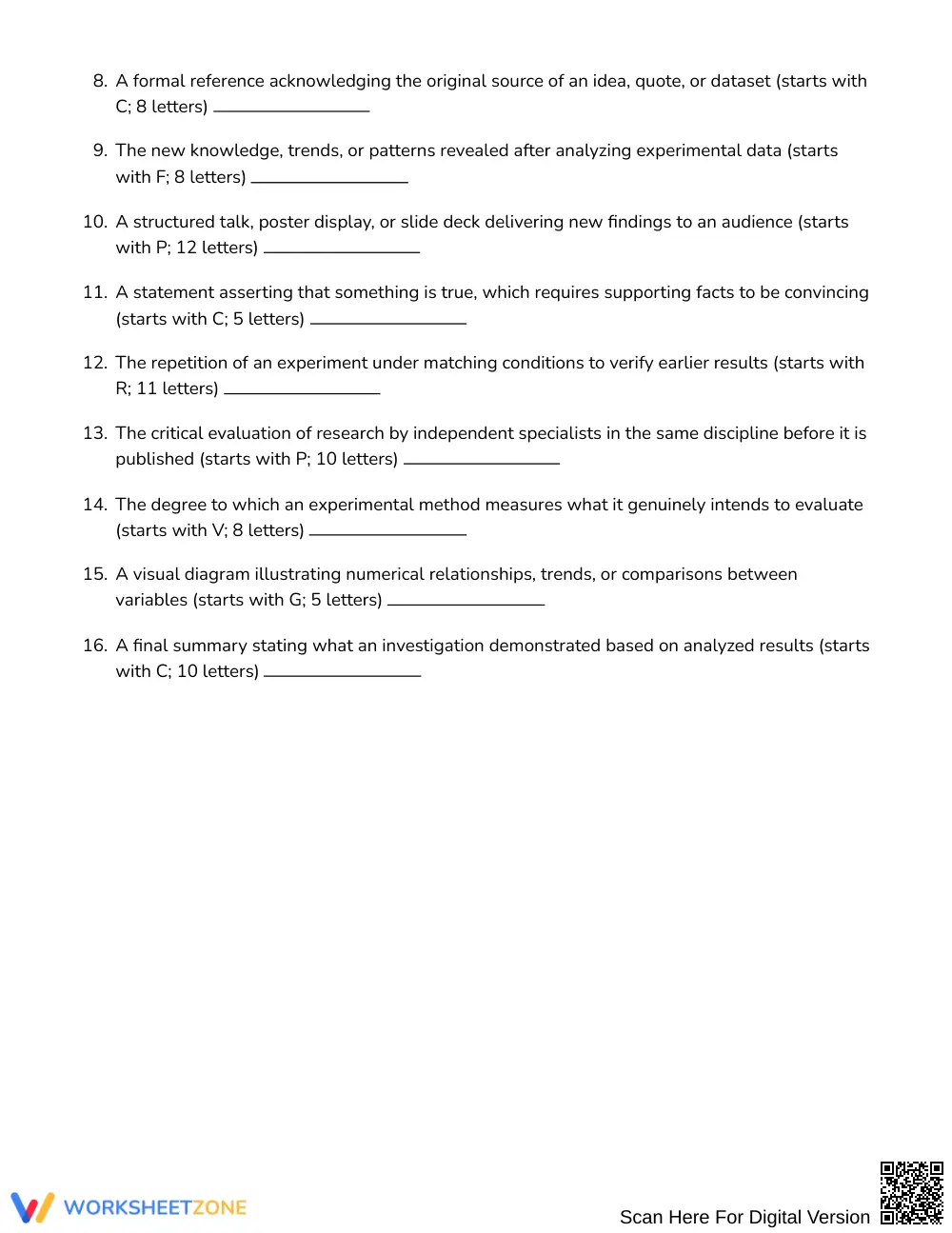
This vocabulary word search reinforces essential terminology for sharing discoveries with evidence across Grades 6–7 science classes. Middle school students analyze 16 clues to identify terms like claim, reasoning, and peer review before locating them in a grid, strengthening scientific literacy and academic communication.
At a Glance
- Grade: Grades 6–7 · Subject: Science
- Standard: Not standards-assessed — vocabulary enrichment
- Skill Focus: Sharing discoveries with evidence
- Format: 3 printable student pages · 16 hidden vocabulary words · Full 4-page answer key included · PDF document
- Best For: Middle school vocabulary review, early finishers, and unit reinforcement
- Time: 25–35 instructional minutes
What's Inside
This 3-page printable activity features a challenging word search focusing on 16 core scientific terms. Rather than providing a standard word bank, the resource supplies 16 rigorous definition clues that require students to deduce target vocabulary, such as replication, methodology, hypothesis, and validity. A complete 4-page answer key provides both term solutions and full visual grid placements.
Puzzle Structure and Mechanics
The puzzle is built on an 18 x 18 grid arranged as a no-bank challenge. Learners solve 16 clues detailing scientific evidence principles, then search for those terms in all eight directions: North, Northeast, East, Southeast, South, Southwest, West, and Northwest. This layout encourages close scanning and active recall rather than passive letter matching.
Standards Alignment
This resource provides targeted vocabulary enrichment and is not aligned to an assessed standard. While it does not align to an official code, these terms directly support middle school scientific inquiry and laboratory reporting practices. Mastering concepts like data, citation, and findings equips students to interpret informational science texts and communicate results accurately.
How to Use It
Use this word search as an engagement activity before direct instruction on scientific argumentation to activate prior knowledge. Alternatively, assign it after an inquiry unit to consolidate technical vocabulary. Formatively observe whether students deduce terms from clues independently or require peer discussion. The entire puzzle requires roughly 25 to 35 minutes to finish.
Who It's For
This activity is designed for Grades 6–7 science students, while also supporting English learners through explicit definitional practice. Teachers can differentiate by providing initial letter hints for struggling learners or challenging advanced students to write original sentences with each word. Pair this resource with a Claim-Evidence-Reasoning anchor chart during introductory inquiry lessons.
Vocabulary acquisition in secondary science classrooms directly underpins academic achievement and evidence-based argumentation. Although designated as a non-standards-assessed vocabulary enrichment resource rather than an assessed standard code, this Grades 6–7 puzzle explicitly develops student mastery in sharing discoveries with evidence. As established by Fisher & Frey (2014), academic language acquisition requires students to encounter, define, and actively manipulate domain-specific terminology within meaningful instructional contexts. By replacing a conventional word list with 16 rigorous definition clues, this no-bank word search prompts middle school learners to retrieve conceptual definitions for terms such as peer review, replication, and validity before scanning an 18 x 18 grid. This dual cognitive task strengthens semantic associations and prepares students to articulate scientific conclusions with technical accuracy, reinforcing foundational communication practices that support cross-disciplinary literacy and experimental inquiry across middle school science learning environments.


