


























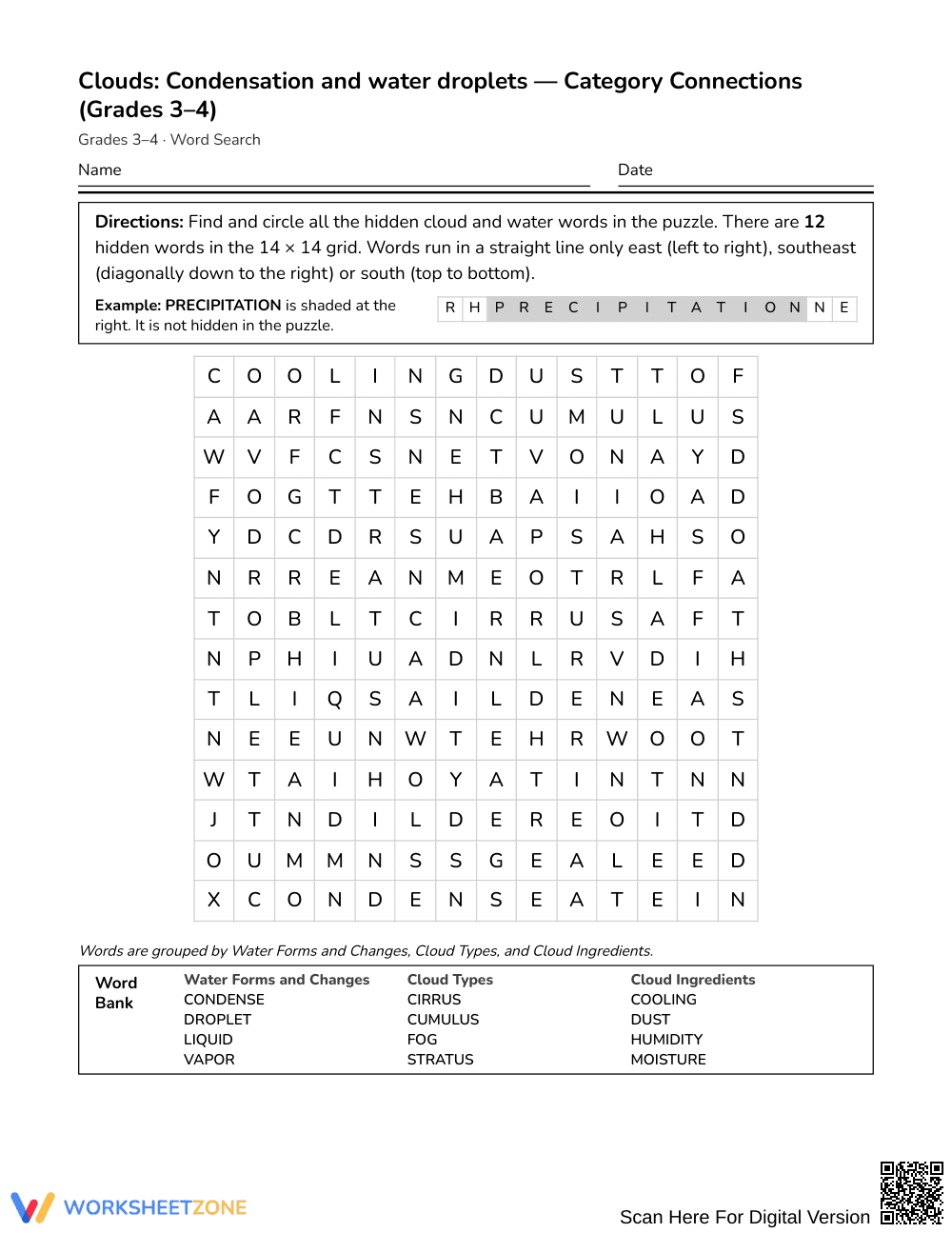

Ready Cloud Condensation Word Search | Grades 3–4 Science
Paste this activity's link or code into your existing LMS (Google Classroom, Canvas, Teams, Schoology, Moodle, etc.).
Students can open and work on the activity right away, with no student login required.
You'll still be able to track student progress and results from your teacher account.
This Grades 3–4 science word search reinforces foundational earth science vocabulary centered on condensation and cloud formation. Students locate and identify 12 key terms arranged by conceptual category, reinforcing how atmospheric water vapor transforms into droplets, cloud formations, and visible weather phenomena.
At a Glance
- Grade: Grades 3–4 · Subject: Science
- Standard: Not standards-assessed — vocabulary enrichment
- Skill Focus: Condensation and water droplets
- Format: 1 page · 12 words · Answer key included · PDF
- Best For: Science unit vocabulary review
- Time: 15–20 minutes
What's Inside: The printable puzzle delivers an accessible layout designed for independent student completion. The activity features a 1-page puzzle containing 12 vocabulary terms organized into three thematic categories: Water Forms and Changes, Cloud Types, and Cloud Ingredients. A 3-page answer key provides clear solution pathways for fast grading or student self-checking.
Puzzle Structure and Mechanics
This activity utilizes a 14 × 14 grid where all 12 vocabulary terms are hidden across three reading directions: East (horizontal left-to-right), Southeast (diagonal downward-right), and South (vertical top-to-bottom). Words never run backward or upside-down, keeping visual scanning developmentally appropriate for elementary learners. Rather than an unorganized list, terms are grouped into three distinct categories to reinforce conceptual associations: Water Forms and Changes (condense, droplet, vapor, liquid), Cloud Types (cumulus, stratus, cirrus, fog), and Cloud Ingredients (cooling, dust, moisture, humidity).
Standards Alignment
This science word search functions strictly as supplementary vocabulary enrichment and is not formally aligned to a specific state or national content standard. Instead, it serves to reinforce content-area literacy and terminology introduced during atmospheric water cycle units.
How to Use It
This puzzle works well at two distinct instructional moments. First, use it as a mid-unit activator directly following direct instruction on condensation, prompting students to connect cloud ingredients with state changes. Second, assign it as a low-stress review task for early finishers or substitute lesson plans. During completion, circulate to observe whether students recognize the conceptual categories or merely search for letter strings; ask students to verbally explain why "dust" and "cooling" share the Cloud Ingredients category. Expect completion in 15 to 20 minutes.
Who It's For
This activity is designed for Grades 3–4 elementary science learners building basic environmental science literacy. The categorized word bank assists emerging readers and English learners by providing semantic anchors. Pair this word search with a hands-on cloud-in-a-jar demonstration or an illustrated anchor chart detailing the water cycle.
Content-area vocabulary acquisition requires intentional exposure and conceptual grouping to solidify scientific understanding. According to Fisher & Frey (2014), structured vocabulary tasks that cluster specialized terms into meaningful categories enable elementary students to build durable domain knowledge rather than memorizing definitions in isolation. By presenting atmospheric concepts within a defined 14 by 14 letter matrix, this puzzle strengthens orthographic recognition while reinforcing relational schema between water states, cloud forms, and physical ingredients. Students engage in active visual scanning across directional paths, reinforcing the spelling and morphological structures of challenging academic terms such as condensation, humidity, and stratus. When embedded within an environmental science unit, targeted vocabulary activities help students bridge conversational language and formal scientific discourse, creating the necessary cognitive foundation for subsequent lessons on weather systems, precipitation cycles, and atmospheric dynamics across elementary grade bands.


