




























Ready Climate Scenario Worksheet | Grade 12 Earth Science
Paste this activity's link or code into your existing LMS (Google Classroom, Canvas, Teams, Schoology, Moodle, etc.).
Students can open and work on the activity right away, with no student login required.
You'll still be able to track student progress and results from your teacher account.
This Grade 12 Earth science worksheet equips students to evaluate regional climate scenarios through thermodynamic energy balance and atmospheric dynamics. High school seniors analyze multi-decadal observational data across inland basins and coastal estuaries, calculating radiative fluxes and assessing feedbacks that drive localized climate shifts.
At a Glance
- Grade: 12 · Subject: Earth & Space Science
- Standard: Advanced Earth Systems — Analyze multi-variable climate data to model regional atmospheric dynamics and energy balance
- Skill Focus: Regional Climate Scenario Analysis
- Format: 5 pages · 10 problems · Answer key included · PDF
- Best For: Advanced atmospheric thermodynamics review and exam preparation
- Time: 45–60 minutes
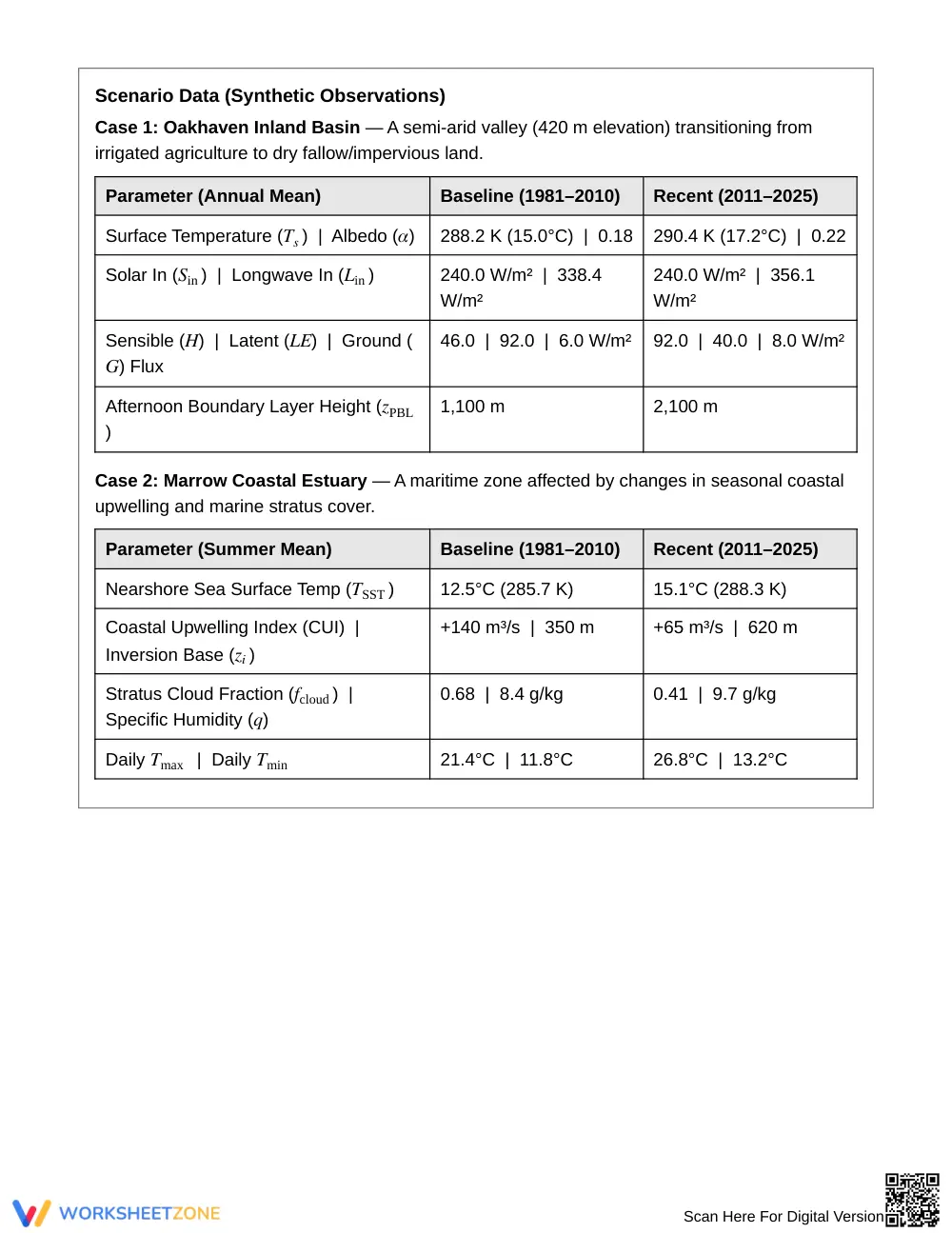
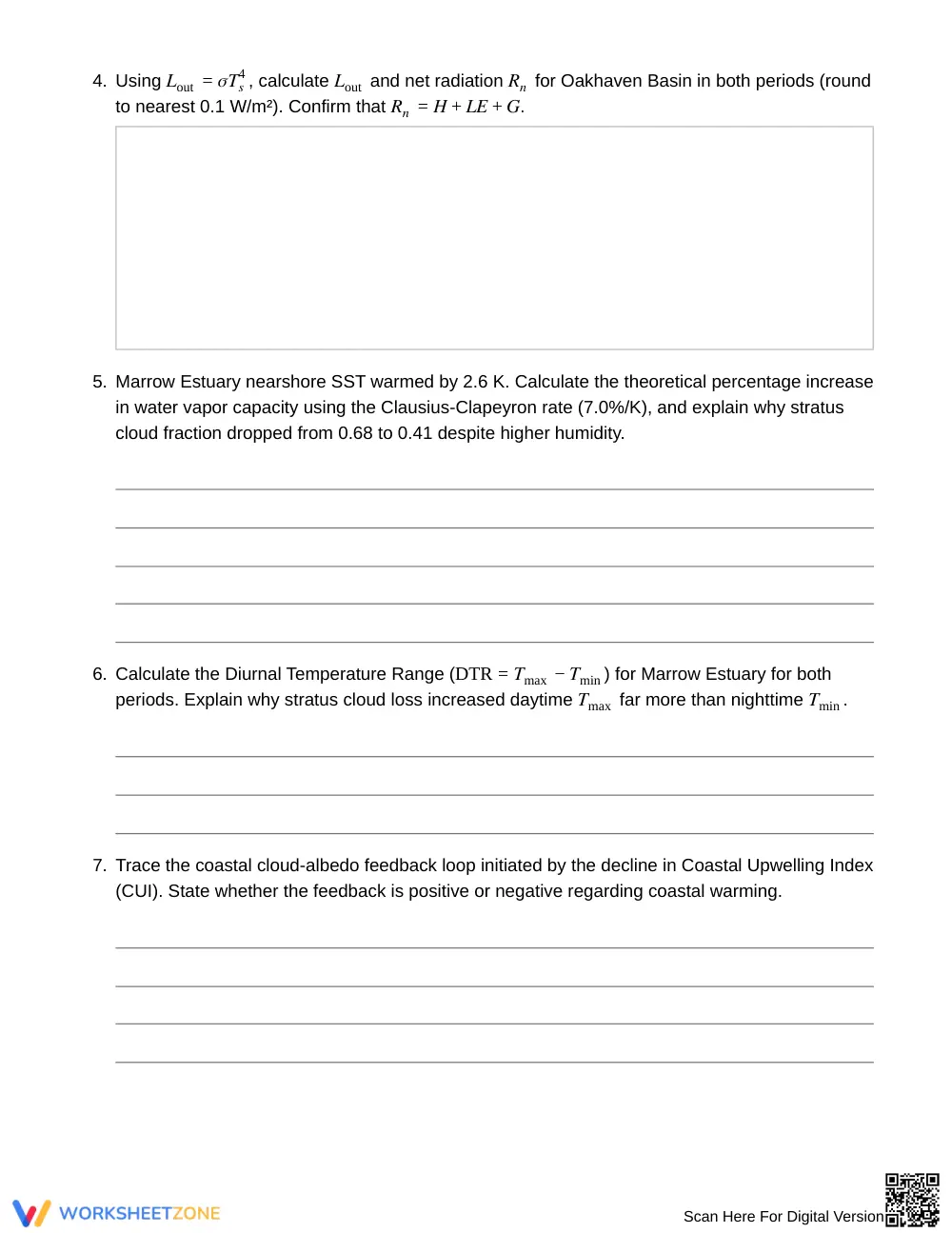
This 5-page worksheet presents 10 analytical problems divided into three sections. Students utilize a complete reference header of thermodynamic formulas and constants alongside synthetic multi-decadal observation tables for two distinct regional cases: Oakhaven Inland Basin and Marrow Coastal Estuary. The included 3-page answer key provides step-by-step mathematical calculations and complete conceptual explanations.
Skill Progression
- Guided practice (Part A, Problems 1–2): Students identify governing thermodynamic and boundary constraints, evaluating surface energy balance and marine subsidence inversions with high scaffolding.
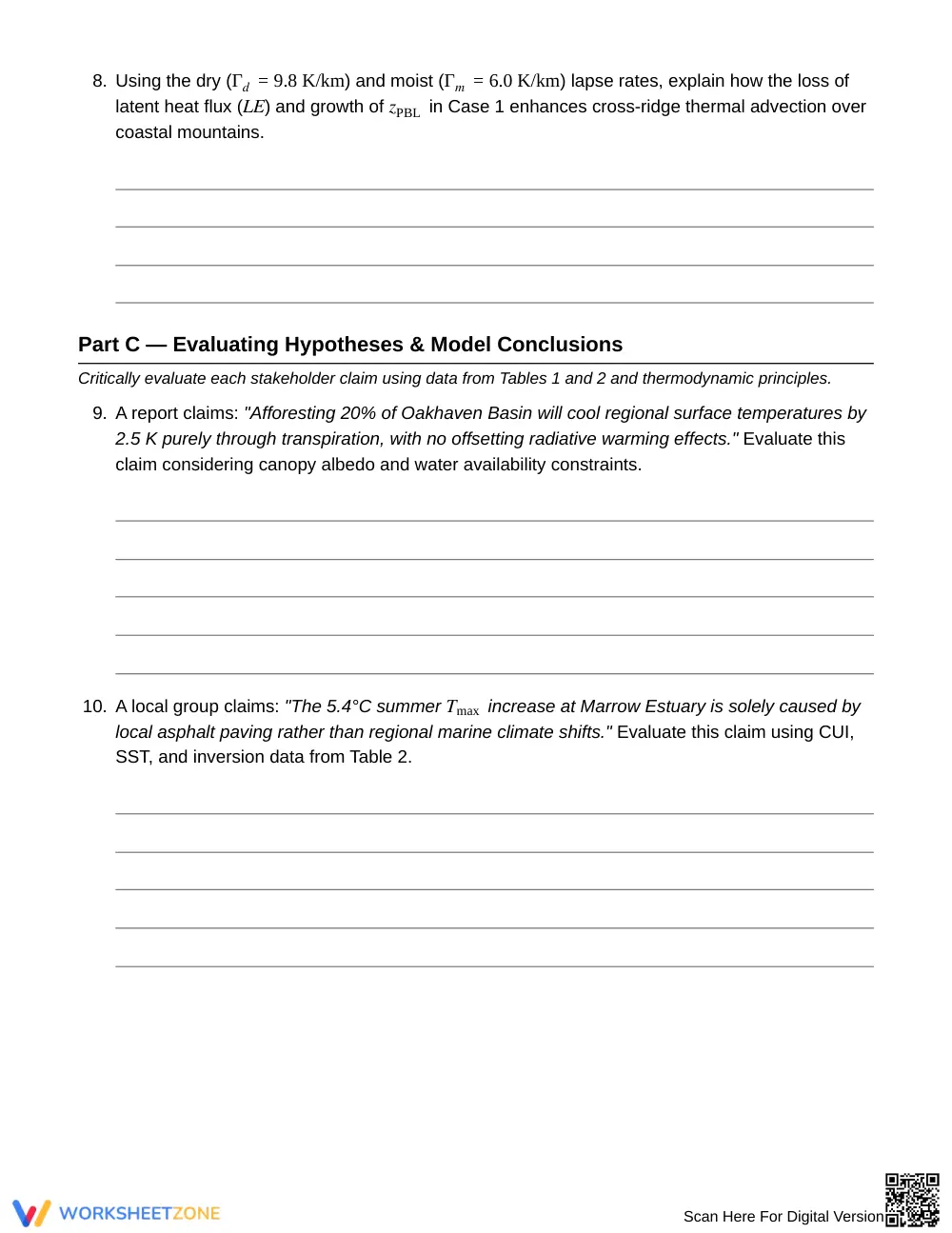
- Supported practice (Part B, Problems 3–8): Students apply quantitative atmospheric formulas to calculate Bowen ratios, radiative flux, vapor capacity shifts, and diurnal temperature ranges across both scenarios.
- Independent practice (Part C, Problems 9–10): Students synthesize empirical data to critically evaluate stakeholder hypotheses concerning regional afforestation and urban surface albedo modifications.
This sequence implements gradual release, moving learners from constraint identification to mathematical execution and independent argumentation.
Standards Alignment
This resource aligns with high school Earth and space science standards requiring students to analyze geoscience data to construct evidence-based models of atmospheric energy flow and climate feedback mechanisms. Both standard codes can be copied directly into lesson plans, IEP goals, or district curriculum mapping tools.
How to Use It
Use this worksheet after direct instruction on boundary-layer meteorology and surface radiation balance. In collaborative groups, assign pairs to compare inland and coastal dynamics before completing Part C individually as a formative assessment. During work time, check that students recognize how reduced latent heat flux drives boundary layer expansion. Expected completion time is 45 to 60 minutes.
Who It's For
This activity suits Grade 12 Earth and Space Science, AP Environmental Science, and advanced physics electives. Formula reference guides support students who need computational scaffolding, while extension prompts challenge advanced learners. Pair this worksheet with an atmospheric lapse rate lesson.
According to research on secondary science instructional design by Fisher & Frey (2014), student mastery of complex Earth systems requires structured opportunities to bridge mathematical modeling with physical phenomenon analysis. This Grade 12 climate scenario worksheet achieves that objective by demanding that learners apply quantitative thermodynamic principles, including the Stefan-Boltzmann law and Bowen ratio partitions, directly to authentic microclimate datasets. Rather than treating climate change as an abstract global trend, the 10 scaffolded problems prompt high school seniors to track turbulent flux redistributions, marine boundary layer inversions, and cloud-albedo feedback loops across two contrasting regional environments. By progressing systematically from constraint identification to hypothesis critique, students generate actionable empirical justifications that demonstrate rigorous scientific literacy. The accompanying three-page answer key establishes clear benchmark criteria for mathematical steps and qualitative reasoning, ensuring educators can evaluate student mastery with consistency and pedagogical precision.


