




























Ready Climate Mitigation Word Search | Grades 9–10 Science
Paste this activity's link or code into your existing LMS (Google Classroom, Canvas, Teams, Schoology, Moodle, etc.).
Students can open and work on the activity right away, with no student login required.
You'll still be able to track student progress and results from your teacher account.
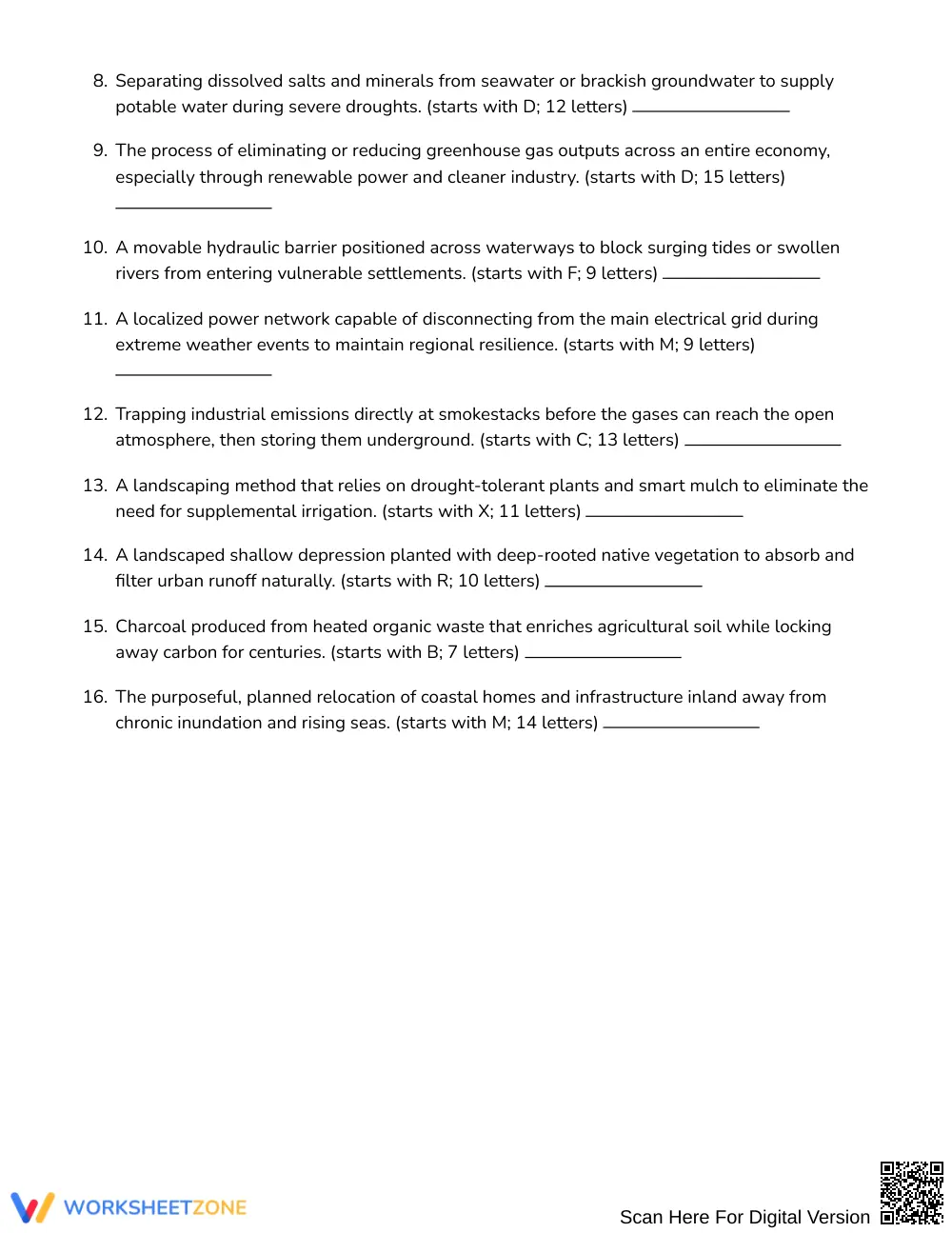
This Grades 9–10 climate science word search strengthens student command of essential environmental terminology through an engaging clue-based format. Learners read comprehensive scientific definitions to deduce target vocabulary before locating each term across the letter grid. The activity reinforces critical distinctions between proactive emissions reduction and community resilience strategies across secondary earth and environmental science units.
At a Glance
- Grade: Grades 9–10 · Subject: Science (Climate Change)
- Standard: Not standards-assessed — targeted vocabulary enrichment and scientific literacy
- Skill Focus: Climate change mitigation and adaptation terminology
- Format: 3 student pages · 16 words · Complete 4-page answer key included · PDF
- Best For: Secondary science vocabulary review, bell ringers, and reinforcement
- Time: 25–35 minutes of focused learning
What's Inside: The 3-page printable activity features 16 scientific clues paired with an advanced puzzle layout and no word bank, requiring students to retrieve concepts from memory. A thorough 4-page answer key provides clear solution maps showing exact word placements alongside corresponding definitions.
Puzzle Architecture
Designed specifically for high school learners, this puzzle uses a challenging no-bank structure that functions as both a recall check and an analytical vocabulary task:
- Grid Layout: An 18 x 18 letter matrix containing 16 hidden terms oriented across all 8 compass directions: North, Northeast, East, Southeast, South, Southwest, West, and Northwest.
- Definition-Driven Retrieval: Rather than scanning for a provided list, students read 16 technical clues covering concepts such as managed retreat, decarbonization, carbon sinks, and microgrids to determine each target word before searching.
Standards Alignment
This resource serves as targeted vocabulary enrichment designed to support secondary earth systems and environmental science curricula. It is not aligned to a specific assessed content standard, focusing instead on deep conceptual literacy and academic language retention.
How to Use It
Introduce this word search after direct instruction on human impacts and climate solutions to consolidate academic vocabulary, or deploy it as an engaging mid-unit review station. For formative assessment, observe whether students identify terms directly from the contextual clues or require reference notes, noting which specific adaptation technologies require whole-class clarification. Most high school students complete the clue decoding and search within 25 to 35 minutes.
Who It's For
This resource is tailored for Grades 9–10 biology, earth science, and environmental science students developing domain-specific vocabulary. Pair this puzzle with an introductory lecture on clean energy systems, a sea-level rise case study, or a graphic organizer comparing regional mitigation versus adaptation policies.
Secondary science achievement depends heavily on mastery of dense domain-specific academic vocabulary. According to Fisher & Frey (2014), intentional word-learning tasks that require learners to process complex definitions and apply conceptual knowledge produce significantly higher retention than passive glossary memorization. This non-bank puzzle challenges students in Grades 9–10 to analyze rigorous definitions of environmental mitigation and adaptation strategies, bridging technical scientific concepts with meaningful recall. By eliminating standard word banks, the activity requires learners to actively synthesize clues concerning photovoltaic technology, carbon sequestration, and coastal engineering before verifying their solutions within the 18 x 18 grid. The resource provides educators with an efficient, high-rigor supplement that secures the foundational vocabulary required for advanced discourse on global environmental challenges.


