

































Ready Chance Events & Simulations Worksheet | Grade 7 Math

Paste this activity's link or code into your existing LMS (Google Classroom, Canvas, Teams, Schoology, Moodle, etc.).
Students can open and work on the activity right away, with no student login required.
You'll still be able to track student progress and results from your teacher account.
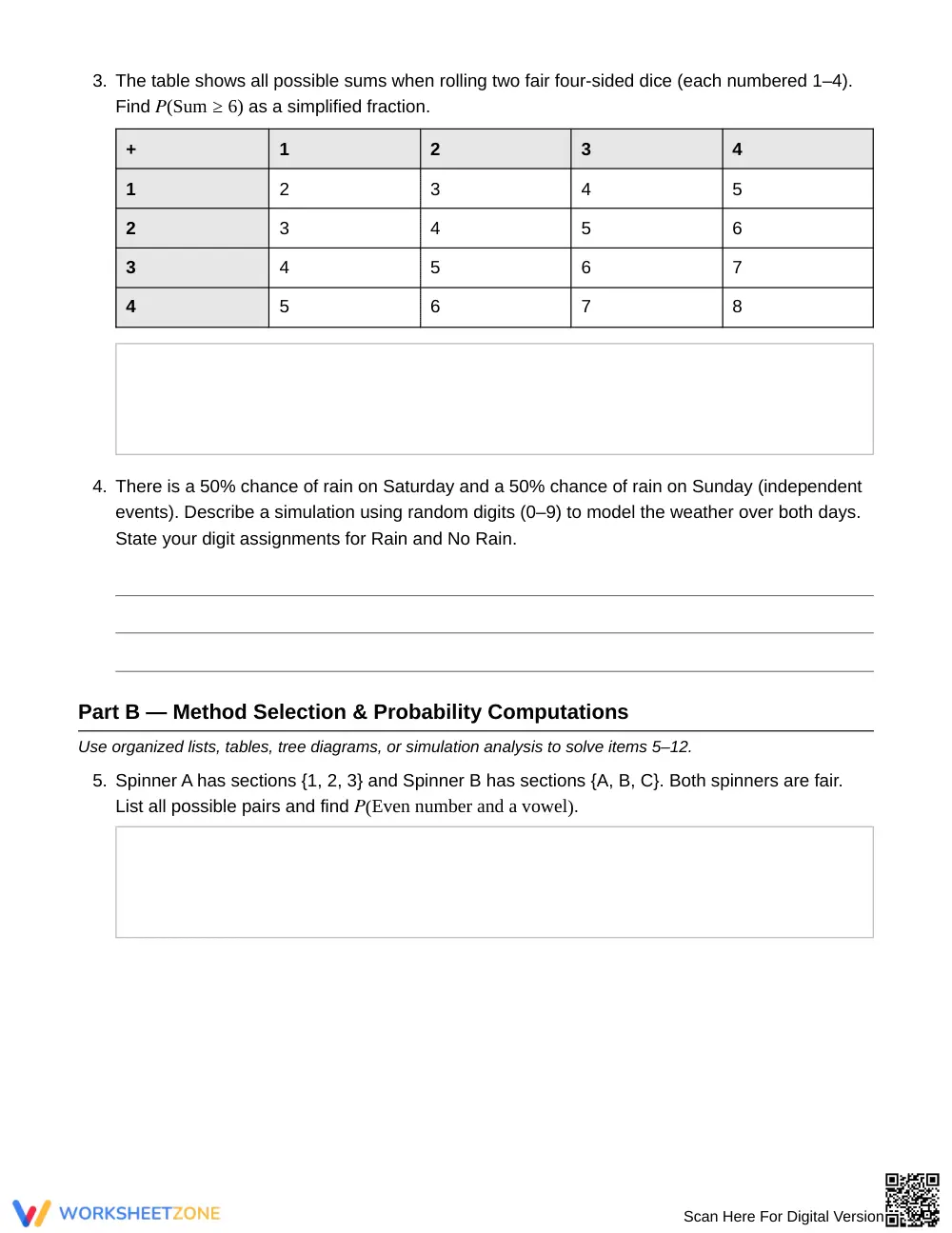
This Grade 7 probability worksheet equips students to master compound chance events and probability simulations through 16 targeted mathematical tasks. Learners construct organized lists, grids, and tree diagrams to calculate theoretical probabilities and evaluate real-world scenarios through simulation data, building complete conceptual mastery.
At a Glance
- Grade: 7 · Subject: Math
- Standard:
7.SP.C.8— Find probabilities of compound events using organized lists, tables, tree diagrams, and simulations- Skill Focus: Mix Chance Events and Simulations
- Format: 5 pages · 16 problems · Answer key included · PDF
- Best For: Core instruction, guided practice, or intervention
- Time: 45–60 minutes
What's Inside
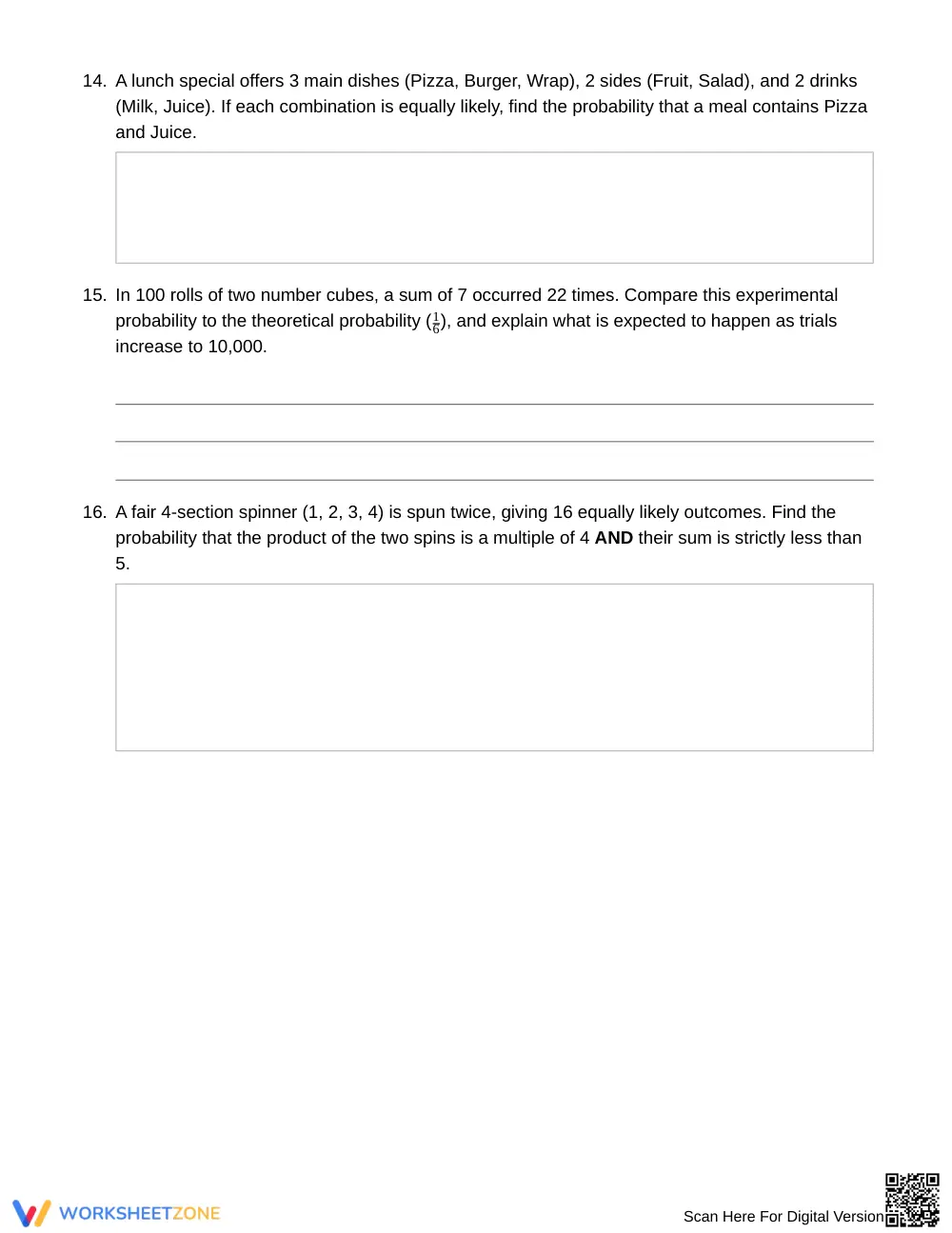
Across five structured student pages, this resource delivers foundational sample space builders, method selection prompts, multiple-choice items, and open-ended simulation design tasks. A reference box opens the worksheet with essential probability formulas and sample space strategies, followed by a complete two-page step-by-step answer key.
Skill Progression
- Guided Practice (Part A, Tasks 1–4): Students establish sample spaces using lists, two-way grids, and basic digit assignments with structured visual supports.
- Supported Practice (Part B, Tasks 5–12): Learners select appropriate sample space models, calculate compound probabilities for independent and dependent events, and analyze multi-trial simulation data.
- Independent Practice (Part C, Tasks 13–16): Students design simulations independently, calculate multi-stage probabilities, and explain long-run relative frequency trends without prompting.
This scaffolded structure follows the gradual release of responsibility model, ensuring students transition smoothly from procedural representations to rigorous mathematical reasoning.
Standards Alignment
This worksheet directly aligns with 7.SP.C.8: Find probabilities of compound events using organized lists, tables, tree diagrams, and simulations. Students represent sample spaces systematically and design simulations to estimate probabilities of compound events. Both standard codes can be copied directly into lesson plans, IEP goals, or district curriculum mapping tools.
How to Use It
Deploy this resource during or immediately following direct instruction on compound probability. For a guided lesson, complete Part A as a whole group, release students to work through Part B in pairs, and reserve Part C for individual assessment. Formative assessment tip: Check Part B Item 7 to verify whether students adjust the denominator for non-replacement events. Expected completion time is 45 to 60 minutes.
Who It's For
This worksheet serves general education Grade 7 math classes, accelerated Grade 6 units, and Grade 8 remedial review groups. Pair this resource with hands-on physical manipulatives—such as standard number cubes, two-color counters, and spinners—to reinforce theoretical outcomes before running abstract digit simulations.
According to research by Fisher & Frey (2014) on the gradual release of responsibility framework, structured instructional progressions that move intentionally from guided modeling to independent application produce significant gains in procedural fluency and conceptual understanding. This Grade 7 probability worksheet embodies those research-based principles by providing 16 scaffolded tasks aligned directly to standard 7.SP.C.8. As middle school learners progress across the 5 printable pages, they develop deep mathematical competence with compound chance events, multi-stage tree diagrams, organized sample space tables, and random simulation protocols. By systematically connecting theoretical expectations to empirical experimental frequencies, this resource enables seventh-grade students to bridge concrete probability representations with abstract analytical reasoning. Teachers can implement these structured practice materials during direct instruction, small-group intervention, or targeted assessment sessions to verify that every student achieves measurable mastery of essential probability modeling techniques and data analysis standards.


