

































Ready Average & Constant Rate Worksheet | Grade 9 Algebra I

Paste this activity's link or code into your existing LMS (Google Classroom, Canvas, Teams, Schoology, Moodle, etc.).
Students can open and work on the activity right away, with no student login required.
You'll still be able to track student progress and results from your teacher account.
This worksheet helps Grade 9 Algebra I students calculate the average rate of change over an interval and recognize when a constant rate signals a linear function. Students move from concept checks to applications and written justifications, interpreting rates with units in real contexts.
At a Glance
- Grade: 9 · Subject: Algebra I
- Standard:
HSF-IF.B.6— Calculate and interpret average rate of change from tables, graphs, and equations- Skill Focus: Average rate versus constant rate of change
- Format: 5 pages · 16 problems · Answer key included · PDF
- Best For: Practice after introducing rate of change
- Time: 40–50 minutes
What's Inside
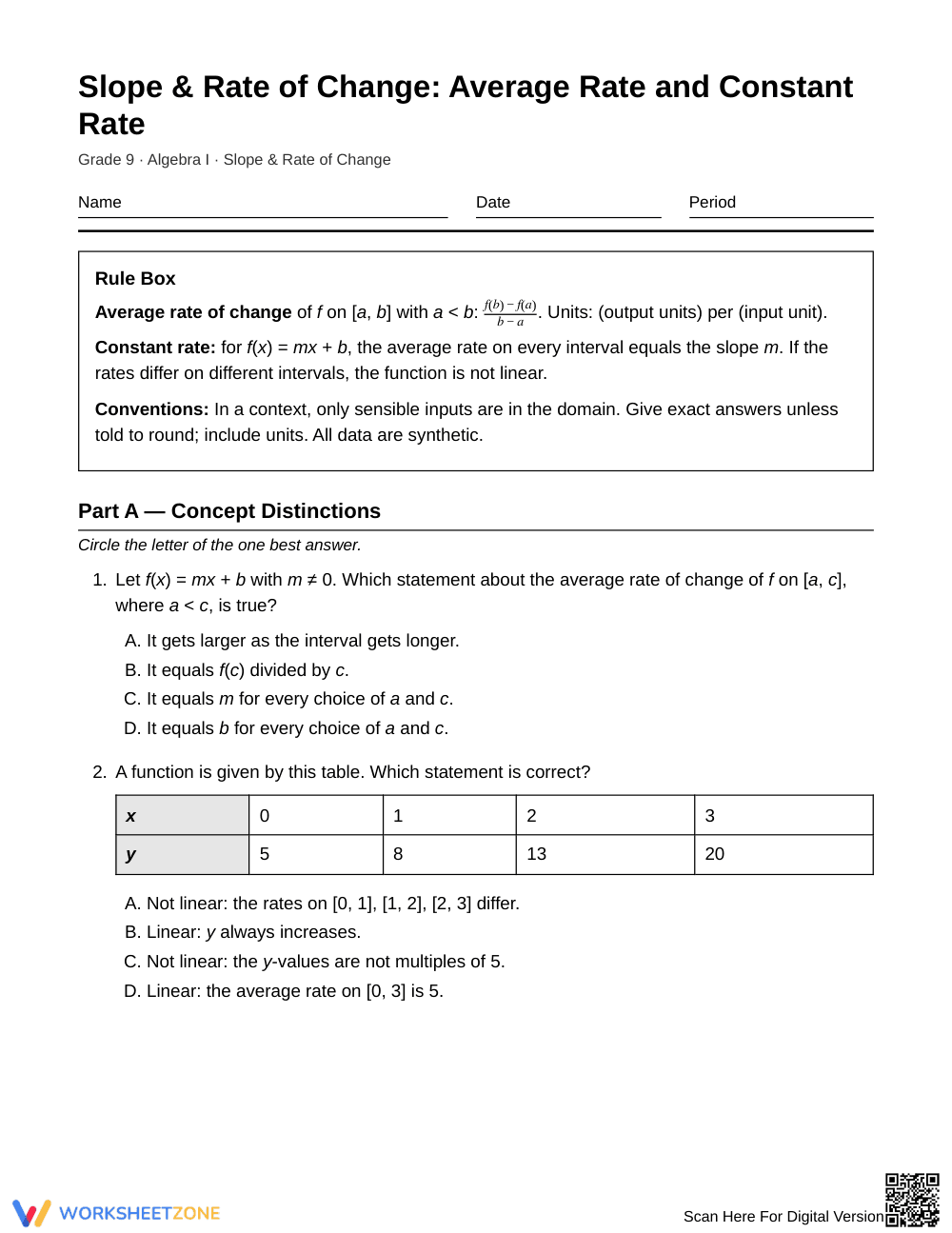
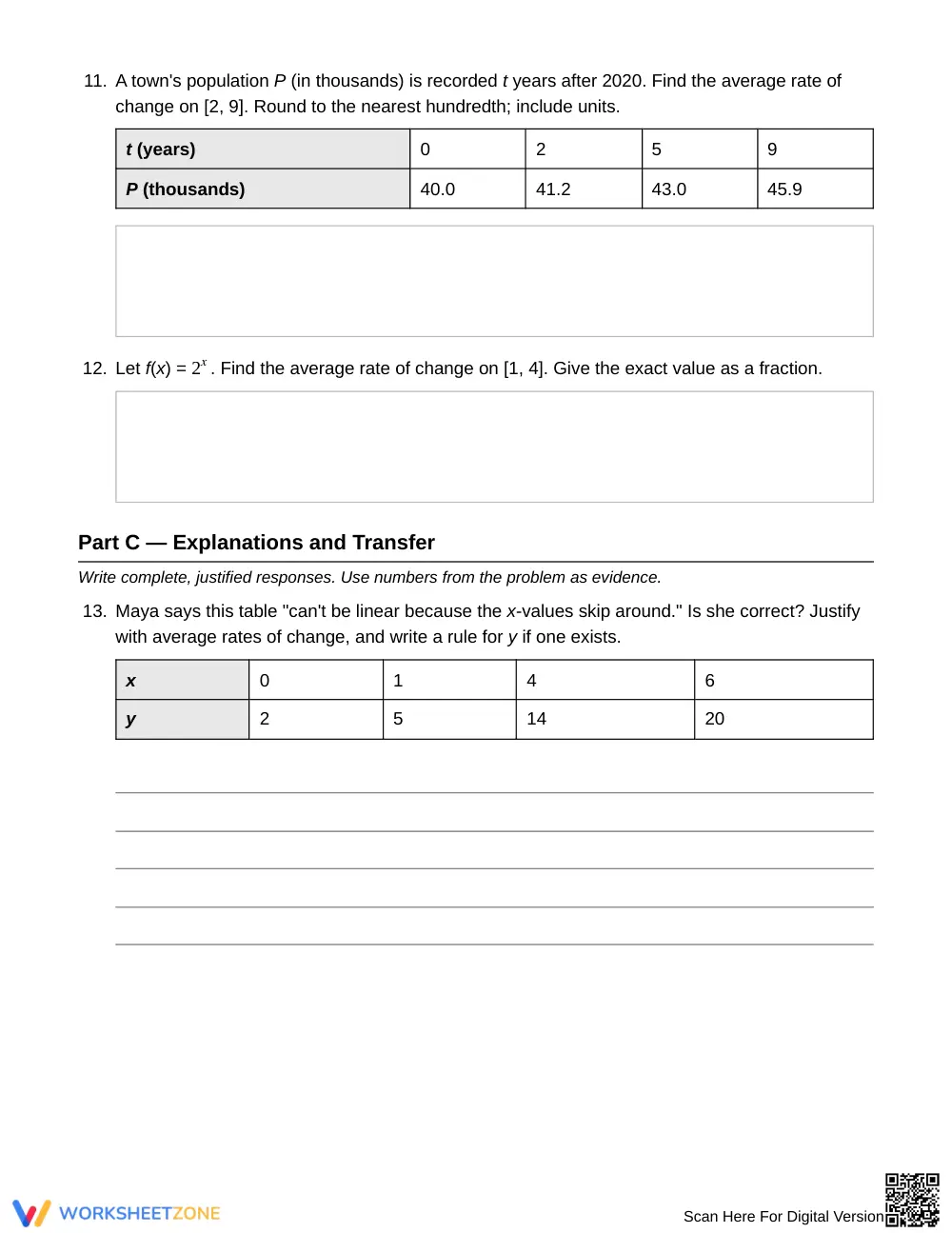
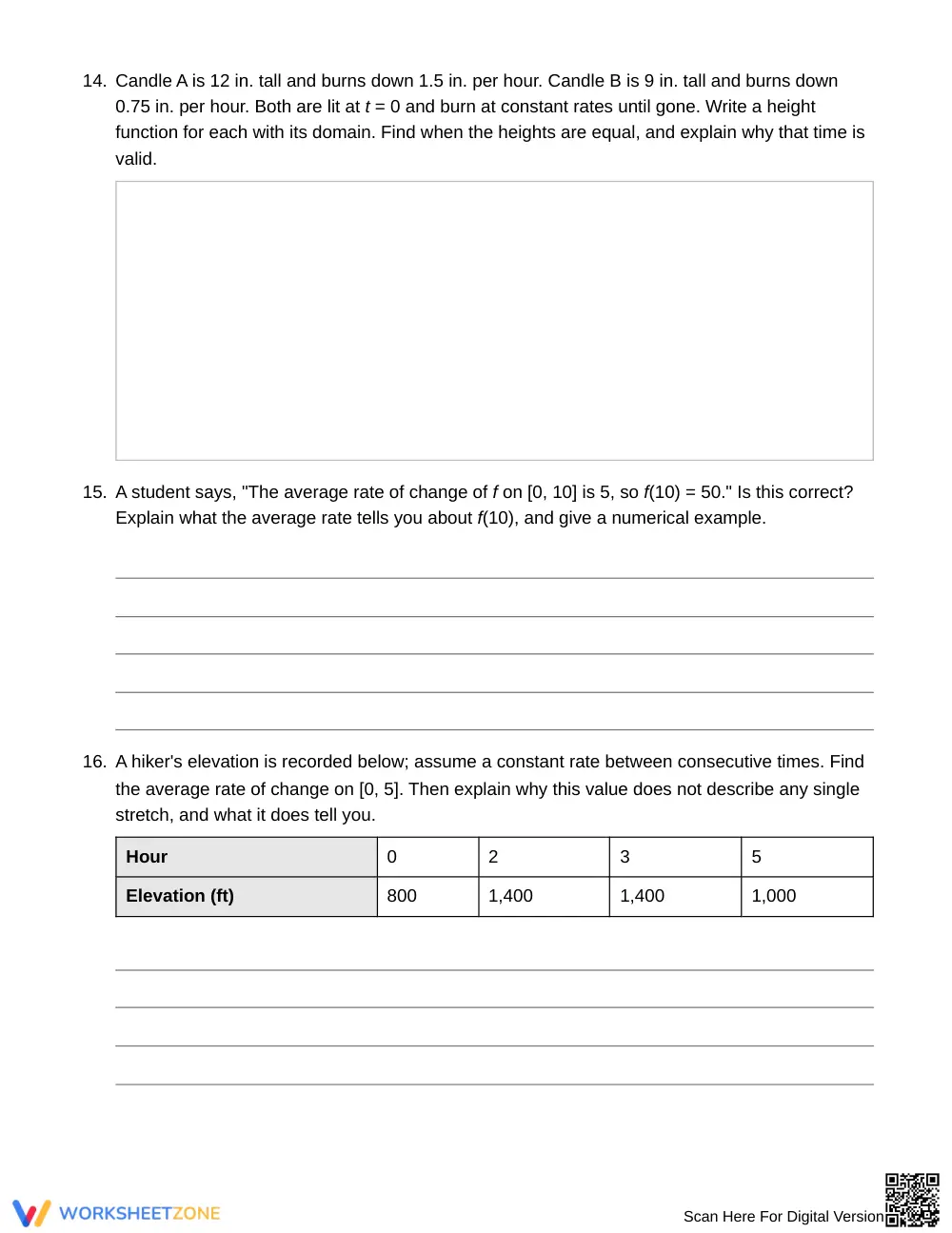
The 5-page PDF opens with a Rule Box covering average rate of change, units, and the constant-rate test. Part A has 4 multiple-choice concept checks. Part B has 8 short applications using tables, a graph, quadratic and exponential functions, and contexts like ink usage and a draining pool. Part C has 4 written justification tasks. A 2-page answer key is included.
Skill Progression
- Guided practice (4 problems): Part A multiple-choice items, with the Rule Box as the main scaffold, target common misconceptions about rates.
- Supported practice (8 problems): Part B applications where students show work and include units.
- Independent practice (4 problems): Part C written justifications that use numbers as evidence.
The sequence follows gradual release (I Do, We Do, You Do), moving from recognition to computation to explanation.
Standards Alignment
HSF-IF.B.6 — Calculate and interpret the average rate of change of a function, presented symbolically or as a table, over a specified interval; estimate the rate of change from a graph. This standard code can be copied directly into lesson plans, IEP goals, or district curriculum mapping tools.
How to Use It
- After direct instruction: assign Parts A and B as independent practice, then review Part A misconceptions as a class.
- As a unit check: use Part C as a written exit task.
Formative tip: while students work, watch whether they divide by the interval length or by an endpoint value. Expect 40–50 minutes in total.
Who It's For
Built for Grade 9 Algebra I students learning slope and rate of change. Students who need support can start with Part A and the Rule Box; others can go straight to the Part C justification tasks. Pair it with a lesson on slope from tables and graphs.
HSF-IF.B.6 asks students to calculate and interpret the average rate of change of a function over an interval. This Grade 9 Algebra I worksheet, with 16 tasks across 5 pages, teaches students to compute (f(b) − f(a))/(b − a), attach units, and recognize that a linear function has the same rate on every interval. Tasks move from multiple-choice concept checks to short applications and written justifications, so students practice procedure and reasoning together. The structure reflects the gradual release model described by Fisher & Frey (2014), in which teachers shift responsibility from guided to independent work. A 2-page answer key supports quick checking, error analysis, and targeted feedback. Teachers can use the worksheet for practice after instruction, review before a unit assessment, or as evidence of student reasoning about rates in context.


